
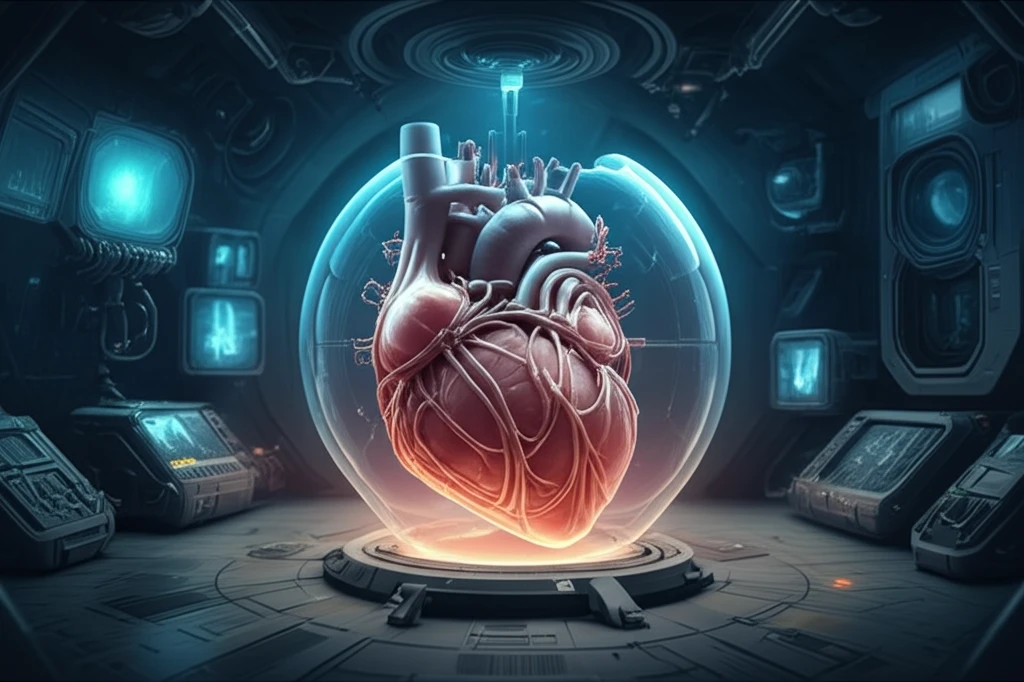
Stem Cell Revolution: Mending Hearts with Lab-Grown Valves?

"Could lab-grown heart valves from stem cells be the future of cardiac treatment? New research offers hope for a less invasive, more sustainable solution."
Heart valve disease is a growing global health concern, impacting millions with conditions that range from mild to life-threatening. Traditional treatments, such as valve repair or replacement, often involve invasive surgeries and the use of mechanical or animal-derived prostheses. While these interventions can improve survival, they come with their own set of challenges, including the risk of rejection, infection, and the need for long-term medication.
But what if there was a better way? Imagine a future where damaged heart valves could be replaced with new ones grown in the lab, using a patient's own cells. This innovative approach, known as tissue engineering, holds immense promise for revolutionizing cardiac treatment and offering a more sustainable, biocompatible solution for heart valve disease. Recent research has made significant strides in this field, bringing us closer to making this vision a reality.
This article delves into the fascinating world of stem cell research and tissue engineering, exploring how scientists are harnessing the power of human cells to create functional heart valves in the lab. We'll examine the latest breakthroughs, challenges, and potential implications of this cutting-edge technology for the future of cardiac care.
Valvular Heart Disease: A Silent Driver of Heart Failure
Valvular heart disease affects the heart's ability to pump blood effectively, and when left unchecked it can lead to serious conditions such as heart failure. Because valves are thin, highly specialized structures that open and close in response to changes in pressure, any impairment disrupts the one-way flow of blood through the heart. This places valve disease at the center of efforts to reduce the burden of heart failure worldwide.
Tissue Engineering: A New Lens on Heart Repair
Tissue engineering is a biomedical process that uses cells together with biochemical and physiochemical factors to restore, improve, and maintain damaged tissues. In the heart context, this means building replacement structures rather than relying solely on existing grafts or prosthetics. Heart valves are thin, highly specialized structures whose open-and-close response to pressure changes makes them demanding targets for engineered replacements. These approaches aim to overcome the limitations of conventional repair by producing living tissue that can integrate with the body.
From Monkey Hearts to Human Cells
In 2018, Chuck Murry and researchers at UW Medicine in Seattle successfully used human stem cells to restore heart function in monkeys with heart failure. This milestone demonstrated that stem-cell-derived tissue could meaningfully repair a damaged large-mammal heart, laying groundwork for later human applications. It marked a turning point where laboratory-grown heart tissue moved from concept toward a therapy that could one day be used in patients.
The Stem Cell Solution: Building Blocks for New Valves
The key to engineering functional heart valves lies in the unique properties of stem cells. These versatile cells have the remarkable ability to differentiate into various specialized cell types found in the body, including those that make up the heart valve tissue. Scientists can guide stem cells to become valve interstitial cells (VICs), which are responsible for maintaining the structural integrity and function of the valve.
- Feeder-Free Protocol: The iPSCs are differentiated using a special method that does not require support cells.
- Valve Interstitial Cells: The iPSCs are matured to Valve Interstitial Cells (VICs).
- Customizable Design: iMSCs are combined with 3D-printing techniques or scaffold engineering to create customized heart valves tailored to each patient's specific needs.
Growing Human Heart Valves From Stem Cells
Australian researchers at the Murdoch Children's Research Institute have created human heart valve tissue from stem cells, reporting their findings in Cell Stem Cell. The work offers new insights into how human heart valves develop, mature, and become damaged, which is considered a potential advance for treating childhood heart disease. Reviews of stem cell therapy likewise note that various kinds of stem cells have been examined for heart repair because of their pluripotency and capacity to grow into functioning cardiomyocytes.
A Pandora's Box of Questions
Stem cell therapy has been framed not only as a revolutionary cure but also as a potential Pandora's box, reflecting lingering uncertainty about safety and long-term outcomes. While various stem cell types show promise due to their pluripotency and ability to become functioning cardiomyocytes, researchers caution that translating lab success into durable clinical benefit remains difficult. The openness of the science means each advance raises new questions about regulation, cell behavior, and how engineered tissue performs once inside a living heart.
Patching, Replacing, or Rebuilding the Heart
Lab-grown heart tissue is envisioned as serving multiple roles: patching damaged hearts after heart attacks, replacing diseased valves, or eventually growing entire replacement hearts. This spectrum contrasts with older strategies that relied on mechanical or biological prosthetics that cannot grow or adapt with the patient. Because stem-cell-derived tissue can develop and integrate, it may offer advantages for patients—especially children—who outgrow fixed replacements.
A Future of Healing: The Promise of Engineered Heart Valves
While significant progress has been made, engineering functional heart valves from stem cells is still a complex and evolving field. More research is needed to optimize the differentiation process, improve the mechanical properties of engineered valves, and ensure long-term durability and biocompatibility. As the technology advances, lab-grown heart valves hold the potential to transform cardiac treatment, providing a less invasive, more sustainable, and personalized solution for patients with heart valve disease. This ongoing research offers hope for a future where regenerative medicine can mend broken hearts and improve the lives of millions.
What Experts See in the Valve Breakthrough
Published in Cell Stem Cell, the Australian findings offer new insights into how human heart valves develop, mature, and become damaged—information experts view as foundational for designing better therapies. When combined with earlier work such as UW Medicine's demonstration that human stem cells can restore heart function in monkeys, the evidence suggests living tissue can assume the specialized roles the heart depends on. The convergence of developmental biology and tissue engineering points toward biological valves as a credible path forward.
Toward Entire Replacement Hearts
Researchers project that lab-grown heart tissue could patch damaged hearts after heart attacks, replace diseased valves, and eventually support the growth of entire replacement hearts. Each step builds on the capacity of stem cells to form functioning cardiac and valve tissue, from monkey models in 2018 to human valve tissue grown in 2025. The long-term frontier is personalized, living implants that repair rather than merely substitute.
Regenerative Medicine Meets Real-World Systems
These advances sit within the larger field of regenerative medicine and biomaterials, which aims to restore or replace damaged tissues using engineered constructs. But bringing lab-grown valves to patients demands more than biology: manufacturing consistency, regulatory pathways, and equitable access must all be solved. As stem cell therapy is described as both a revolutionary cure and a Pandora's box, the systemic challenge is managing powerful new technology responsibly.
What Lab-Grown Valves Mean for Patients
For children with heart disease, growing human heart valve tissue from stem cells could help advance treatments that currently rely on imperfect replacements. The promise is restoring real function—as demonstrated when human stem cells restored heart function in monkeys with heart failure—rather than merely managing symptoms. For patients facing valvular disease and its march toward heart failure, a living valve grown to match them represents the human payoff of the research.