
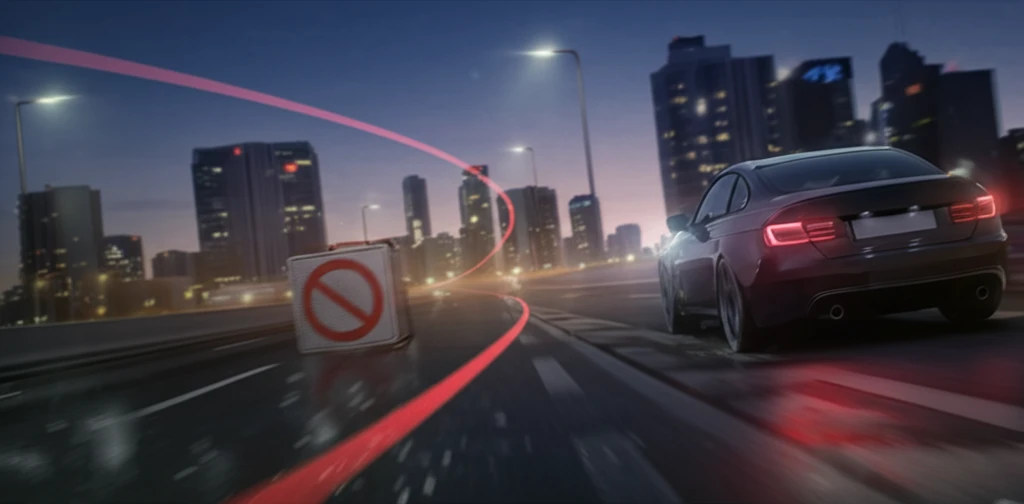
Steering the Future: How Evasive Steer Assist is Changing Road Safety

"Discover how rear-wheel steering technology enhances car agility and helps drivers avoid collisions, making roads safer for everyone."
Road safety is a growing global concern. According to a World Health Organization report, over a million people are killed each year due to road accidents. These accidents aren't just statistics; they represent real people and families affected by tragedy. As our roads become more congested, the need for advanced safety measures has never been more critical.
In the EU, accident statistics reveal a concerning trend: while road fatalities have decreased, the reduction in injuries is significantly slower. This suggests that while we're preventing some deaths, many people are still getting hurt. Driver error remains a primary cause of accidents, highlighting the need for systems that can support drivers in making quick, safe decisions. Technologies like collision warning systems, steering assistance, and automated braking are becoming increasingly important.
Evasive Steer Assist (ESA) is an innovative solution designed to provide drivers with that extra bit of help in critical situations. By using advanced sensors and steering technology, ESA can detect potential collisions and help drivers steer clear of danger. This article explores how ESA works, its benefits, and how it's paving the way for a safer future on our roads.
Emergency Responsiveness, Radar and Camera Detection
Evasive Steer Assist is designed to make steering more responsive in emergencies, relying on radar and a camera to detect slow-moving or stopped vehicles ahead. On Ford vehicles, owners switch the feature on or off from the Driver Assistance menu by selecting Pre-Collision Assist. The collision-avoidance data behind the evasive steering feature, including steering angle requests, is processed by the vehicle's image-processing module (IPMA). Ford cautions that the system does not control steering, and that driver-assist features are supplemental and do not replace the driver's attention, judgment and control.
Supplemental Assistance, Not Autonomy
Evasive steering assist (ESA) is designed to improve the driver's steering maneuver in the event of a potential imminent front collision with another vehicle or a vulnerable road user (VRU). If the driver begins a steering maneuver but that steering input is not enough to avoid the collision, the system steps in to supplement it. Manufacturers such as Ford are careful to describe the technology as supplemental: it does not replace the driver's attention, judgment or need to control the vehicle. Ford also notes that it does not replace safe driving, and points owners to the Owner's Manual for details and limitations.
From Collision Warning to Steering Support
Ford's Evasive Steering Assist alerts the driver when a stopped vehicle is directly in the path ahead and then provides additional steering assistance to help avoid the object. The automaker has been explicit that the system won't steer for the driver, but helps the driver avoid dangers in the path. The technology sits within a longer history of Ford safety innovations, alongside features such as the Rear View Camera. Ford continues to reiterate across its model lineups that Evasive Steer Assist does not control steering.
How Evasive Steer Assist Works
Evasive Steer Assist (ESA) is designed to support drivers in avoiding rear-end collisions by providing steering assistance. The system uses cameras and radar to detect slower-moving or stationary vehicles ahead. It then assesses the risk of a collision, and if the risk is high, ESA intervenes to help the driver steer around the obstacle.
- Detects potential collisions using cameras and radar.
- Calculates a safe escape path.
- Assists the driver in steering around obstacles.
- Enhances vehicle agility with rear-wheel steering.
Amplifying Input and Managing Oncoming Traffic
Ford has described its Evasive Steering Assist as aiding and amplifying the driver's steering input rather than taking control of the wheel, according to reporting on the system while it was still in development. Academic work has focused on the hardest part of these maneuvers: dealing with oncoming vehicles during an evasive swerve, with one Chalmers study presenting a method to mitigate the collision risk with oncoming vehicles during such maneuvers. Other research points out that in emergency steering evasion, the vehicle may leave the road or collide with obstacles ahead when the driver's steering torque is either excessive or insufficient, prompting work on an optimized emergency steering evasion torque assistance system.
Steering Support, Not Full Automation
Mercedes-Benz markets its own Evasive Steering Assist as a system that can help prevent an accident in emergency situations. The Mercedes power-assisted steering system detects when the driver no longer requires braking but rather needs to steer, then supports the maneuver. As presented, the technology is assistance-oriented, responding to the driver's intent rather than acting on its own.
A Shared Approach Across Automakers
Evasive steering assistance is not exclusive to a single brand: similar systems are offered by Audi, BMW, Ford, Volvo, VW and others. The typical approach involves increasing steering torque to help the car steer around an obstacle and straightening the vehicle after the swerve. A common safety requirement across these systems is that the driver must initiate the steering input before assistance engages. For consumers weighing these features, comparison platforms allow driver-assist technologies to be evaluated side-by-side.
The Future of Road Safety
Evasive Steer Assist represents a significant step forward in collision avoidance technology. By providing timely steering support, ESA enhances vehicle agility, reduces accident risks, and promotes safer driving practices. As technology continues to evolve, we can expect even more sophisticated systems that further minimize driver errors and enhance overall road safety. Embracing these innovations is essential for creating a future where our roads are safer for everyone.
Mainstream Safety Content in 2026
The 2026 Ford Mustang EcoBoost Fastback shows how far evasive steering has come, listing Evasive Steer Assist among its standard driver-assist content. In CarExpert's review of the car, the feature appears alongside Blind-spot assist, lane centring (automatic only), lane keep assist, post-collision braking, a reversing camera and rear cross-traffic assist. Its inclusion in a sports car's equipment list signals that evasive steering is now a mainstream safety expectation rather than a flagship luxury extra.
Toward Automatic Obstacle Avoidance
Ford has stated that with Evasive Steering Assist it aims to reduce collisions by automatically steering around obstacles in the roadway ahead, building on the observation that most drivers already begin turning the wheel when faced with an obstacle just ahead. TechTarget similarly frames evasive-steering assist, flagged as a trend in the 2024 electric vehicle market, as a safety feature that automatically steers the vehicle to potentially avoid an imminent collision. At the same time, Ford's own documentation continues to stress that Evasive Steer Assist does not control steering, underscoring the gap between how the technology is described and what it actually does.
Shared Sensors, Driver-Tunable Alerts
Evasive Steer Assist (ESA) employs the same wide-view camera and radar sensor technology used by the Pre-Collision Assist and automatic emergency braking (AEB) systems to help avoid collisions. Because it draws on this shared sensor architecture, the feature benefits from collision-avoidance infrastructure that is already present in the vehicle. Drivers can toggle Evasive Steer Assist on or off and can set the alert sensitivity from the vehicle's settings screen, meaning real-world effectiveness depends partly on how owners configure the system.
Watching the Driver as Well as the Road
The Lexus LS 460 achieved a world first in preventive safety, pairing Emergency Steering Assist — which helps the driver take rapid, evasive action to avoid a collision — with a world-first Driver Monitoring System. That monitoring system initiates safety warnings and pre-crash systems when a collision risk is detected while the driver is not looking at the road ahead. Together, the two technologies illustrate the human element of evasive steering: the system watches both the road and the driver, supporting attention without replacing it.