
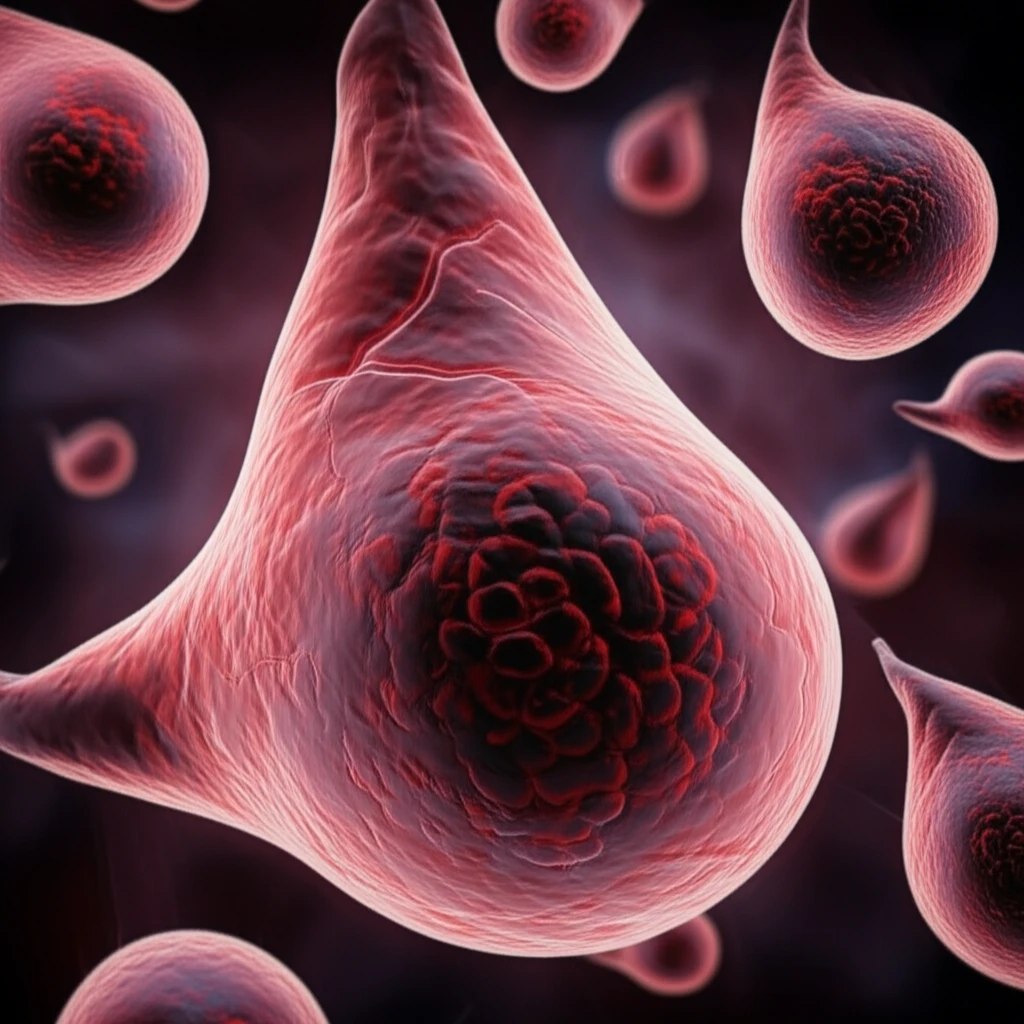
Starving Cancer: Can Energy Restriction Combat Drug Resistance?

"New research explores how mimicking energy restriction can target cancer stem cells and overcome multi-drug resistance in breast cancer."
Breast cancer remains a leading cause of cancer-related deaths among women globally. A significant challenge in breast cancer treatment is the development of drug resistance, often attributed to cancer stem cells (CSCs). These CSCs possess unique properties, including high expression of ATP-binding cassette (ABC) transporters, which enable them to effectively pump out drugs, leading to multi-drug resistance (MDR).
A promising area of research focuses on targeting CSCs to overcome drug resistance. One such approach involves energy restriction, which aims to limit the availability of energy to cancer cells, thereby disrupting their survival and drug resistance mechanisms. Energy restriction mimetic agents (ERMAs) offer a way to mimic the effects of energy restriction without requiring drastic dietary changes.
This article delves into a study investigating the potential of ERMAs, specifically OSU-CG5, to counteract multi-drug resistance in breast cancer CSCs. The research also explores the synergistic effects of combining OSU-CG5 with conventional chemotherapy agents like doxorubicin, offering a potential strategy to improve treatment outcomes.
Drug Resistance and Breast Cancer Stem Cells
Research identifies breast cancer stem cells (BCSCs) as a focus for understanding resistance to chemotherapy, endocrine therapy, and targeted therapy. A 2023 review analyzed stem-cell-related drug-resistance factors across breast cancer stages using the METABRIC dataset. In an experimental model, long-term doxorubicin exposure produced MCF-7-D500 cells with increased multidrug resistance, cancer stemness, and invasiveness compared with parental cells.
Current Treatment Challenges
Standard breast cancer treatment commonly relies on systemic therapies selected according to tumor subtype and molecular characteristics. However, resistance can emerge, and treatment failure may involve biologically distinct cell populations within the tumor. These limitations support continued investigation of complementary strategies, while the available material does not establish energy restriction as a validated clinical treatment.
The Emergence of the BCSC Concept
The cancer stem-cell framework developed around the idea that a subset of tumor cells may contribute to aggressive progression, recurrence, metastasis, and therapy resistance. Reviews of breast cancer stem cells have examined their origins, biomarkers, molecular regulation, and therapeutic implications. Proposed origins include mutations in stem cells, dedifferentiation of somatic cells, and plasticity associated with epithelial-mesenchymal transition and the tumor microenvironment.
How Energy Restriction Targets Drug-Resistant Breast Cancer Stem Cells
The study, conducted by researchers at the University of Sharjah, United Arab Emirates, investigated the effects of energy restriction mimetic agents (ERMAs) on doxorubicin-resistant breast cancer cells. Doxorubicin-resistant MCF-7 and MDA-231 cell lines were generated by exposing the cells to increasing concentrations of doxorubicin, a common chemotherapy drug.
- MTT cell viability assay: This assay measures the metabolic activity of cells, indicating their viability and response to treatment.
- Immunofluorescence: This technique uses fluorescently labeled antibodies to visualize specific proteins within cells, allowing researchers to assess the expression of drug resistance markers.
- Western blot: This technique separates proteins based on their size and electrical charge, enabling researchers to determine the expression levels of ABC transporter proteins, which contribute to drug resistance.
- Flow cytometry: This technique allows for the identification and quantification of specific cell populations based on their surface markers, enabling researchers to assess the presence of breast CSC markers CD44 and CD24.
Current Research Directions
Recent reviews describe breast cancer drug resistance as a problem involving multiple mechanisms rather than a single pathway. Contemporary cancer stem-cell research focuses on how these cells contribute to tumor growth, treatment resistance, and relapse. Proposed therapeutic directions include combination regimens, molecularly targeted therapies, photodynamic therapy, and ferroptosis-inducing treatments, although these reviews describe strategies under investigation rather than proving that energy restriction overcomes resistance.
Why Resistance Persists
Evidence reviewed in the literature indicates that tumor-initiating or cancer stem cells may contribute to drug resistance, treatment failure, and recurrence. This helps explain why therapies that reduce the bulk of a tumor may not eliminate every biologically important cell population. The reviewed material also emphasizes heterogeneous breast cancer subtypes, molecular mechanisms, and dysregulated miRNA and ncRNA patterns, underscoring why a single intervention may be insufficient.
Interpreting Therapeutic Comparisons
The available material does not provide a direct comparison between energy restriction and established breast cancer treatments. More generally, treatment approaches may differ in whether they target tumor bulk, specific molecular pathways, or resistant cell populations. Comparisons should therefore account for tumor subtype, treatment mechanism, resistance biology, and the level of evidence supporting each approach.
The Future of Breast Cancer Treatment: Targeting CSCs with Energy Restriction
The study's findings suggest that targeting breast CSCs with ERMAs could be a promising strategy to minimize multi-drug resistance. Combining ERMAs with conventional chemotherapeutic agents like doxorubicin may offer a clinically relevant approach to improve cancer treatment outcomes.
A Cautious Interpretation
The source material supports viewing drug resistance as a complex biological problem involving cancer stem cells, tumor heterogeneity, and multiple molecular mechanisms. It does not directly establish that energy restriction can starve resistant breast cancer cells or improve patient outcomes. Any such proposal would require evidence that connects metabolic intervention with resistant-cell biology and clinically meaningful treatment responses.
Developing New Strategies
A 2022 review describes drug resistance to available systemic therapies as a major challenge in breast cancer. Future research is therefore likely to focus on therapies that address the molecular and cellular features associated with resistant breast cancer stem-like cells. The available source does not identify energy restriction as an established solution, so its role remains an open research question rather than a demonstrated clinical strategy.
The Burden of Chemotherapy Resistance
Chemotherapy resistance remains a major challenge in breast cancer treatment. The available source links this resistance to difficulties in effective disease management and to high rates of relapse. This broader clinical burden explains why researchers continue to seek strategies that can complement or improve existing therapies, although the source does not evaluate energy restriction specifically.
Living With Treatment Resistance
Treatment resistance can make breast cancer management more difficult by limiting the effectiveness of systemic therapies and contributing to recurrence. Research on cancer stem cells seeks to explain why some tumor cells may persist despite treatment. Any proposed energy-restriction approach would need to be evaluated not only for tumor effects but also for practical safety, tolerability, and relevance to patients.
By limiting the availability of energy to cancer stem cells, ERMAs can disrupt their survival mechanisms and reduce their ability to resist drug treatment. This approach holds the potential to overcome a major obstacle in breast cancer therapy and improve patient survival rates.
Further research is needed to fully elucidate the mechanisms of action of ERMAs and to optimize their use in combination with other cancer therapies. However, these findings represent a significant step forward in the development of new and effective treatments for drug-resistant breast cancer.