
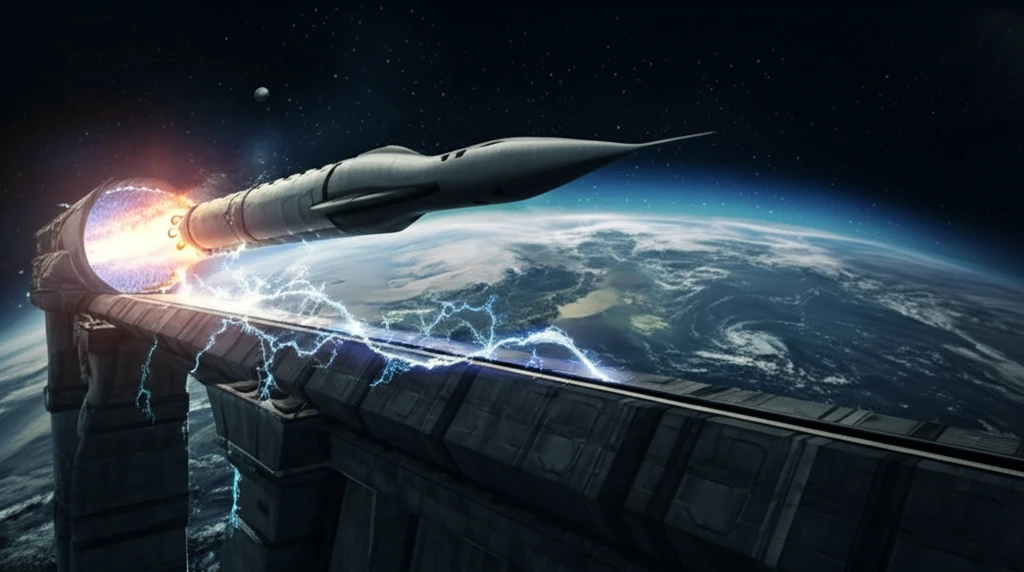
SSTO Rockets: How Electromagnetic Launch Could Revolutionize Space Travel

"Explore the feasibility of single-stage-to-orbit rockets boosted by electromagnetic launch systems and the innovative tech that's reshaping space access."
For decades, the dream of affordable and reliable space travel has driven innovation in launch vehicle technology. Single-stage-to-orbit (SSTO) rockets, which promise full reusability without the complexity of multi-stage systems, have long been a focus of this ambition. However, achieving SSTO with purely chemical propulsion faces significant hurdles, particularly in maximizing payload capacity while maintaining a high mass ratio.
Enter electromagnetic launch (EML) systems, a groundbreaking technology that offers a potential solution. By providing an initial, non-chemical boost to SSTO rockets, EMLs can significantly reduce the reliance on onboard propellant, thereby increasing payload capabilities and lowering launch costs. This innovative approach combines the strengths of traditional rocket propulsion with the efficiency of electromagnetic acceleration, potentially revolutionizing access to space.
This article delves into the feasibility of SSTO rockets augmented by EML systems, examining the historical context, technical challenges, and economic implications of this exciting concept. Drawing upon research and simulations, we'll explore how EML technology could reshape the future of space transportation, making it more accessible and sustainable.
Defining SSTO and Today's Prototype Concepts
A single-stage-to-orbit (SSTO) vehicle reaches orbit from the surface of a body using only its propellants and fluids, without expending tanks, engines, or other major hardware. Universe Today reports that aerospace firm ARCA has developed a concept for an SSTO rocket called the Haas 2CA, which - if all goes as planned - would be the first SSTO rocket in history, relying on a single stage and a single engine to place payloads and crew into Earth's orbit. On the research side, a feasibility study has examined SSTO rockets given an initial velocity by electromagnetic launch, running trajectory simulations of nonlinear dynamic models to determine the initial velocities needed for feasible SSTO schemes under different maximum payload ratios. Coverage of concepts like the Convair Nexus reusable SSTO proposal reflects the enduring fascination with single-stage launchers.
Why Rockets Struggle to Reach Orbit in One Stage
The accepted method of reaching orbit is to burn propellant and shed hardware as it empties, but a pure single-stage rocket must do the whole job with one vehicle and one engine. As a Kerbal Space Program community discussion explains, rockets are inefficient at low speeds, which makes a winged rocket-powered SSTO 'not very sensible' in practice. The same discussion concludes that a pure SSTO rocket is possible, 'it's just you need too much rocket for too small payload' - the fundamental trade-off that limits what a single-stage vehicle can carry. Tutorial content in simulation games reflects how designers iterate on this trade-off, carefully tuning a design to maximize what a single stage can deliver.
From Bono to Roton: A History of SSTO Concepts
Attempts to build single-stage launchers stretch back decades. According to the astronautix encyclopedia, Philip Bono produced one of the earliest designs for an expendable single-stage-to-orbit booster burning liquid hydrogen and liquid oxygen, while the X-Rocket was a vertical-takeoff, vertical-landing SSTO design by Maxwell Hunter II at Lockheed in the late 1980s. In the late 1990s, the Rotary Rocket Company developed the Roton concept - a fully reusable SSTO crewed spacecraft with a rotating annular aerospike engine whose rotation pumped fuel and oxidizer to the rim, topped by a helicopter rotor for landing. Universe Today frames the wider quest with the image of the Millennium Falcon, a single craft that carries its own fuel and flies into orbit and from world to world without discarding stages. Fan-made projects such as the Mars-94, a Russian Martian SSTO built in the Juno: New Origins sandbox, show how the concept still captures the imagination.
The Promise of Electromagnetic Launch
Electromagnetic Launch (EML) systems use electromagnetic forces to accelerate projectiles to high speeds. Unlike chemical rockets that rely on propellant combustion, EMLs offer several key advantages. They can achieve higher initial velocities, reduce chemical fuel consumption, and potentially lower launch costs. The technology encompasses various approaches, including electromagnetic railguns, aircraft launch systems, and thrust launchers, each with its own characteristics and capabilities.
- Increased Payload Capacity: EMLs reduce the need for large propellant reserves, freeing up space for more payload.
- Reduced Launch Costs: Lower propellant consumption and simpler rocket designs can lead to significant cost savings.
- Improved Reliability: EMLs offer a more controlled and predictable launch environment compared to traditional chemical rockets.
- Greater Efficiency: Electromagnetic acceleration is potentially more energy-efficient than chemical combustion.
Electromagnetic Launch as an SSTO Enabler
Recent academic work has explored whether an electromagnetic launcher could give an SSTO rocket enough initial velocity to make the single-stage scheme feasible. A feasibility study from Harbin Institute of Technology took several typical SSTO rocket prototypes and demonstrators as examples and carried out trajectory simulations based on their nonlinear dynamic models. From those simulations, the researchers derived the initial velocities required for a feasible SSTO scheme under different maximum payload ratios. The study thus positions electromagnetic-launch-assisted takeoff as a possible way to close the gap between what a single-stage vehicle can achieve and what reaching orbit demands.
The Hard Lessons of Vertical Takeoff and Landing
The history of reusable launch vehicles is also a history of technical failure, and the vertical-takeoff, vertical-landing rocket is a central part of that story. The High Frontier's two-part history of the VTVL rocket recounts the pioneering work of the 1960s, when the first attempts were made to bring rockets straight back down to Earth. As the second part explains, a new set of circumstances then set the stage for the reemergence of VTVL rocket technology, suggesting that early setbacks were as much about timing and resources as about physics. The same pattern of ambition followed by disappointment has shadowed single-stage-to-orbit programs, which face comparably unforgiving requirements.
Air-Breathing Assistance: The ReNova Concept
One way designers have tried to overcome the payload limitations of single-stage rockets is to draw on the atmosphere during the early part of the flight. A concept developed by Martin, documented in a Russian-language spaceflight blog, proposes a single-stage launch vehicle that uses atmospheric air at the initial stage of ascent. By drawing on surrounding air at the start of the climb, the ReNova concept appears intended to lighten the onboard load during the phase of flight where rocket engines are least efficient. This air-breathing approach stands in contrast to pure rocket SSTO designs, which must carry every kilogram of oxidizer from the ground.
Future of Space Launch
Electromagnetic launch systems offer a compelling pathway to more affordable, efficient, and reliable space access. By addressing the limitations of traditional chemical propulsion, EML technology has the potential to revolutionize SSTO rockets and unlock new possibilities for space exploration and commerce. As research and development continue, the integration of EML with SSTO vehicles could usher in a new era of space travel, making it more accessible and sustainable for future generations.
The Staged Reality vs. the SSTO Ideal
Commentary on the SSTO question often begins by contrasting the single-stage ideal with the rockets that actually fly. Universe Today points out that the Atlases, Falcons, and Deltas of the real world take off from a launch pad, fly until the fuel in a stage is used up, then jettison that stage and thrust with the next. Staged architecture exists precisely because it sidesteps the punishing weight fraction that a single-stage vehicle would demand. The gap between the Millennium Falcon-style SSTO dream and the staged reality of today's launch industry helps explain why so many SSTO proposals remain concepts rather than operational vehicles.
An Uncertain Road Ahead
Looking forward, the prospects for practical single-stage-to-orbit flight remain genuinely uncertain, and most near-term progress is likely to be incremental rather than revolutionary. Electromagnetic launch assistance, advanced propulsion, and lighter materials all have the potential to improve what a single stage can lift, but none has yet demonstrated a complete answer. For the foreseeable future, advances in this area will probably be measured in modest efficiency gains and experimental demonstrators rather than a clean transition to single-stage operations. Whether SSTO becomes routine ultimately depends on sustained research, engineering breakthroughs, and the patience that the history of reusable rocketry has repeatedly demanded.
The Payload Fraction Problem in Practice
The core systemic challenge of SSTO design is made concrete in the experience of builders working in simulation environments such as Kerbal Space Program. One community member's stock rocket SSTO family includes a Type B ship used as a cargo vehicle that can carry at least 40 tonnes of payload to a 100-kilometre orbit, while a smaller Type A, roughly half the weight, serves mainly as a crewed ship but can be modified into a cargo carrier. The builder notes that although they had constructed many winged 'plane SSTOs' before, they only finally succeeded with two pure rocket SSTOs - a reminder of how narrow the margin is in this regime. The result is an architecture in which every kilogram of payload, structure, and propellant must be justified, and where small design choices decide whether the vehicle reaches orbit at all.
Pushing the Limits, One Builder at a Time
Beyond engineering, the SSTO challenge is a deeply human one, and it shows up vividly in the ambitions of builders who take on the problem for themselves. One Kerbal Space Program player describes how, during the 'great crash', they managed to build a rocket-only SSTO capable of escaping Kerbol - the game's stand-in for the Sun - a feat well beyond the everyday goal of reaching orbit. The same player reasoned that once in orbit, the craft could likely return from a landing on Duna, with a single refueling session making it all but certain. Stories like these capture the same blend of obsession and resourcefulness that has driven real-world SSTO research, where enthusiasts and engineers alike keep pushing against hard physical limits.