
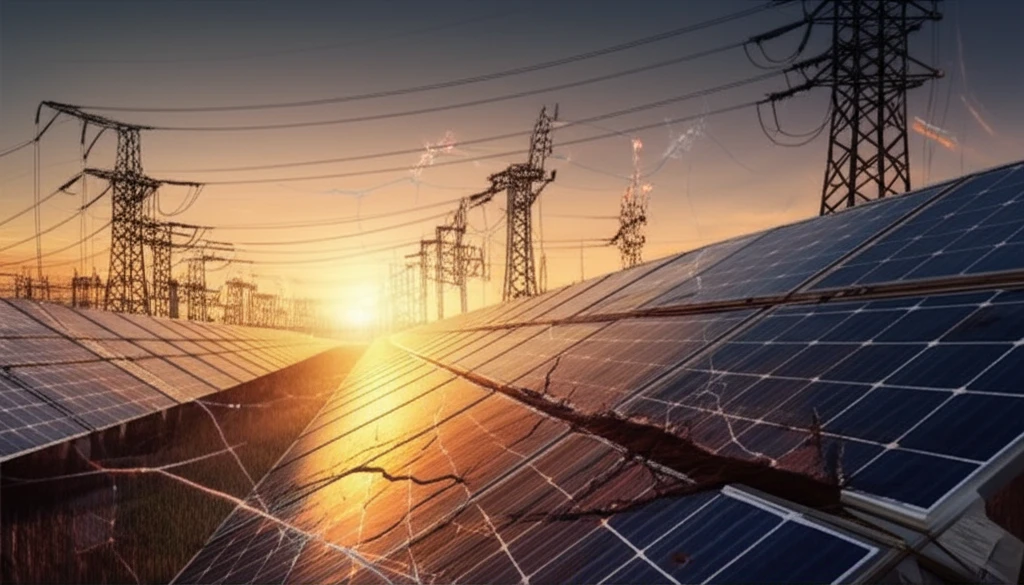
Solar Power's Shifting Impact: How Plant Degradation Affects Distribution Networks

"A Deep Dive into the Quaid-e-Azam Solar Park Study and the Future of Sustainable Energy Grids"
Renewable energy is crucial for meeting future electricity demands, with solar power playing a significant role. Technologies like solar photovoltaic (PV) plants are becoming more prevalent, ranging from small-scale to large-scale installations. However, the intermittent nature of renewable sources, such as fluctuating solar irradiance, presents challenges that require careful planning and management.
Integrating Distributed Generations (DGs) from renewable sources into existing grids without proper planning can lead to power quality issues. Strategic placement and sizing of DGs are essential to maintain system performance and stability. A comprehensive understanding of real and reactive power sources is vital for effective integration.
This article examines the potential of the Quaid-e-Azam Solar Park (QASP) in Pakistan and its impact on distribution networks. By analyzing historical weather data and modeling PV plant yields, we uncover the long-term effects of solar power integration on grid efficiency and voltage stability. This study offers insights into the importance of detailed assessments for distributed generation planning, ensuring sustainable and reliable energy delivery.
Solar Power's Growing Footprint
Solar energy has become a dominant force in renewable capacity expansion globally, with solar PV accounting for the majority of new renewable installations in recent years. The integration of distributed solar generation into distribution networks has transformed traditional power flow patterns, creating both opportunities and technical challenges. As solar adoption accelerates, understanding how plant degradation affects grid performance becomes increasingly critical for utilities and grid operators.
Smart Grid Integration Frameworks
The smart grid concept has emerged as the primary framework for managing renewable energy integration, leveraging automation and digitization to enhance grid flexibility and reliability. Systematic reviews categorize renewable energy impacts into grid stability and control, infrastructure challenges, energy storage management, and intermittent power source integration. However, these approaches face limitations when addressing long-term degradation effects on distributed solar assets and their cumulative impact on distribution network performance.
Evolution of Solar-Grid Integration
Early solar integration efforts focused primarily on grid connection and basic power quality management, with limited consideration for long-term performance degradation. The development of advanced control strategies and energy storage solutions marked significant milestones in addressing intermittency challenges. More recently, research has begun examining how aging solar installations affect distribution network reliability and power quality over extended operational lifetimes.
Understanding the Quaid-e-Azam Solar Park (QASP) Study
The Quaid-e-Azam Solar Park (QASP) is a 1000 MW solar PV plant located in Bahawalpur, Pakistan. It is one of Asia's largest solar farms. The park operates in phases, with the first 100 MW already installed and connected to the grid via a 132 kV substation. This plant aims to reduce Pakistan's electricity generation deficit by harnessing renewable energy.
- Data Analysis: Historical hourly weather data from 2000-2014 was analyzed to estimate PV plant yields.
- Seasonal Modeling: Yearly data was divided into four seasons, each modeled using Beta Probability Density Function (PDF) to create 24-hour solar curves.
- Network Testing: Solar farm power outputs were tested in an IEEE 33-bus distribution network with time-varying seasonal hourly loads.
- Performance Metrics: System losses and bus voltages were calculated to evaluate the impact of solar PV power.
Advancing Solar Technology Understanding
Recent comprehensive reviews highlight AI-assisted optimization as a key frontier for improving solar energy system performance and grid integration. Global renewable capacity reached 3,372 GW in 2023, representing 260% growth since 2010, though grid adaptation continues to lag behind deployment rates. Current research emphasizes innovations in transparent and bifacial modules, urban deployment strategies, and the need to address the technological gap threatening energy security.
Technical Limitations and Storage Challenges
The intermittent nature of solar power remains the most significant technical challenge, creating grid stability issues that require sophisticated forecasting systems and flexible backup resources. Current battery storage systems provide only 2-4 hours of capacity, which is insufficient for multi-day periods of low solar generation. High renewable energy integration presents comprehensive challenges for power system operations, particularly when considering the long-term degradation of distributed solar assets.
Performance Degradation Variability
Solar panel degradation rates vary significantly depending on technology type, environmental conditions, and manufacturing quality, typically ranging from 0.5% to 1.0% annually. These degradation patterns create non-uniform performance characteristics across distributed solar installations within the same distribution network. Understanding these variations is essential for accurate forecasting and grid management, though comprehensive comparative data across different climates and deployment scenarios remains limited.
Recommendations for Maintaining Network Quality
To maintain network quality and reliability, detailed assessments should be performed during the planning and sizing of distributed generation. These assessments should account for time-varying factors, such as seasonal load changes and PV module degradation. By considering these variables, operators can proactively address potential issues and ensure the sustainable integration of solar power into distribution networks. Long-term monitoring and adaptive strategies are essential for maximizing the benefits of solar energy while mitigating its challenges.
Integrated Assessment Perspectives
Expert consensus emphasizes that addressing solar plant degradation requires coordinated approaches combining advanced monitoring, predictive analytics, and adaptive grid management strategies. The intersection of climate variability, technology evolution, and infrastructure aging creates complex dynamics that demand interdisciplinary research and practical field validation. Successful mitigation strategies will likely integrate real-time performance data with grid planning models to anticipate and manage degradation-related impacts on distribution networks.
Emerging Research Directions
Future research priorities include developing more accurate degradation prediction models that account for local environmental factors and operational patterns. Advanced materials research aims to create more durable solar modules with slower degradation characteristics. Integration of machine learning and IoT technologies promises to enable real-time degradation monitoring and predictive maintenance strategies that can minimize distribution network impacts.
Grid Reliability Implications
Renewable energy, while advancing clean energy goals, presents significant challenges to power grid stability and reliability. Solar and wind power are often unpredictable and not always able to produce power when needed, requiring grid operators to develop sophisticated management strategies. The cumulative effect of solar plant degradation across distributed installations can amplify these challenges, potentially affecting voltage regulation, power quality, and overall distribution network performance over time.
Operational Considerations
Grid operators and utility managers face practical challenges in monitoring and maintaining distributed solar installations as they age, often lacking comprehensive visibility into performance degradation patterns. End-users may experience gradual changes in system reliability and power quality that are difficult to attribute to specific causes. The economic implications of premature solar asset retirement or costly repowering decisions affect both utilities and consumers, creating stakeholder dynamics that influence technology adoption and grid planning decisions.