
Soil Arching Simplified: How New Research Streamlines Embankment Design

"Engineers gain ground with simplified soil arching techniques, enhancing the safety and efficiency of embankment construction."
In the realm of geotechnical engineering, the construction of stable and durable embankments is a critical challenge. Embankments, often used in road and railway construction, require careful design to withstand soil displacement and ensure long-term stability. Traditional methods can be complex and require numerous parameters, leading to increased design time and potential inaccuracies. Recent research has focused on simplifying these methods, making them more accessible and reliable for engineers on the ground.
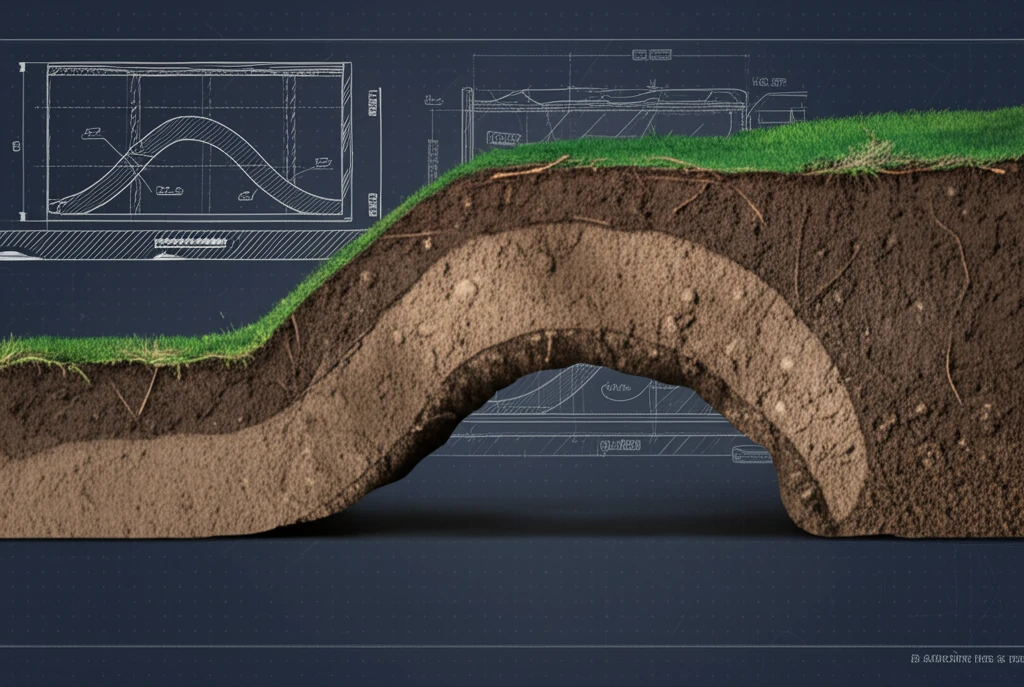
A key area of focus has been on soil arching, a phenomenon where soil forms a natural arch to redistribute loads away from areas of displacement. Understanding and accurately modeling this behavior is essential for designing effective support systems, particularly in geosynthetic-reinforced pile-supported embankments (GRCSEs). These structures combine the strength of reinforced soil with the load-bearing capacity of piles, offering a robust solution for challenging soil conditions. However, the complexity of soil-structure interaction has often hindered the widespread adoption of these techniques.
This article explores the innovative approaches presented in recent studies to streamline the design process for soil arching in embankments. By reducing the number of required parameters and simplifying the calculations, engineers can now achieve more efficient and reliable designs. These advancements not only save time and resources but also enhance the safety and durability of embankment construction.
Stress Transfer from Yielding to Rigid Zones
Soil arching is the phenomenon by which stress is transferred from yielding soil to adjacent rigid zones, a process commonly encountered in geotechnical engineering. In granular soils, this transfer moves load from a yielding portion of soil to stiffer, non-yielding adjacent regions. Design standards for trenchless pipelines base their earth-pressure calculations on the Terzaghi soil arching model, following Marston's earlier formula for earth pressure on buried structures. Recent work has extended this understanding to dynamic conditions, with discrete element method (DEM) studies investigating how arching evolves in deep trapdoor models under seismic shaking of varying magnitude, frequency, and direction.
Continuum Versus Discrete Numerical Modeling
Numerical modeling of soil arching generally falls into two families: continuum methods and discrete (particle-based) approaches. Studies comparing these approaches for soft soil improved by vertical piles highlight the limitations and advantages of each when investigating soil arching. For lateral earth pressure behind retaining wall facings, researchers have employed both the finite difference method (FDM) and a coupled discrete-continuum approach combining DEM with FDM. Within these analyses, the arching effect is understood as the reduction of stresses experienced by yielding underground structures.
Terzaghi's Arching Effect and Its Legacy
The foundational description of soil arching comes from Karl Terzaghi's theoretical soil mechanics, which defined arching as the transfer of pressure from a yielding mass of soil onto adjoining stationary parts. Terzaghi noted that arching also occurs when one part of a yielding support moves out more than adjoining parts. The concept has since become central to design practice; for example, soil arching between anti-slide piles produces an arch-shaped stress distribution around the piles that significantly influences their bearing capacity and stability.
The Evolution of Soil Arching Models
Soil arching models are crucial for predicting how soil will behave under various loads and displacements. The Ground Reaction Curve (GRC) is a fundamental tool used to represent the relationship between soil displacement and pressure. Historically, GRC models have been complex, requiring numerous parameters to accurately capture the soil's behavior. For instance, the original GRC model, known as the OABCDE curve, involved six points and multiple parameters to define its shape. This complexity made it challenging for engineers to implement in practical designs.
- Reduced number of parameters required for design.
- Easier implementation in practical engineering applications.
- Minimized uncertainties in soil behavior prediction.
- More efficient and reliable embankment designs.
Refining Arching Models for Walls and Tunnels
Recent research suggests the soil arching effect reaches its ultimate state when the arch ring thickness, load-bearing ratio, and triangular compaction zone all reach their maximum values. To simplify derivations, some researchers approximate the central arc soil arch as two inclined linear soil arches by considering the deflection of the small principal stress caused by arching. Reviews of soil arching theory trace its application to projects such as retaining walls, where arching strongly influences the distribution of earth pressures. In tunneling, soil arching plays an important role in stress redistribution, settlement, and the load acting on supports, with recent work examining how various parameters shape the expansion and contraction zones around a tunnel.
Failure Modes and the Limits of Arching
Arching, first described by Terzaghi in 1943, depends on the shear strength of the soil and the relative yielding of the soil mass. Not all arching is beneficial or stable: research on trapdoors in c'-phi' soils has examined both active and passive arching conditions using upper and lower bound limit analyses to chart realized arching mechanisms and associated loads. Design calculations must also account for failure of the arch itself, and a proposed method for determining reasonable pile spacing considers both end-bearing soil arching and friction soil arching, including general shear failure and yielding failure of the two arch types.
Geosynthetics, Piles, and Arching Magnitude
Comparative studies distinguish between fully mobilized and partially mobilized soil arching, which reflects how far stress redistribution has developed due to relative movement between adjoining soil portions. In soft-soil areas, geosynthetic-reinforced and pile-supported subgrades are commonly used to reduce post-construction settlement, and comparisons of computed soil arching heights inform such designs. Laboratory investigations have demonstrated the benefit of geosynthetic reinforcement in maintaining soil arching stability, while showing that cyclic footing loads slightly increased the soil arching ratios in certain test cases compared with others.
Conclusion: Embracing Simplicity for Enhanced Stability
The progressive development of soil arching models represents a significant advancement in geotechnical engineering. By simplifying the design process and reducing the number of required parameters, engineers can now create more efficient, reliable, and conservative embankment designs. The simplified GRC model not only saves time and resources but also enhances the safety and durability of these critical infrastructure components. As research continues to refine these techniques, the future of embankment construction looks increasingly stable and secure.
A Practitioner's Question: When Does Arching Engage?
In practice, engineers continue to ask when soil arching becomes a factor in design. One recurring practitioner question concerns the depth at which arching begins to reduce the overburden pressure, from both soil and surcharge, acting above a tunnel. Even for shallow tunnels, designers want to know whether arching effects should be included in their analysis. The question highlights a gap between textbook theory and site-specific reality, where soil type, cover depth, and support conditions determine whether arching actually develops.
Beyond Classical Arching in Reinforced Systems
Emerging research is finding that arching behavior in geosynthetic-reinforced soils above voids follows a repeated U-shaped stress distribution, a trend inconsistent with the traditional soil arching effect between piles, which increases first and then decreases. New insights into soil arching in column-supported embankments point to key concepts such as bearing failure and critical height. These findings have implications for the practical design of efficient embankments and for the effective design of future experimental studies.
Depth, Zones, and the Influence of Soil Parameters
Buried-structure behavior illustrates how systemic factors shape arching. Research on the mechanical response and soil arching mechanism of buried structures reports that the vertical arching factor (VAF) decreases with increasing burial depth and exhibits an abrupt change at the transition between non-landslide and landslide zones. The same study found that the internal friction angle exerts less influence on soil arching effects than burial depth.
Real-World Soils: Relative Density and Water Content
Field-facing studies highlight how real soil conditions complicate arching analysis. Passive soil arching exists in many soil-grille interaction systems, yet most scholars have studied influencing factors such as trapdoor width and loading method, with fewer considering relative density and water content. In aeolian sand backfills used for grillage structures, these largely unexplored parameters may substantially affect the development of passive arching.