
Smarter Inventory: How Top-k Queries Are Revolutionizing RFID Systems

"Discover how a cutting-edge approach to data queries is optimizing efficiency and accuracy in retail and beyond."
In today's fast-paced business environment, precise inventory management is crucial. Radio Frequency Identification (RFID) systems have become indispensable, offering real-time tracking and data collection across various sectors. But what if you could make these systems even smarter, faster, and more efficient? That's where Top-k Queries come into play.
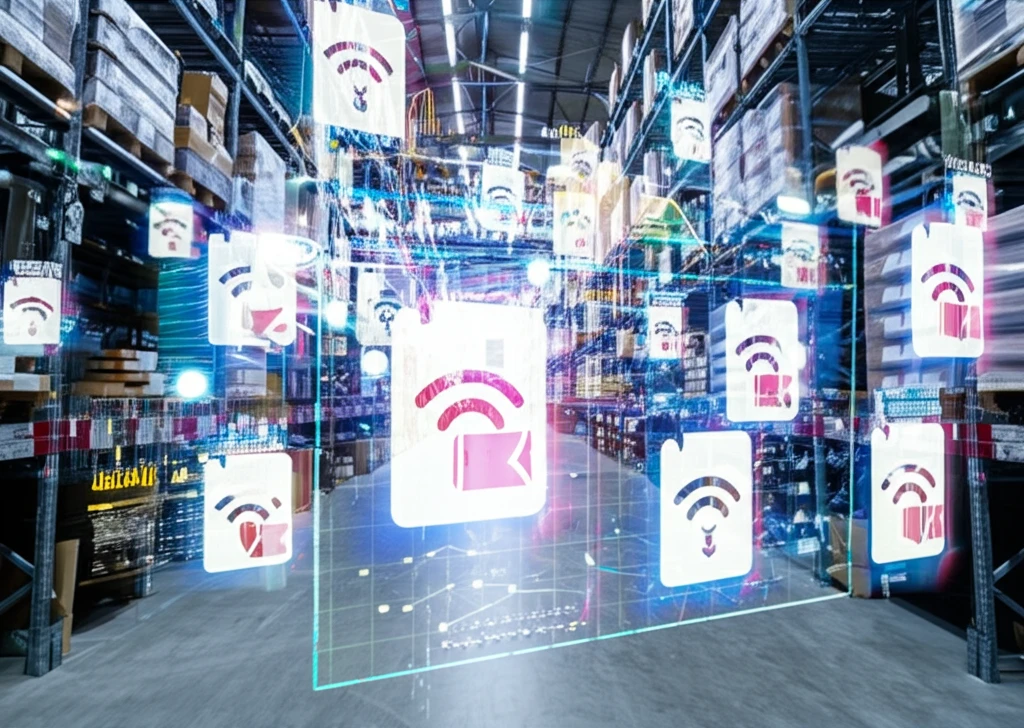
Imagine a retail setting where shelves are stocked with items from countless brands and manufacturers. Each item has an RFID tag, a unique identifier broadcasting information. Now, picture needing to quickly identify the best-selling (or worst-selling) categories to inform marketing strategies or restock inventory. Traditional methods might take time, but Top-k Queries are designed to provide this information almost instantaneously.
This article delves into how Top-k Queries are transforming categorized RFID systems, allowing businesses to swiftly extract the most relevant data. We'll explore a novel protocol, supplementary techniques, and the real-world impact of this innovative approach.
RFID Technology and Its Impact
Radio-frequency identification (RFID) technology uses electromagnetic fields to automatically identify and track tags attached to objects, enabling contactless data capture. An RFID system comprises a tiny radio transponder (tag), a radio receiver, and a transmitter. Tags contain electronically stored information that can be read from several meters away without requiring direct line-of-sight. This capability makes RFID a form of electronic barcoding that can be much smaller than traditional labels, enhancing asset management, supply chains, and business operations worldwide.
Conventional RFID Systems and Limitations
Standard RFID systems typically operate in low, high, ultra-high, or microwave frequency bands, each offering trade-offs between range, data rate, and interference susceptibility. Accepted methods involve fixed or handheld readers querying passive or active tags, often integrated with enterprise software for inventory tracking. Limitations include signal attenuation by metals and liquids, tag collision in dense environments, and higher costs compared to barcode systems. Privacy concerns and regulatory constraints also pose challenges to widespread adoption.
Evolution of RFID Technology
RFID technology evolved from radar-based identification systems in the 1940s, with early implementations used for friend-or-foe identification in military aviation. The foundational discovery enabling modern RFID was the development of passive backscatter tags, which harvest energy from reader signals. A key milestone was the introduction of the Electronic Product Code (EPC) standard in the late 1990s, facilitating global supply chain interoperability. These discoveries laid the groundwork for today's pervasive RFID applications in logistics, retail, and asset management.
What Are Top-k Queries and Why Do They Matter?
At its core, a Top-k Query is a request to find the 'top k' smallest or largest categories within a dataset. In the context of RFID systems, this translates to quickly identifying the k most (or least) frequent item categories. For example, a retailer might use a Top-k Query to determine the ten product categories with the lowest stock levels, enabling prompt replenishment.
- Rapid Insights: Top-k Queries provide near-instantaneous data, allowing for quick decision-making.
- Enhanced Efficiency: By focusing on the most critical categories, businesses can optimize resource allocation.
- Improved Accuracy: Cutting-edge protocols ensure precise results, minimizing errors in inventory and sales data.
- Strategic Advantage: Informed decisions lead to better marketing strategies, optimized stocking, and increased profitability.
Advances in RFID Query Processing
Recent research focuses on optimizing RFID systems through top-k query processing, which identifies the k most relevant items from large-scale tag populations efficiently. Review studies highlight algorithms that reduce reader-tag communication overhead, improving inventory speed and accuracy in dense deployments. Advances include probabilistic data structures and machine learning techniques to estimate item distributions without exhaustive scanning. These innovations promise to revolutionize inventory management by enabling real-time, selective data retrieval.
Challenges and Criticisms of RFID Adoption
Critics argue that RFID adoption faces significant hurdles, including high initial infrastructure costs and ongoing maintenance expenses. Failures in real-world deployments often stem from tag misreads due to environmental interference or improper tag placement. Privacy advocates raise concerns about unauthorized tracking and data security vulnerabilities. Moreover, interoperability issues between different RFID standards can hinder seamless integration across supply chains.
RFID versus Alternative Technologies
Compared to traditional barcodes, RFID offers non-line-of-sight reading, simultaneous multi-tag scanning, and greater data storage capacity. However, RFID systems generally incur higher per-unit tag costs and require more complex reader infrastructure. Against newer technologies like Bluetooth Low Energy (BLE) beacons, RFID excels in passive, battery-free operation but may lag in range and data throughput. The choice between technologies often depends on specific use-case requirements such as cost sensitivity, environmental conditions, and data granularity.
The Future of Inventory is Smart
As RFID technology continues to evolve, the integration of Top-k Query protocols offers a glimpse into the future of inventory management. By leveraging these advanced techniques, businesses can unlock new levels of efficiency, accuracy, and strategic decision-making, positioning themselves for long-term success in an increasingly data-driven world.
Expert Perspectives on RFID's Evolution
Experts agree that RFID's evolution toward smarter inventory solutions hinges on addressing scalability and data management challenges. Synthesis of current trends suggests a shift toward hybrid systems combining RFID with IoT sensors for enriched contextual awareness. Commentary emphasizes the need for robust analytics to transform raw tag data into actionable insights. Ultimately, the technology's value lies in its ability to enhance operational efficiency while minimizing manual intervention.
Emerging Trends and Future Directions
Future developments may see RFID integrated with blockchain for immutable supply chain records and with AI for predictive inventory optimization. Miniaturization and energy harvesting could enable even smaller, longer-lasting tags. The proliferation of 5G networks may enhance reader connectivity and data transmission speeds. These frontiers suggest RFID will remain a cornerstone of smart logistics and Industry 4.0 initiatives.
Systemic Issues in RFID Deployment
Systemic challenges include the environmental impact of tag disposal and the digital divide limiting access in developing regions. Regulatory frameworks vary globally, creating compliance complexities for multinational deployments. The technology's reliance on radio spectrum allocation raises concerns about congestion and interference with other wireless services. Addressing these issues requires collaborative efforts between industry stakeholders, policymakers, and standards organizations.
Human Factors and Operational Transformation
On the ground, RFID adoption transforms workflows by reducing manual counting errors and freeing staff for higher-value tasks. Workers in warehouses and retail stores report improved efficiency but sometimes express concerns about job displacement. Training and change management are critical to ensuring smooth transitions. Ultimately, RFID's real-world impact depends on balancing technological benefits with human-centered implementation.