
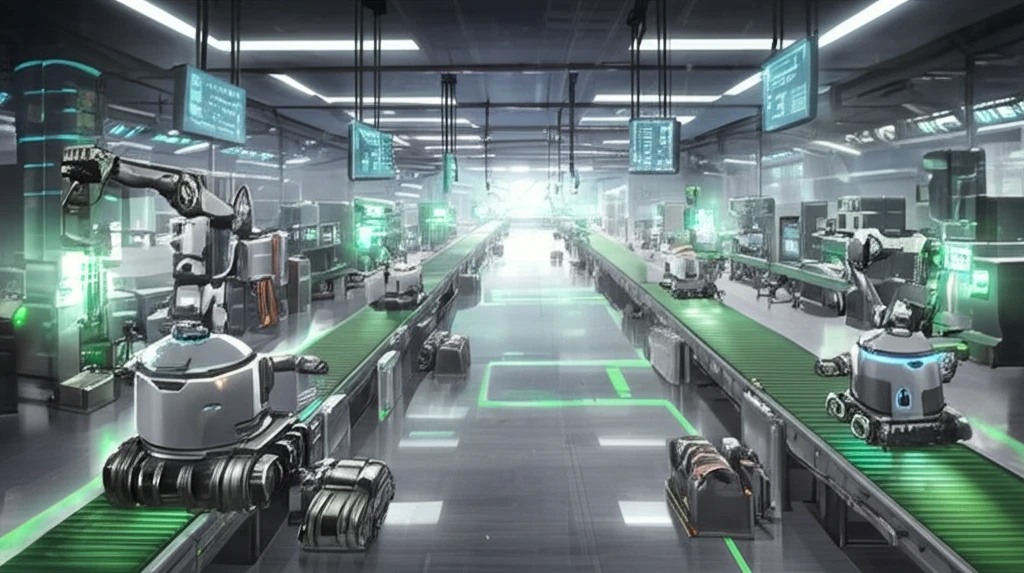
Smarter Factories: Optimizing Material Delivery for a Greener Future

"Discover how mixed model assembly lines are becoming more sustainable through energy-efficient material delivery systems, reducing environmental impact and boosting productivity."
In an era where sustainability is not just a buzzword but a necessity, manufacturing enterprises are increasingly focusing on energy consumption as a core problem. The drive for sustainable scheduling has led to innovative approaches in how materials are delivered within mixed-model assembly lines. This article explores how optimizing material delivery can significantly reduce energy consumption while maintaining, or even improving, operational efficiencies.
The traditional approach to material delivery often overlooks the intertwined relationship between energy use and operational tasks. By integrating energy efficiency directly into the scheduling process, companies can minimize waste and maximize resource utilization. This involves rethinking everything from vehicle routing to the timing of deliveries, ensuring that each step contributes to a leaner, greener manufacturing process.
This article delves into the strategies and technologies that are making this transformation possible. We'll explore the algorithms, the practical applications, and the real-world benefits of adopting a multi-objective optimization approach to material delivery. Prepare to discover how smart scheduling is paving the way for a more sustainable and productive manufacturing landscape.
Manufacturing's Energy and Emissions Footprint
The manufacturing sector is the single largest end-use consumer of energy worldwide, accounting for more than 30% of total final energy demand and a comparable share of global greenhouse gas emissions. Energy costs represent a significant operational burden for manufacturers, making efficiency improvements both an environmental and economic imperative. Digitalization-enabled AI, grounded in data collection and analysis across the production process, is increasingly recognized as a tool for detecting operational inefficiencies and optimizing resource use. Benchmarking data from sources including the U.S. Energy Information Administration's Manufacturing Energy Consumption Survey and the International Energy Agency provide a foundation for evaluating decarbonization investments across the sector.
Dominant Frameworks and Their Shortcomings
Traditional approaches to improving manufacturing sustainability have centered on energy efficiency improvements, renewable energy integration, and circular economy principles — yet the literature reveals significant gaps in data and understanding. The U.S. Department of Energy has noted that trade-offs between competing sustainability objectives remain difficult to fully quantify, leaving decision-makers without clear guidance on optimal strategies. While energy storage systems and renewable sources such as solar and wind are increasingly being embedded within manufacturing processes, comprehensive frameworks for evaluating these integrations at scale are still underdeveloped. The research community continues to call for more robust assessment methodologies that account for the full lifecycle impacts of manufacturing decisions.
The Evolution of Sustainable Manufacturing
Sustainable manufacturing emerged as a defined field in response to growing recognition that industrial production — consuming vast quantities of energy, water, and raw materials — was placing unsustainable demands on environmental, economic, and social systems. The concept has evolved from early pollution-prevention and cleaner-production paradigms into a more holistic framework encompassing eco-efficient activities designed to minimize waste, reduce emissions, and enhance productivity simultaneously. A comprehensive review tracing the historical motives behind the emergence of this field notes that its evolution has been shaped by increasingly stringent environmental regulations, rising resource costs, and shifting societal expectations around corporate responsibility. Key milestones include the formalization of assessment tools for measuring sustainable manufacturing performance and the integration of circular economy principles into production design.
What is Energy-Efficient Material Delivery?
Energy-efficient material delivery is a method of scheduling and executing material delivery tasks in mixed-model assembly lines that minimizes energy consumption while meeting operational demands. It's a holistic approach that views energy use as an integral part of the production process, not just an overhead cost.
- Optimizing Vehicle Routing: Finding the shortest, most energy-efficient paths for delivery vehicles.
- Synchronizing Deliveries: Coordinating deliveries with production schedules to reduce waiting times and minimize the need for on-site storage.
- Using Efficient Vehicles: Employing electric or hybrid vehicles and maintaining them for optimal performance.
- Load Optimization: Maximizing the load carried by each vehicle to reduce the number of trips required.
- Smart Scheduling: Utilizing algorithms to predict demand and schedule deliveries in the most energy-efficient manner.
Emerging Directions in the Field
Recent scholarship continues to explore how emerging technologies — from machine learning to advanced sensor networks — might further close the gap between theoretical and realized energy efficiency in manufacturing. However, the pace and direction of this research remain fragmented, with significant variation in methodology and scope across studies. Much of the work to date has focused on case-study-level demonstrations rather than large-scale, cross-industry validation. As a result, translating promising findings into widely adoptable best practices remains an ongoing challenge.
Skepticism and Setbacks
Skeptics of aggressive sustainability mandates in manufacturing often point to the upfront capital costs and potential productivity disruptions that accompany rapid transitions to cleaner processes. Some critics argue that voluntary, market-driven approaches outperform regulatory mandates in driving genuine efficiency gains, citing instances where compliance-focused strategies have led to superficial rather than substantive changes. Additionally, not all technology deployments deliver their promised returns; poorly integrated systems or misaligned incentives can result in wasted investment and operational setbacks. These cautionary outcomes underscore the importance of evidence-based planning and realistic performance expectations when pursuing manufacturing sustainability initiatives.
Sustainable vs. Conventional Manufacturing
A growing body of evidence suggests that manufacturers adopting sustainable business practices realize both financial and environmental benefits compared to those relying on conventional methods. The U.S. Environmental Protection Agency has documented a large and expanding cohort of manufacturers achieving measurable cost savings alongside reduced environmental footprints through sustainable operations. A 2025 comparative study using a mixed-methods approach found that energy usage across sustainable manufacturing processes was significantly reduced relative to conventional counterparts, while also improving overall operational effectiveness and financial sustainability. These findings reinforce the case that sustainability-oriented process design need not come at the expense of competitiveness.
The Future of Sustainable Manufacturing
The shift towards energy-efficient material delivery is more than just a trend; it's a fundamental change in how manufacturers view their operations. By embracing multi-objective optimization and integrating sustainability into their core processes, companies can not only reduce their environmental impact but also improve their bottom line. As technology advances and new strategies emerge, the future of manufacturing will undoubtedly be greener, more efficient, and more sustainable.
What the Evidence Collectively Shows
Expert reviews converge on the conclusion that minimizing environmental impact in manufacturing is achievable without sacrificing productivity or economic viability, provided that energy efficiency and waste reduction are treated as interconnected objectives rather than isolated goals. A systematic review of expert systems for improving energy efficiency in the manufacturing industry highlights the growing sophistication of decision-support tools that can optimize resource allocation in real time. The literature emphasizes that the most successful implementations pair technological solutions with organizational changes — including workforce training, supply chain coordination, and continuous performance monitoring — to sustain gains over time.
Technologies and Trends on the Horizon
Looking ahead, the convergence of artificial intelligence, Internet-of-Things connectivity, and advanced materials science is expected to unlock new possibilities for real-time energy optimization and waste minimization in factories. Researchers and practitioners alike anticipate that digital twins — virtual replicas of physical production systems — will become increasingly central to simulating and refining sustainable manufacturing strategies before deploying them on the shop floor. While these technologies hold considerable promise, their widespread adoption will depend on addressing current barriers around data standardization, interoperability, and workforce readiness.
Manufacturing's Paradox in the Global Economy
Modern manufacturing occupies a paradoxical position: it is indispensable to the global economy yet simultaneously one of the sectors bearing the greatest responsibility for carbon emissions, waste generation, and resource depletion. This tension has intensified as governments, consumers, and investors increasingly demand demonstrable sustainability performance from industrial producers. The systemic nature of these challenges means that no single technology, policy, or corporate initiative can deliver transformative change in isolation — coordinated action across supply chains, regulatory frameworks, and international standards is essential. Addressing manufacturing's environmental footprint at scale requires confronting deeply embedded dependencies on fossil energy, linear material flows, and legacy infrastructure that resist incremental reform.
People Behind the Processes
Behind the statistics and technological solutions lie the workers, engineers, and managers whose daily decisions determine whether sustainability goals translate into practice on the factory floor. Training programs and organizational cultures that empower employees to identify and implement efficiency improvements have proven critical to sustaining gains achieved through capital investments. Real-world impact also depends on equitable access to sustainable manufacturing technologies, as small and medium-sized enterprises in developing economies often lack the resources to adopt innovations readily available to larger firms. Ultimately, the human dimension — encompassing skills development, labor transitions, and community engagement — will shape whether the shift to greener manufacturing benefits all stakeholders or deepens existing inequalities.