
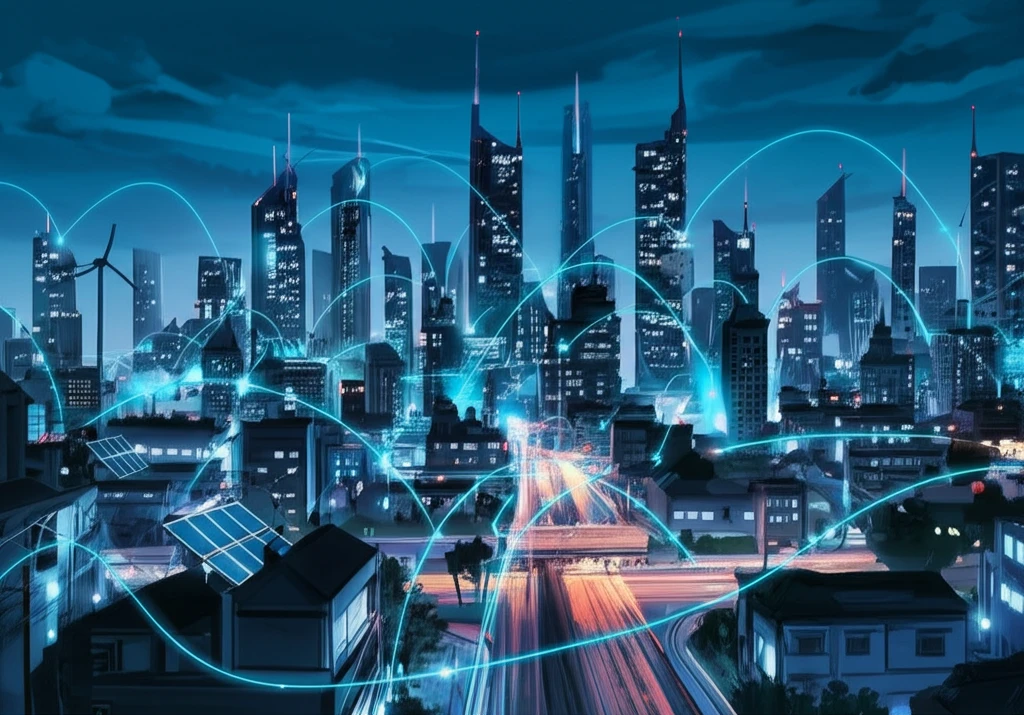
Smart Grids, Smarter Savings: How to Cut Energy Costs with Distributed Resources

"Unlock energy efficiency and savings by leveraging distributed resources on the DC distribution network. Discover how optimizing power flow can lead to significant cost reductions."
In an era where energy efficiency and sustainability are paramount, the evolution of direct current (DC) distribution grid technology offers a promising path forward. As distributed energy resources become increasingly integrated into our power systems, minimizing network loss emerges as a critical strategy for enhancing both energy efficiency and overall system stability. For homes and businesses alike, understanding how these advanced technologies can lead to lower energy costs is more important than ever.
Traditional approaches to reducing energy loss often involve complex algorithms, sophisticated power device modeling, and the addition of more hardware. These methods can be costly, increase system response times, and potentially reduce system stability. Recognizing the intermittent nature of distributed energy sources, a more effective strategy focuses on directly controlling error and response speed through advanced control mechanisms. This innovative approach avoids the need for extensive grid topology changes, cumbersome power flow algorithms, and additional equipment.
This article delves into an optimization method designed to reduce network loss in DC distribution systems by strategically leveraging distributed resources. We'll explore how this approach not only enhances energy efficiency but also contributes to a more sustainable and cost-effective energy future. By understanding the principles behind this technology, consumers and businesses can make informed decisions about integrating distributed energy resources into their energy management strategies.
Efficiency Gains on the Modern Grid
Smart grid technology enhances the operational efficiency of the grid and its ability to transmit energy with minimal loss. Distributed energy resources have the potential to deliver services to facilities and buildings at lower cost and lower environmental impact than traditional electric-grid-only services. These efficiency and cost advantages are central to the savings case for distributed resources.
The Limits of Conventional Grid-Only Service
The accepted approach has long been to rely on electric-grid-only services delivered over a traditional AC transmission network. That conventional model has recognized limitations, since distributed energy resources can serve the same needs at lower cost and environmental impact. Comparisons of transmission technology also show that conventional AC networks carry more line loss than modern alternatives, underscoring why the standard approach is being revisited.
From Analog Networks to the Smart Grid
The smart grid began as a conventional electrical grid that has been progressively upgraded with a variety of operational and energy measures, including smart meters, smart appliances and renewable energy resources. A landmark step toward integrating distributed generation came with the framework developed at the Tampere University of Technology in Finland, which enabled greater integration of distributed generation into active distribution networks.
Unveiling the Optimization Method: A Step-by-Step Guide
The method begins with a detailed derivation of the network loss formula, based on power flow calculations, to analyze the patterns of network loss. An optimal power flow (OPF) mathematical model of the DC distribution network is then established, with the primary goal of minimizing network loss while adhering to system security constraints and operational limits. This optimization problem is solved using the artificial bee colony (ABC) algorithm, a technique inspired by the foraging behavior of honeybees.
- Network Loss Formula Derivation: Calculating loss using power flow.
- Optimal Power Flow Model: Minimizing loss and ensuring security.
- ABC Algorithm Implementation: Solving tide optimization.
- Master-Slave Control: Regulating voltage and current in real-time.
Industry and Research at the Forefront
At the Hannover Messe, the world's biggest industrial fair, ABB showcased smart grid solutions with a particular focus on the potential of energy storage to make grids smarter. Meanwhile, researchers have proposed local DC distribution networks tailored to the growing penetration of distributed generation sources and sensitive electronic loads. Together, industrial showcases and academic proposals point to storage and DC architectures as the leading edge of distributed-resource research.
Integration Hurdles and Open Questions
The same research that champions distributed resources also documents real friction points. Today's distribution networks face ever-increasing penetration of distributed generation sources that are mostly DC output, alongside sensitive electronic loads that consume DC power, creating a mismatch with legacy infrastructure. These integration challenges mean that realizing the cost and efficiency benefits of distributed resources requires new network designs rather than simple plug-in adoption.
AC Versus DC: Weighing the Trade-Offs
Compared with the AC transmission network, the DC transmission network has less line loss, more power supply capacity and more flexible operation modes. Rapid advancement in flexible DC transmission technology has therefore made DC an increasingly attractive option for carrying power from distributed sources. Advanced AC and DC technologies are both being developed, including to connect offshore wind farms into transmission and distribution networks, reflecting a technology mix rather than a single winner.
The Future is Efficient: Embracing Smart DC Distribution
The research clearly demonstrates the potential for significant energy savings through optimized DC distribution networks. By adopting innovative methods like real-time control and strategic power flow management, we can pave the way for a more sustainable and cost-effective energy landscape. These advancements promise to not only reduce energy bills for consumers and businesses but also contribute to a greener future for all.
Making the Grid Smarter
When developed and scaled, smart grids help address four main challenges facing the power sector by improving operational efficiency and minimizing transmission loss. Industry demonstrations, such as ABB's focus on energy storage at Hannover Messe, reinforce that storage is a key lever for making smart grids smarter. Distributed energy resources round out the picture by delivering services at lower cost and lower environmental impact than grid-only alternatives.
The Road Ahead
Analyses of the power systems of the future emphasize the role of demand response in smart grids, in which flexible loads and distributed resources react to grid conditions in real time. DC-based local distribution networks represent a next frontier, given their lower line losses and greater supply capacity as flexible DC transmission technology advances. The combination of storage, demand response and new network architectures defines the near-term path forward.
Systemic Pressures on the Power Sector
Smart grids were developed to help address four main challenges facing the power sector, from operational efficiency to the ability to transmit energy with minimal loss. Widespread adoption depends on solving systemic integration problems, such as meshing mostly-DC distributed generation with sensitive electronic loads. Long-distance and offshore energy integration, using advanced AC and DC technologies to connect offshore wind farms, adds another layer of systemic complexity.
Savings That Hit Home
For everyday consumers, the payoff of distributed resources is tangible: energy cost savings tips and smart changes for conserving energy can help make homes more energy-efficient and cut down on bills. At the building level, distributed energy resources provide services at lower cost than traditional grid-only options. The human-scale result is households that not only spend less but also participate in a smarter, cleaner energy system.