
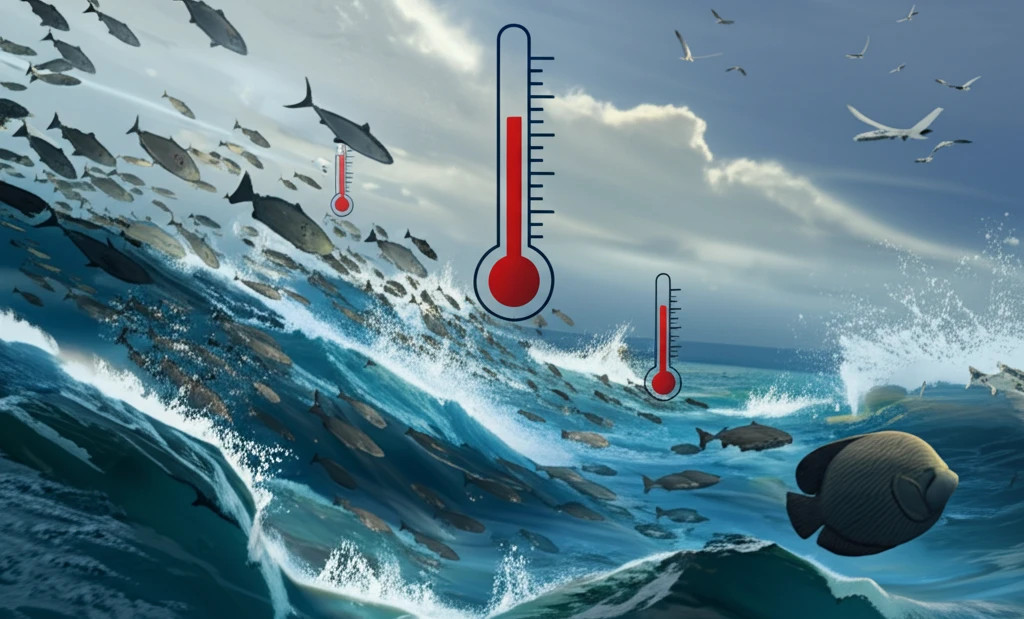
Seafood on the Seesaw: How Fish Populations Adapt to Shifting Ocean Conditions

"New research reveals the surprising ways New England fish are riding the waves of climate change – and what it means for your next seafood dinner."
The North Atlantic, a region teeming with marine life, is undergoing significant environmental upheaval. Warming waters, changing currents, and altered ecosystems are no longer abstract threats; they are tangible realities impacting the productivity and distribution of fish populations, a cornerstone of New England's economy and cultural identity.
For years, fisheries management has relied on established models, assuming a degree of stability in fish populations. However, these traditional approaches often fail to account for the dynamic nature of marine ecosystems. Recent research highlights the need for a more adaptive approach, one that acknowledges the shifting productivity of fish stocks and incorporates environmental factors into management strategies.
A groundbreaking study delves into the complexities of these changes, examining the productivity of 25 fish stocks in the Northeast US continental shelf. By analyzing decades of data and employing advanced statistical methods, the researchers uncovered surprising patterns and revealed the potential for more effective, climate-aware fisheries management.
Uneven Warming, Uneven Impacts
Climate change does not affect fish populations equally; some face suboptimal habitat while others gain more suitable conditions. Warmer water can stress coldwater fish, which tend to eat less and grow less, while warmwater species like smallmouth bass are expanding. Researchers combine genomic data with climate modelling to identify the populations most at risk and help conservation managers prioritize where actions are likely to have the greatest impact. Fishery responses are further complicated because climate change alters fish population dynamics as well as other factors in fishers' harvest decisions, such as access to alternative sources of food or income. Frameworks that integrate requirements across all life stages are being developed to anticipate impacts across the entire fish life cycle.
Modelling the Impacts, Predicting the Winners and Losers
Predicting how fish will respond to warming relies heavily on models that forecast the persistence of species under projected climate conditions, such as those developed for inland Cutthroat Trout. Similar projections in the Arctic suggest that the Greenlandic shrimp fishery is likely to suffer, both from predicted changes in climatic conditions and from a growing cod population that feeds on shrimp. Yet these approaches carry limitations, since temperature affects fish species differently and species that are not fond of warming waters will struggle while others fare better. The result is a cause-and-effect picture in which consequences vary by region and species, so the mitigation measures that follow must be tailored accordingly.
From Ear Stones to Long-Term Warnings
A foundational tool in understanding fish and climate is the otolith, a calcified stone inside a fish's ear that scientists can read like tree rings to reconstruct environmental history. With climate change, such natural archives have grown more important, because the future of wild fish populations may depend on how well we understand them. Long-term research has also revealed that warming oceans mean species will persist but at lower abundance, with slower population growth rates that make overfishing easier. Catch-potential studies point to a large-scale redistribution of global fisheries, projecting average increases of 30–70% in high-latitude regions and declines of up to 40% in the tropics.
Unstable Waters: Climate Change and Fish Productivity
The study’s core finding is that the productivity of many New England fish stocks isn’t static; it fluctuates over time, often in response to environmental cues. Researchers used state-space models, sophisticated statistical tools, to analyze long-term data on fish populations, recruitment rates, and environmental conditions. These models allowed them to estimate the “dynamic productivity” of each stock – in other words, how their capacity to reproduce and thrive changes from year to year.
- Temperature Swings: Rising water temperatures significantly impact fish metabolism and energy allocation, leading to changes in productivity.
- Current Events: Shifts in ocean currents, like the Labrador Current and the Gulf Stream, disrupt ecosystems and affect fish distribution and survival.
- Climate Connections: Atmospheric patterns, like the North Atlantic Oscillation, influence water temperature and wind patterns, further impacting fish populations.
Complex Responses Across Species and Regions
Recent reviews emphasize that projecting fish responses to climate change requires integrating physiological and behavioural processes across the entire life cycle, a lesson drawn in part from fluctuating pelagic fish populations in the Far East region. Large-scale studies using data from 235 fish populations across 38 ecological regions track not only where fish are but how they react to environmental effects such as changing water temperatures. Assessments of demersal fish show that some distribution and range-size changes match what warming would predict while others run contrary, underscoring the complex nature of population responses. Regional work adds a management dimension: in Greece's Aoos basin, research found limited presence of non-native rainbow trout, and researchers see an opportunity to prevent the species from becoming established and to protect native wild trout threatened by climate change and human pressures.
When Expectations Don't Match Observations
Not every observation fits the expected warming narrative. In Lake Erie, scientists studying how fish communities use the Great Lakes found fish gathering near low-oxygen zones, a pattern shaped by warmer thermal stratification and by rainfall and nutrient inputs that influence oxygen depletion. Paleoclimate evidence can also be misleading: changes to the West African Monsoon seen in past records were driven primarily by the sun rather than large greenhouse-gas increases, offering limited insight into how the system will be affected by climate change. In Lake Tanganyika, researchers extracted sediment cores whose fossil layers record past rises and falls in fish populations, showing how long-term records can both illuminate and complicate projections, even as the ocean, which has absorbed most of the heat trapped by greenhouse gases for a century, continues to alter marine ecosystems and fish populations.
Winners, Losers, and Shifting Borders
Comparisons across ecosystems reveal that fish size is closely tied to environmental conditions, with rising water temperatures in the North Sea, for example, reported to be driving down the size of key species. A separate University of Michigan study reached a similar conclusion for inland lakes, finding that climate change is profoundly affecting the body sizes of fish across generations. Habitat suitability also divides species into winners and losers: warmer water stresses coldwater fish, which eat less and grow less, while smallmouth bass populations expand as conditions become more suitable. Movement creates geopolitical friction as well, since fisheries that were not shared in the past are now straddling borders as fish relocate, and climate change is exacerbating these management conflicts.
Toward Adaptive Fisheries Management
This research underscores the urgent need for fisheries management to evolve. By incorporating dynamic productivity estimates into existing models and considering the influence of environmental factors, managers can make more informed decisions about harvest levels and conservation strategies. This adaptive approach will be crucial for ensuring the long-term sustainability of New England's fisheries in the face of a changing climate. Now more than ever, local fisheries will play a key role in our community's ability to thrive in the face of climate change.
Expert Voices on an Alarming Phenomenon
Experts describe the ecological reshuffling underway as alarming even when it looks locally beneficial: a UNSW researcher notes that having more fish in reefs that have lost kelp may be good news for some fishing activities, but globally it is certainly an alarming phenomenon. Genomics is emerging as a conservation tool, with researchers combining genomic data with climate modelling to identify the populations most at risk and help conservation managers prioritize where actions are likely to have the greatest impact. Otoliths — the calcified "ear-stones" inside fish skulls — increasingly offer a window on the secret lives of fishes affected by climate change. A U.N. report concludes that climate change is severely straining the world's oceans, creating profound risks for coastal cities and food supplies.
Adaptation, Management, and the Arctic Frontier
The future of fish populations depends heavily on human choices, and experts argue that fixing fisheries management can in many cases reverse declining trends even in the face of climate change. This will require countries to collaborate and cooperate on management solutions that anticipate and mitigate climate effects. In the Arctic, the outlook for fish species rests largely on global climate action and the pace of Arctic warming: some species may adapt to changing conditions, while others face potential extinction if changes occur too rapidly. Regardless of trajectory, warmer water will continue to stress coldwater fish, which tend to eat less and grow less under suboptimal habitat conditions.
Record Heat and Systemic Strain
Record-high ocean temperatures present a systemic challenge to wild fish, with impacts relevant to the coastal and marine environment around the UK and beyond, as highlighted in reporting that draws on WWF analysis of what extreme ocean warmth could mean for marine life and people. Across North America, the same warming forces are pushing some fish into suboptimal habitat, where stressed coldwater fish eat less and grow less, even as other species find newly suitable conditions. The breadth of these effects — from northern European waters to continental freshwater systems — shows that warming stress is not confined to any single region or fishery. Warming water, whether in oceans or inland, places persistent strain on species that depend on cooler conditions.
Food Supply and Nutrition at Risk
Climate change is further reducing fish stocks, with worrying implications for global food supplies as seafood feeds billions of people. The losses extend beyond the number of fish to their nutritional value: it has been predicted that increasing water temperatures will cause natural omega-3 availability from seafood to decline by more than 50% by 2100. Climate change is also affecting natural cycles of nutrients in the ocean, compounding the strain on marine food webs. As warming continues, shrinking catches and lower nutritional quality together heighten the challenge of feeding a growing global population.