
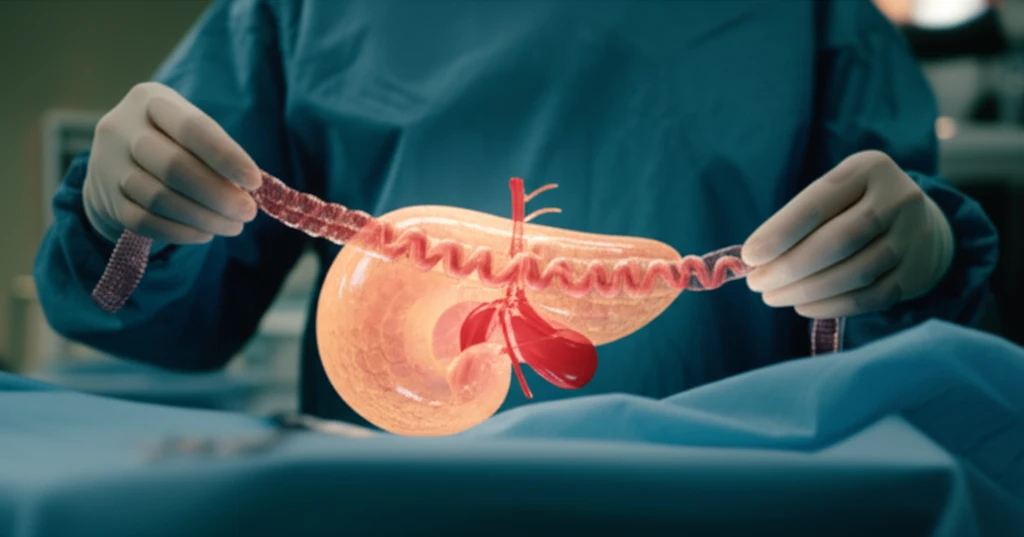
Scarf Technique Saves the Day: A New Method for Pancreatic Surgery After Gastrectomy

"Learn about the 'jejunal scarf-covering method,' a groundbreaking surgical innovation that prevents pancreatic fistulas in patients undergoing complex abdominal procedures."
Pancreaticoduodenectomy (PD) is a common surgical procedure to treat malignancies of the ampulla of Vater, duodenum, head of the pancreas, and distal common bile duct. The creation of a safe and secure anastomosis (connection) between the pancreas and the small intestine is critical to prevent complications.
One of the most serious complications following PD is the development of a pancreatic fistula (PF). A pancreatic fistula is a leak from the surgical connection, leading to intra-abdominal abscesses, sepsis, hemorrhage, and high mortality. Therefore, surgeons have explored various techniques to reinforce the pancreaticoenterostomy and prevent leakage.
Traditional methods of reinforcing the anastomosis involve wrapping skeletonized vessels and the anastomotic site with materials like the round ligament or greater omentum. However, these options are often unavailable in patients who have previously undergone total gastrectomy, a procedure where these tissues are often removed. This is where the 'jejunal scarf-covering method' comes in, offering a novel solution for these complex cases.
POPF Rates and Surgical Mortality
Postoperative pancreatic fistula (POPF) occurs in 5% to 30% of patients following pancreaticoduodenectomy, representing the most consequential complication of this procedure. Refinements in surgical technique and perioperative care have reduced PD mortality to 3–5% in high-volume centers, though POPF continues to drive significant morbidity. The absence of pancreatic fibrosis is a known risk factor, but its intraoperative assessment remains subjective, complicating risk stratification efforts.
The Whipple Procedure and POPF Management
The Whipple procedure (pancreaticoduodenectomy) is a complex resection of the pancreatic head, duodenum, bile duct, and gallbladder, typically performed for malignant tumors in this region. Despite improvements in perioperative care, POPF remains one of the most feared complications, arising when pancreatic juice leaks from the surgical anastomosis. Management of severe pancreatic fistula presents clinical challenges, with catheter drainage and relaparotomy both employed as primary treatment options. Evidence for optimal management strategies remains limited, highlighting the need for standardized approaches.
Evolution of Pancreaticoduodenectomy
Pancreaticoduodenectomy is one of the most challenging surgical procedures, requiring the highest level of surgical expertise. This procedure has constantly evolved over the years through the meticulous efforts of numerous surgeons, navigating through early limitations and misconceptions. The foundational milestones laid the groundwork for modern pancreatic surgery, with key surgeons contributing to its development. Historical reviews highlight how initial challenges and misconceptions shaped the procedure's current state.
The Jejunal Scarf-Covering Method: A Step-by-Step Guide
The jejunal scarf-covering method involves using a segment of the jejunum (small intestine) to wrap and reinforce the pancreaticojejunostomy (PJ) site, where the pancreas is connected to the jejunum. This technique is particularly beneficial for patients who have undergone total gastrectomy, as it utilizes the available jejunum to provide additional support and protection to the anastomosis.
- Jejunal Loop Creation: A segment of the proximal jejunum (the portion closest to the stomach) is brought up to the surgical site in a retrocolic position (behind the colon).
- Double Loop Formation: The jejunum is positioned to create a loop, and the sides of the loop are sutured together to form a double-layered structure.
- Pancreaticojejunostomy (PJ): The remnant pancreas, with a stent (tube) inserted into the pancreatic duct, is placed onto this prepared jejunal double loop. A precise, layered anastomosis is then performed to connect the pancreatic duct to the jejunum.
- Jejunal Scarf Wrapping: After the PJ is complete, the portion of the jejunal loop opposite the anastomosis is carefully bent over and wrapped around the PJ site, creating a protective 'scarf.'
- Securing the Wrap: The edges of the jejunal wrap are then sutured to the pancreatic parenchyma (the functional tissue of the pancreas) to ensure it stays securely in place.
- Additional Anastomoses: Finally, the hepaticojejunostomy (connection between the bile duct and jejunum) is performed, and drainage tubes are strategically placed to manage any potential leakage.
Advances in Pancreatic Surgery Research
Research in pancreatic surgery continues to evolve, with ongoing investigations into techniques that may reduce complications like POPF. Current studies focus on refining surgical approaches and improving risk prediction models. The field remains active with new contributions exploring ways to optimize outcomes for patients undergoing complex pancreatic procedures.
Challenges in Achieving Consistent Outcomes
Despite advancements in surgical technique and perioperative management, pancreatic fistula remains a persistent challenge with variable success rates across institutions. Some prevention strategies have shown limited effectiveness in certain patient populations, and debate continues regarding optimal management approaches. Failures to achieve consistent outcomes underscore the complexity of this complication and the need for continued innovation.
Robotic vs Open Pancreatoduodenectomy
Assawasirisin and colleagues evaluated robotic versus open pancreatoduodenectomy, stratifying patients by alternative fistula risk score into low-, intermediate-, and high-risk groups. In high-risk patients, the robotic approach was associated with reduced rates of pancreatic fistula, delayed gastric emptying, and surgical site infection, as well as shorter hospital stay. However, this method may be affected by the dilution effect if the benefit of RPD is seen only in high-risk patient groups. The alternative fistula risk score (aFRS) was developed to predict the probability of developing POPF.
The Future of Pancreatic Surgery: Hope for Complex Cases
The jejunal scarf-covering method represents a significant advancement in surgical technique, offering a valuable option for preventing pancreatic fistulas in challenging cases. While further research and long-term studies are needed, this innovative approach holds great promise for improving patient outcomes and reducing the morbidity associated with pancreatic surgery after total gastrectomy.
Expert Perspectives on Surgical Outcomes
Expert commentary emphasizes the importance of surgical technique refinement and perioperative optimization in reducing pancreatic complications. The field benefits from ongoing dialogue among surgeons about best practices and emerging evidence. Continued focus on standardization and evidence-based approaches is essential for improving patient outcomes in pancreatic surgery.
Innovations in Pancreatic Surgery
Future directions in pancreatic surgery may include further development of minimally invasive techniques and improved risk prediction models. Research into personalized surgical approaches and enhanced recovery protocols promises to advance the field. Emerging technologies and collaborative research efforts will likely shape the next generation of pancreatic surgical care.
Systemic Impact of Pancreatic Fistula
Pancreatic fistula remains the most challenging complication after pancreaticoduodenectomy, with significant impact on patient outcomes and healthcare resource utilization. Risk factors and outcomes associated with POPF highlight the need for effective prevention strategies. The clinical impact of POPF underscores the immediate need for prospective studies on effective strategies to mitigate its development after pancreaticoduodenectomy.
Global Research Landscape and Patient Outcomes
Bibliometric analysis of postoperative pancreatic fistula after pancreaticoduodenectomy maps the global research landscape and trends, providing valuable insights for identifying research hotspots. This comprehensive mapping guides future studies and promotes standardized advancement in the field. The findings contribute to understanding how research efforts can better serve patients facing complex pancreatic procedures.