
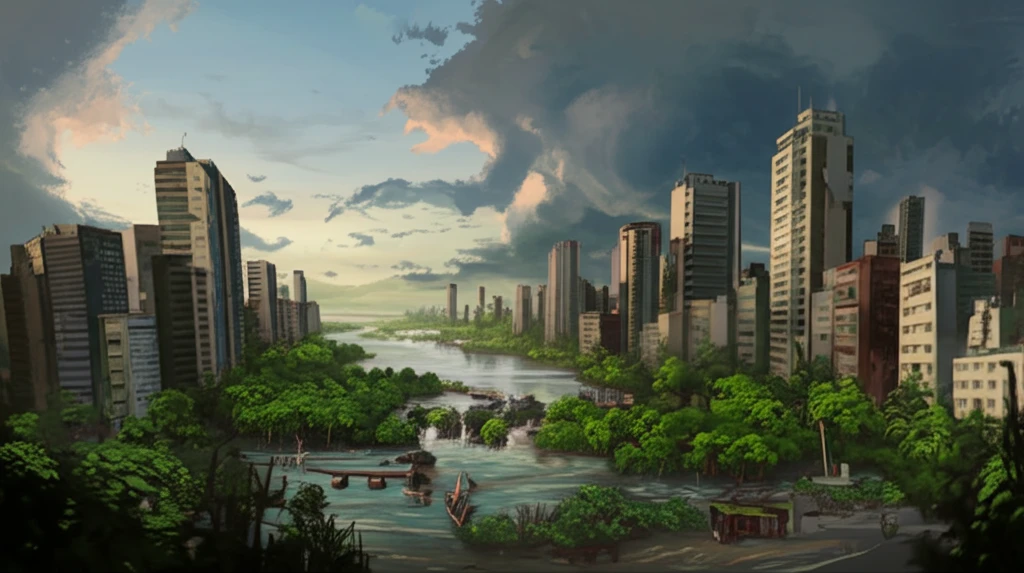
Santos' Silent Struggle: Can This Coastal City Adapt to Climate Change?

"Uncover the untold story of Santos, Brazil, as it confronts rising sea levels and extreme weather. Is its adaptive capacity strong enough to weather the storm?"
The world's coastal cities face a looming threat: climate change. Rising sea levels, extreme weather events, and shifting environmental conditions are no longer distant possibilities but present-day realities. Santos, a bustling port city in Brazil, is on the front lines of this crisis. Understanding its adaptive capacity – its ability to adjust to these changes – is crucial for securing its future.
Adaptive capacity isn't just about physical infrastructure. It encompasses a society's collective ability to act, innovate, and protect itself in the face of adversity. This involves everything from governmental regulations and institutional frameworks to community engagement and individual awareness. For Santos, assessing this capacity requires a deep dive into its unique social, economic, and environmental context.
This article explores the adaptive capacity of Santos, drawing insights from research conducted within the Metropole Project. We will examine the challenges the city faces, the initiatives it has undertaken, and the potential pathways towards building a more resilient and sustainable future for its residents.
The Growing Evidence Base for Climate Adaptation
NASA reports that there is unequivocal evidence Earth is warming at an unprecedented rate, with human activity identified as the principal cause. Effective climate adaptation depends on robust data collection, as intermediaries and data brokers help navigate the overwhelming universe of environmental information. Research on climate-vulnerable communities shows that knowledge, attitudes, and practices related to climate change and health are shaped by local perceptions, while institutional resources influence the adoption intensity of adaptation practices among populations such as farmers.
Frameworks for Tracking and Guiding Adaptation
Adaptation tracking seeks to characterize and compare trends in climate change adaptation over time and across nations, yet systematic approaches remain underdeveloped. International standards such as ISO 14090:2019 and ISO 14091:2021 provide organizational guidance on climate adaptation principles and resilience for infrastructure. Government frameworks recognize that climate change already threatens coastlines, infrastructure, human health, and food systems through increasing storm, flood, fire, and heatwave events.
Decades of Neglect and Emerging Awareness
The UNFCCC brought representatives from countries worldwide to set plans to limit climate change impacts, but these agreements were not legally binding and received little attention. Historically, the neglect of adaptation agendas has been attributed to disagreements over responsibility for the origins of climate change. Over the past 50 years, there has been a documented increase in the number and intensity of climatic events, including rising temperatures, precipitation changes, droughts, floods, wildfires, and storms. The concept of mal-adaptation has also emerged, describing changes that worsen climate outcomes beyond what climate change alone would cause.
Santos: A City Under Pressure
Santos occupies a pivotal position in Brazil's economy, but this prominence comes with vulnerabilities. Like many coastal areas, it has been subjected to intense financial speculation and environmental degradation. Climate change, particularly sea-level rise, threatens to exacerbate these existing pressures, potentially overwhelming the city's infrastructure and increasing the vulnerability of its population.
- Environmental Degradation: Historical industrial activity and urban expansion have significantly impacted the city's ecological balance.
- Social Vulnerability: Unequal distribution of resources leaves poorer neighborhoods disproportionately exposed to climate risks.
- Governance Gaps: Municipal legislation has been slow to incorporate climate change adaptation measures.
- Lack of Integration: Insufficient coordination among various agencies hinders effective risk management.
Advances in Adaptation Science and Measured Effectiveness
Climate-change adaptation encompasses a broad range of human policies and activities intended to reduce both realised and expected risks posed by climate change. Research on specific cities such as New Orleans and New York has revealed antagonisms within adaptation measures, where interventions can produce conflicting outcomes. Studies quantifying the effectiveness of individual adaptation strategies—including increased thermal resistance, changed thermal capacity, higher albedo surfaces, vegetation roofs, solar shading, and natural ventilation—provide evidence for which approaches perform best under projected conditions.
Political Complexity and Institutional Shortcomings
Greece failed on multiple fronts in the European Commission's 2018 Adaptation Preparedness Scorecard, illustrating how even EU member states can fall behind in developing adaptation strategies. New Zealand's Climate Change Minister has acknowledged that adaptation is the most complex and politically charged component of the climate challenge, with costs that governments are reluctant to confront. Despite widespread recognition that human actions are increasing climate variability and that existing emissions will drive significant environmental changes, the urgency of adaptation continues to outpace institutional responses.
Engineering Limits and Human Resilience
Traditional climate change adaptation assessment relies on conventional engineering solutions, evaluating only hydrological extremes while overlooking intangible values such as recreational amenities from blue-green infrastructure. Urban drainage design decision-making highlights the tension between standard engineering responses and more holistic approaches that incorporate broader community benefits. Human adaptability is well documented, yet the scale and speed of the climate crisis tests the limits of individual and collective capacity to respond.
Building a Resilient Future
The journey towards climate resilience is a continuous process of learning, adapting, and innovating. For Santos, this means fostering greater connectivity between local efforts, promoting transparency in decision-making, improving organizational structures for collaboration, and empowering a broader range of stakeholders to take ownership of the issue. By addressing its vulnerabilities and capitalizing on its strengths, Santos can pave the way towards a more sustainable and resilient future.
Diverse Perspectives on Adaptation Capacity
Effective climate change adaptation requires integrating gender sensitivity into all levels of planning and execution to address differential impacts on women and men. Surveys of U.S. local health department directors reveal widespread recognition of climate threats but limited adaptive capacity due to perceived lack of expertise and resources. Research on farmers' perceptions shows that adaptation behaviour is driven by diverse theoretical assumptions and identified factors, underscoring the need for context-specific approaches.
Worsening Heat and the 1.5°C Challenge
The Tropical Andes are expected to experience some of the most drastic climate changes in South America, with a clear trend of increasing air temperatures across the region. The Hamburg Climate Futures Outlook finds that the world is not on track to limit global warming to 1.5°C despite Paris Agreement goals, casting doubt on the feasibility of key adaptation thresholds. Global analyses of hourly heat data from 1981 to 2023, combined with projections to the end of the 21st century, indicate that extreme heat events will intensify in duration and severity under high-emission scenarios.
Systemic Risks and the Funding Gap
Climate change is a systemic challenge, and adaptation solutions that focus only on direct impacts may be insufficient against the broader direct and indirect consequences of a changing climate. Addressing risks to specific elements of food systems requires designing systemic responses that do not create negative spillover effects on other parts of the system. Transboundary climate risks complicate adaptation further, as climate events and slow-onset changes alter overseas investment returns and remittance flows. Only 6% of adaptation funding and 0.5% of multilateral climate finance reaches health-related projects, leaving communities without the resources they need.
Lives at Stake and the Cost of Inaction
At least 400,000 deaths each year are directly linked to climate change, with children among the most vulnerable populations requiring targeted adaptation responses. Community-based adaptation actions, such as those documented in Bulang Village in Xishuangbanna, China, demonstrate the potential of local initiatives to address climate impacts. Real adaptation is as politically challenging as mitigation but substantially more expensive, with scientists calculating a net present value of climate change impacts at $1,240 trillion under current emission trajectories.