
Revolution on Canvas: How Mexican Art Shaped National Identity

"Discover how artists like Diego Rivera and others used their work to depict laborers and influence the formation of Mexican national identity during a revolutionary era."
The Mexican Revolution (1910-1920) was a period of profound social and political upheaval, leaving a lasting impact on the nation's identity. Art became a crucial tool in shaping this identity, reflecting and influencing the values, struggles, and aspirations of the Mexican people. During this transformative era, artists played a pivotal role in depicting the lives and contributions of laborers, both urban and rural, and embedding them within the broader narrative of national reconstruction.
John Lear's book, "Picturing the Proletariat: Artists and Labor in Revolutionary Mexico, 1908–1940," delves into this fascinating intersection of art, labor, and national identity. By examining a wide array of visual materials—prints, photographs, illustrations, and murals—Lear uncovers the ways in which artists represented the working class and how these representations contributed to the forging of a new Mexican identity.
Lear’s work moves beyond the conventional focus on well-known muralists to include a broader spectrum of artists and artistic movements. By incorporating the stories and works of figures like Saturnino Herrán, José Guadalupe Posada, and others, Lear offers a more comprehensive understanding of the diverse artistic landscape that shaped revolutionary Mexico. This approach allows for a richer and more nuanced appreciation of the period's cultural and political dynamics.
A Catastrophe That Became a Cultural Catalyst
The Mexican Revolution of 1910 to 1920 is described by the Open University as the first major political upheaval of the twentieth century, a conflict in which over a million people died and which stood as the era's first revolt against imperialism, specifically that of the United States. In its aftermath, Mexican modernism emerged in the early twentieth century as a revolutionary artistic movement that transformed the country's cultural landscape. The scale of the conflict and the scale of the cultural response are closely linked: the upheaval created the conditions under which a national artistic identity could be rebuilt. Together these sources frame the revolution as both a demographic catastrophe and the catalyst for a lasting cultural renaissance.
The Political Narrative and Its Cultural Blind Spot
The standard historical approach treats the Mexican Revolution (1910-1920) as a long, bloody struggle among several factions in constantly shifting alliances, one that ultimately ended the thirty-year dictatorship and established a constitutional republic. A limitation of this political-military framing is that it can underplay the cultural program that accompanied nation-building, particularly the role of figures such as José Vasconcelos, who deployed education and the arts to help shape a unified national identity. Focusing narrowly on leaders and battles risks treating art as a footnote rather than as an instrument of the new state. Accounts that center Vasconcelos' contributions instead show how philosophy, education and painting were deliberately harnessed to construct the country's self-image.
The 1920s Turning Point and the Birth of Social Realism
Scholars locate the foundational milestone of Mexican revolutionary art in the muralist turn of the 1920s. It was then that Social Realism originated among the Mexican muralists, before blossoming in the United States and Europe during the 1930s and growing into an international style. The radical decades of the revolution are likewise the focus of 'Picturing the Proletariat', a study of Mexican art and artists praised as a fine, original and well-crafted piece of history. These sources converge on the same conclusion: the 1920s and 1930s were the crucible in which a distinctly Mexican, socially committed art was forged.
The Artist as a Social Commentator
One of the central themes explored in Lear’s analysis is the relationship between artists, labor unions, and the state. During the revolutionary and post-revolutionary periods, artists were not merely passive observers but active participants in the social and political movements of their time. Many artists aligned themselves with labor unions and leftist political organizations, using their art to advocate for workers' rights and social justice.
- Labor Representation: The ways in which artists portrayed workers, both urban and rural, in their art.
- Political Alignment: The connections between artists and labor unions, as well as their involvement in leftist political movements.
- State Influence: The role of the government in promoting and supporting art that aligned with its ideological goals.
Beyond the Murals: An Expanding Canon
Recent coverage of modern Mexican art pushes against the assumption that the movement can be reduced to its murals, with one exhibition review circulated on Pinterest insisting that modern Mexican art is bigger than murals. The review is framed as thrilling, treating the broadening of the canon as an event in itself. The material pinned alongside it emphasizes revolution-era culture and muralista imagery, showing how the old icons still anchor popular engagement. For now this is a single review rather than a settled scholarly position, but it reflects a live debate about the movement's boundaries.
The Mural Myth and Overlooked Legacies
A major counterpoint to the mural-centered story comes from the exhibition 'Paint the Revolution: Mexican Modernism, 1910-1950', organized by the Philadelphia Museum of Art, a sprawling and thrilling survey of paintings, drawings, photography and prints that art critic Christopher Knight walks through in his Los Angeles Times tour. The sheer range of media in the show is itself an argument that the canonical emphasis on murals has narrowed the movement. A further complication is the revolution's own cultural legacy, which contemporary critics such as Anita Brenner described as nothing less than "the first great modern art created in America". Radical American observers also connected Mexican problems, including slavery, to United States policy, meaning the movement was understood from its earliest years through an international and critical lens.
Academic Bodies vs. Popular Thematics
Comparative scholarship has examined post-revolutionary Mexican art through the lens of the body, with Oxford research on 'Post-Revolutionary Body Politics' situating painting and murals within broader debates about identity and power. Within this literature, Mary Kay Coffey's 'How a Revolutionary Art Became Official Culture: Murals, Museums and the Mexican State' (2012) is singled out as the most sophisticated and theoretically informed analysis of the muralist movement to date. Popular comparison, meanwhile, tends to run along thematic rather than theoretical lines, pairing revolution-era women, folklore, Aztec design and revolution iconography in the same visual conversation. The contrast between academic frameworks such as body politics and informal thematic groupings illustrates how widely the movement's interpretation ranges.
The Enduring Legacy of Revolutionary Art
Lear’s "Picturing the Proletariat" offers valuable insights into the complex relationship between art, labor, and national identity in revolutionary Mexico. By examining a wide range of visual materials and exploring the diverse perspectives of artists, labor leaders, and government officials, Lear provides a nuanced and compelling account of this transformative era. His work underscores the enduring power of art to shape collective memory, promote social change, and contribute to the ongoing construction of national identity. For those interested in the intersection of art, politics, and social movements, Lear’s book offers a rich and rewarding exploration of a pivotal moment in Mexican history.
Icons, Markets and a Living Inheritance
Expert commentary on the revolution's artistic legacy returns repeatedly to individual careers, with Frida Kahlo de Rivera (1907-1954) standing as perhaps the most recognizable figure in the country's modern canon. Alongside such icons, the secondary market keeps the wider field alive, with listings and auction lots covering painters from Carlos Merida and Kurt Seligmann to Francisco Toledo, complete with market price analysis. The result is a synthesis in which scholarly biography and commercial valuation reinforce each other: Kahlo's life anchors the narrative, while market data demonstrates that the era's artists remain actively collected. Commentary thus treats the revolution's art not as a closed historical chapter but as a living, traded inheritance.
From Easels to New Media and Civic Healing
The influence of the muralist movement was strong enough to shape newly invented technologies such as still photography and cinema, and that diffusion continues to define its reach. A 2024 design trend report treats Mexican muralism as a fine example of how design and art can help promote healing and unity after a long conflict, suggesting the form is being re-purposed for contemporary civic use. Future outlooks increasingly frame the movement's legacy as adaptable, with its visual language migrating across media and into new public commissions. On this view, the revolution's art is less a period style than an ongoing template for national expression.
Institutional Pressures and National Confusions
Any full accounting of Mexican art's role in national identity must contend with broader systemic pressures on the arts establishment, where aging audiences, skyrocketing costs, breathtaking demographic shifts, failing education and decreasing social relevancy are repeatedly cited as threats. Cultural confusion compounds the challenge: National Geographic notes that Mexico's Independence Day, commonly confused in the United States with Cinco de Mayo, marks Father Hidalgo's call for independence from Spain in September 1810, a moment that began a decade-long struggle and is routinely mixed up with the later revolutionary history that produced muralism. Keeping the 1810 independence struggle distinct from the 1910-1920 revolution matters for understanding which events the art commemorates. The survival of that art's institutions, in turn, depends on solving sector-wide problems of relevance and funding.
Public Walls, a Painter's Vision and a Borderland Reach
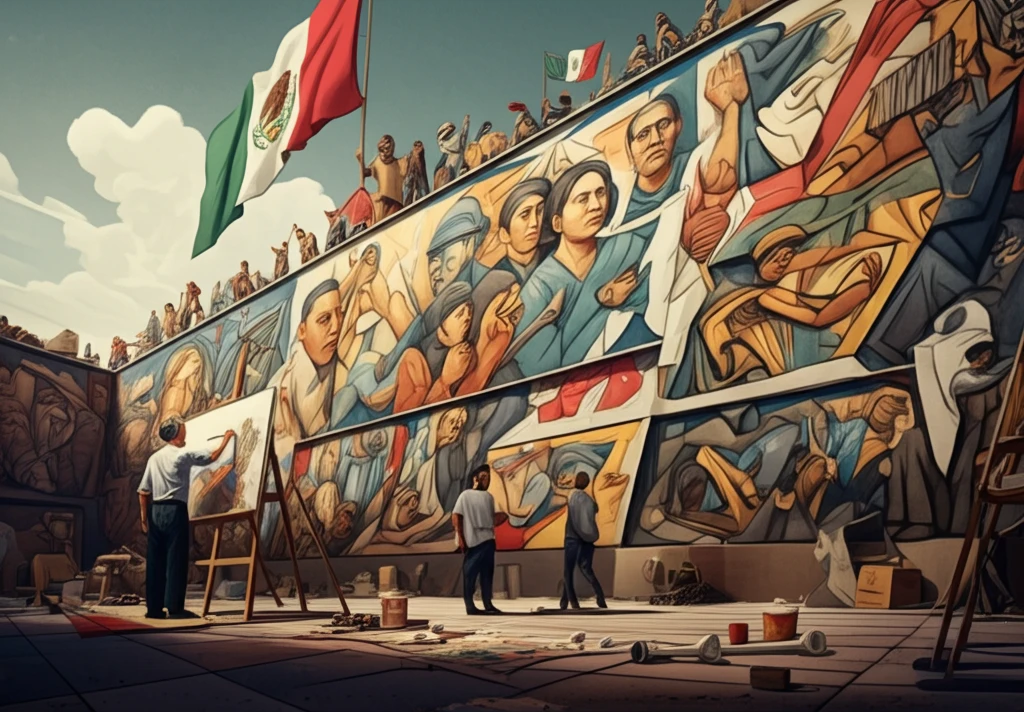
The human story of the movement begins with the murals themselves: muralism was the first major art form to gain traction, with public buildings mainly in Mexico City used as easels to showcase the events and leaders of the Mexican Revolution. Diego Rivera, one of the leading artists of the time, painted large works depicting his vision of Mexico, giving the conflict a monumental visual voice. The impact was not contained within Mexico's borders, since the revolution touched communities on the Texas side of the Rio Grande from Brownsville to El Paso. Across this borderland, the same upheavals that inspired Rivera's canvases reshaped the daily lives of Tejano communities.