
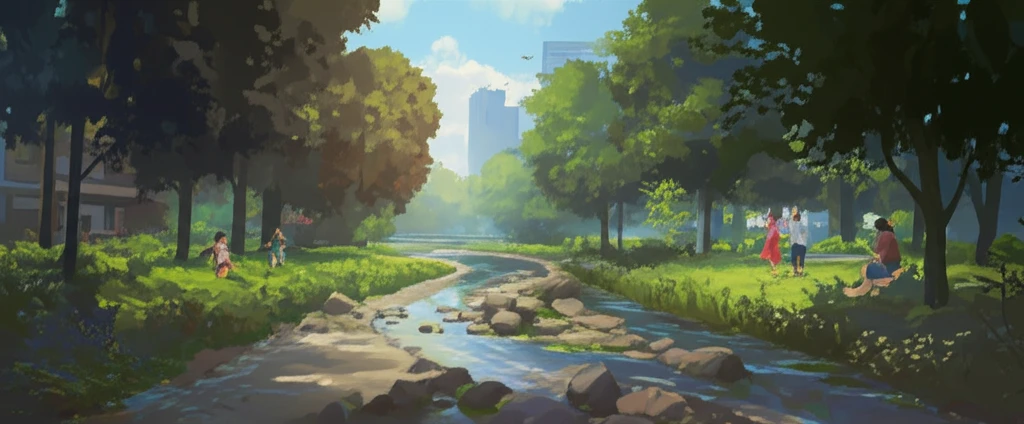
Reviving Urban Waterways: How to Restore Streams for a Healthier City

"Discover innovative strategies for urban stream restoration, enhancing water quality and recreational opportunities in your community."
Urban streams, often overlooked, are vital components of a city’s ecosystem. They offer numerous benefits, from managing stormwater to providing habitats for wildlife and recreational spaces for people. However, many urban streams face significant challenges, including pollution, habitat degradation, and reduced water quality. These issues not only impact the environment but also diminish the quality of life for urban residents.
The English Coulee, a stream that flows through Grand Forks, North Dakota, is a prime example of an urban stream facing such challenges. With a catchment area of 347 km², the Coulee plays a crucial role in the region's water management system. However, it has suffered from stagnation of flow, overgrowth of vegetation, poor water quality, and accumulation of debris, leading to unpleasant odors and potential health hazards. Addressing these issues is essential to restore the Coulee’s ecological function and recreational appeal.
Fortunately, innovative approaches can revitalize urban streams like the English Coulee. By combining hydrologic and hydraulic modeling with thoughtful design, it is possible to enhance water quality, promote biodiversity, and create attractive recreational spaces for urban communities. This article explores these revitalization strategies, providing a roadmap for restoring urban streams and unlocking their full potential.
Degradation at Scale: Sediments, Nutrients, and Lost Connections
Stream restoration is work conducted to improve the environmental health of a river or stream, in support of biodiversity, recreation, flood management and/or landscape development. In urban watersheds, restoration and sewer systems jointly shape the sources and fluxes of water, carbon, and nutrients. Excess sedimentation and nutrients are a main concern in the Chesapeake Bay watershed and contribute to multiple dead zones and habitat degradation, which is why repairing damaged and degraded streams remains necessary even where urban restorations show ecological shortcomings. As greater numbers of urban streams are culverted, the longitudinal, lateral, and vertical socio-spatial connections between them and their urban context are impacted.
The Urban Stream Syndrome and the Limits of Standard Designs
The term "urban stream syndrome" describes the consistently observed ecological degradation of streams draining urban land. The challenges of working to restore physical and biological functions in urban or developed streams and their watersheds focus on hydrologic characteristics that no longer fit a natural stream. A notable limitation to producing effective restoration strategies is the absence of exact goals and targets; without these, determining the type and number of restoration activities required to restore ecological communities remains problematic.
From Buried Pipes to Daylighting
Traditional methods of managing urban streams placed them in underground pipes, and urban stream daylighting has since emerged as a stream restoration and green infrastructure technology in response. Recognizing the value streams could provide, the United States is moving toward reservation of floodplains and creating parks and open spaces, especially in urban locations, while avoiding channelization in order to preserve a more natural environment. Enhancement efforts in urban streams typically are limited to rehabilitating channel morphology and riparian habitat, but such physical improvements alone do not address all factors affecting biotic health.
Strategies for Urban Stream Restoration
Restoring an urban stream requires a multifaceted approach that addresses both water quantity and quality. Effective strategies often involve structural controls and channel modifications designed to improve flow, reduce pollution, and enhance habitat. Hydrologic and hydraulic modeling plays a crucial role in evaluating the effectiveness of these interventions, allowing planners to optimize designs and maximize their impact.
- Replacing culverts to improve flow at critical intersections.
- Removing or modifying dams and weirs that impede water movement.
- Installing pumps and pipes to supplement flow during dry periods.
- Creating retention ponds to capture and treat stormwater runoff.
Daylighting, Wicked Problems, and Uncertain Biodiversity Gains
Recent work spans thousands of full-text research PDFs, articles, conference papers, and preprints on stream restoration, signaling a large and active field. Many urban streams have vanished from the surface as a collateral effect of urban growth, and from the late 1990s to the early 21st century research on river ecological restoration emerged in China, including different projects to daylight buried streams. Stream restoration has been used to improve stream conditions and, in part, to ameliorate losses, yet the relationship between restoration and recovery of biological diversity is unclear. Some researchers argue that if urban stream restoration is truly a wicked problem, the unique management methods needed for wicked problems must be applied correctly for restoration efforts to be considered successful.
Why Restorations Struggle: Flashy Hydrographs and Unregulated Nutrients
Rapid flows into urban streams lead to flashy hydrographs, in which stream levels rise rapidly in response to precipitation events, while other common shifts in hydrology driven by urbanization include lower baseflows that can cause problems during flood discharges. Restoration practices are often implemented to address urban stream syndrome, commonly using natural channel design to stabilize eroding stream banks and establishing diverse streamside vegetation to filter pollutant inputs. Yet most states do not have numeric standards for nutrients, and point source discharges of nutrients are recognized as a factor leading to stream degradation and failure to achieve narrative water quality standards.
Comparing Channel Designs in the Urban Context
Streams draining urban catchments ubiquitously undergo negative physical and ecosystem changes, recognized to be primarily driven by frequent stormwater runoff input. The common management intervention is rehabilitation of channel morphology. Analyses comparing how alternative urban stream channel designs influence ecohydraulic conditions indicate that the choice of design materially shapes restoration outcomes.
A Call to Action for Urban Stream Restoration
Revitalizing urban streams is not just an environmental imperative but also an opportunity to enhance the quality of life for urban residents. By implementing thoughtful restoration strategies, cities can transform degraded waterways into thriving ecosystems and attractive recreational spaces. The English Coulee project demonstrates the potential of hydrologic and hydraulic modeling to inform effective restoration designs, providing a roadmap for other communities seeking to revitalize their urban streams. Let's embrace the challenge of urban stream restoration and unlock the hidden potential of these valuable resources.
The Cost Question: Are Urban Stream Restorations Worth It?
Typical urban stream restoration costs of US$500-1,200 per foot are larger than the cost of the least expensive alternatives for management of nitrogen loads from stormwater, such as detention ponds, which are equivalent to $30-120 per foot of restored stream. Within stream restoration practice there has been little use of formal decision analysis methods for evaluating tradeoffs in selecting restoration sites and design alternatives. Out-of-stream restoration practices, such as stormwater ponds, created wetlands, and restored riparian areas, offer an additional set of options given that urban development is a leading cause of stream impairment that reduces biodiversity and negatively affects ecosystem processes and habitat.
Long-Term Gains and Matching Effort to Need
Long-term assessment of floodplain reconnection as a stream restoration technique shows it to be a popular approach for managing nitrogen in degraded, flashy urban streams. Newer research points to the role of flow hydraulics and to restoring the altered hydrogeomorphic process, highlighting the benefits of addressing the issue at the broader watershed scale. At the same time, stream restorations filter pollutants out of local waterways and improve the health of the Chesapeake Bay, but there is a mismatch between where such work would do the most good and where the most public support for it lies.
Global Divides and Systemic Constraints
Stream burial began much earlier in the Global North than in the Global South, and buried rivers are now increasingly linked to decision support systems, ecology, restoration, and urban planning and design in the literature. Analyses of projects in Andean cities, based on their social and ecological restoration goals, reveal systemic challenges as well as opportunities to construct projects that are self-sustainable and more resilient in the Andean context, as illustrated by contrasting projects in Quito, Ecuador.
Restoring Neighborhood Streams, Community by Community
Restoring Neighborhood Streams is a detailed guide for restoring urban streams. It provides replicable methods for carrying out restoration work. Its approach is explicitly framed around fostering a mutual relationship between the built and natural environments.