
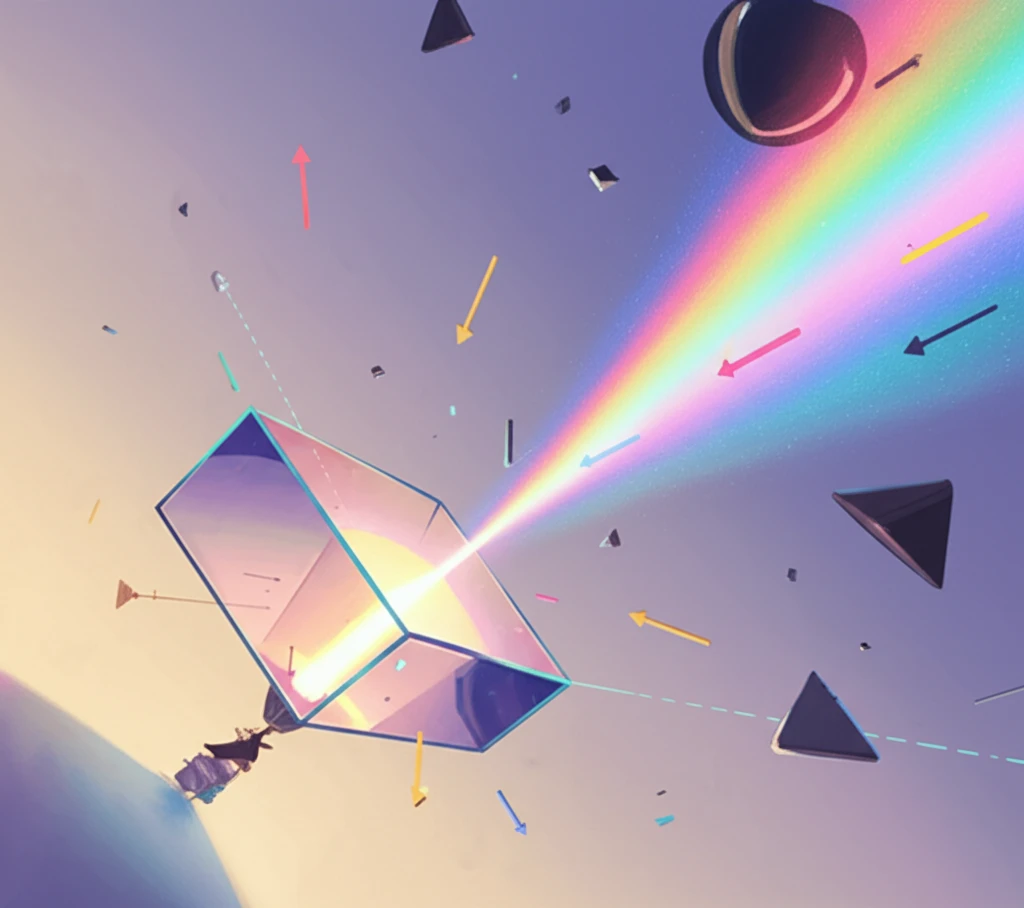
Refraction Revolution: A Simpler Path to Understanding Light's Bending Ways

"Unlock the mysteries of light refraction with a new, intuitive approach that simplifies complex physics for students and enthusiasts alike."
Light refraction, the bending of light as it passes from one medium to another, is a cornerstone concept in physics. Traditionally, it's taught using a mix of wave theory, ray diagrams, and complex electromagnetic principles. While these methods are effective, they can often feel abstract and challenging, especially for students encountering the topic for the first time. Classic textbooks, while thorough, sometimes present refraction as a mere 'deviation from a path,' leaving learners grappling with the underlying 'why' and 'how'.
The traditional explanation involves Snell's Law, a mathematical relationship that dictates the angles of incidence and refraction. While precise, Snell's Law can obscure the intuitive understanding of what's actually happening to light at the interface between two materials. The second part of refraction laws which emphasizes that the incident ray, the normal to the surface, and the refracted ray must lie on the same plane of incidence, essential but not always immediately clear to newcomers.
But what if there was a way to simplify refraction, making it more accessible and intuitive without sacrificing accuracy? Recent research introduces just that: a reformulation of the laws of refraction designed to enhance conceptual understanding and problem-solving skills, particularly for those in their early encounters with geometric optics. This article delves into this innovative approach, revealing its potential to transform how we teach and learn about light refraction.
Refraction at a Glance: Where the Numbers Land
Refraction is the change in direction of light when it passes from one medium to another, a definition echoed across classroom resources and hands-on experiments alike. The mechanism behind it is well established: because light travels at different speeds in different materials, entering a denser medium slows the wavefront and bends its direction. The impact of this principle extends beyond optics textbooks, as steel ladle linings alone consume 25 percent of all refractories produced worldwide, according to industry statistics tracking the high-temperature industries that depend on such materials. In geophysics, refraction statistics describe a separate but related technique in which first-break energy on shot records is used to calculate corrections for seismic exploration. Taken together, these figures and methods show refraction's reach across physics, engineering, and resource extraction.
The Standard Model of Refraction and Where It Falls Short
The standard treatment of atmospheric refraction assumes a predictable Earth curvature, commonly modeled with a factor of 7/6 times the Earth's radius, and predicts that celestial objects near the horizon appear elevated and remain visible longer than simple geometry would suggest. Refraction affects all electromagnetic radiation, not just visible light, though to varying degrees; in the visible spectrum, blue light bends more than red, which can make astronomical objects appear dispersed into a spectrum in high-resolution images. Yet the standard approach has well-documented limits. When light passes through non-corresponding lenslets in confocal lenslet arrays, for instance, it may be absorbed or form ghost images, constraining the field of view. Such failures show that idealized refraction models, while powerful for standard cases like lens imaging, break down at edges, interfaces, and complex optical systems.
A Legacy Written in Broken Light
The very word refraction carries the history of the concept: it derives from a Latin term meaning literally broken back, describing how a ray of light appears to snap when it passes from one transparent material into another. Foundational observations of this bending predate modern physics, and the classic demonstrations remain vivid today, including rainbows forming in the sky, rainbow-like bands cast when white light passes through a glass prism, and a pencil appearing bent when dipped in water. Early accounts established that refraction occurs at the boundary between two media, where the speed of light differs from one medium to the next. The insight also proved general, as other kinds of waves, such as sound passing from one medium into another, undergo the same kind of refraction.
A Fresh Perspective on Refraction
The new formulation proposes a shift in perspective: instead of focusing on angles, it emphasizes what happens to the components of light's direction as it crosses the boundary between two media. Imagine light as a vector, with both horizontal and vertical components. The key idea is that the component of this vector parallel to the surface changes proportionally to the relative refractive index between the two materials. In simpler terms, the 'sideways' part of light's motion is altered, while the overall direction adjusts accordingly.
- When light is refracted, its component parallel to the surface separating the two media is multiplied by the relative refractive index.
- This adjustment maintains the light's presence within the plane of incidence.
- The third component value can be determined by its vector total value being 1.
New Tools, New Findings, and Persistent Gaps
Recent research on light refraction spans instrumentation, medicine, and education. Phys.org reports that researchers at the University of Tokyo have built a microscope able to detect a signal over an intensity range 14 times wider than conventional microscopes, extending what can be resolved through optical systems. In ophthalmology, an optical-bench evaluation examined the latest refractive enhanced depth of focus intraocular lens, assessing its performance for vision correction. On the teaching side, studies of student misconceptions about light refraction report the lowest misconception level of 10.4 percent on the light refraction indicator, showing how stubbornly even well-taught ideas resist understanding. Interactive simulations, such as the PhET Bending Light activity, have become standard tools for letting learners see how changing the medium, from air to water to glass, changes the bending angle.
When Bending Light Refuses to Cooperate
Refraction is not an unconditional rule; it has well-defined failure conditions. Because the speed of light changes as it moves between media, the angles of refraction can be calculated from known speeds or wavelengths, and at the critical angle light can no longer pass into the second medium, reflecting entirely instead. A Physics Forums thread working through a classic air-to-glass problem shows how the critical angle is routinely tested in practice. There are also structural limits to refraction-based measurement methods: as one physics tutorial notes, if velocity decreases at an interface, critical refraction cannot take place and no refracted energy returns to the surface, so the method simply goes blind to certain layers. Hidden layers and blind zones are among the known shortcomings of such methods.
Refraction vs. Reflection and the Physics of Dispersion
Refraction and reflection are the two basic behaviors of light that are studied alongside one another in geometrical optics. Reflection describes light bouncing back into the previous medium, while refraction describes light bending as it passes from one medium into another, a distinction drawn consistently across physics references. The refractive index of a material varies with the wavelength of light, so the angle of refraction changes correspondingly; in a prism, violet light bends the most and red the least, producing the familiar rainbow of dispersion. Optical prisms and lenses exploit this wavelength dependence to redirect and separate light, and the human eye itself relies on refraction to form images.
Simplifying the Complexities of Light
This new formulation offers a promising avenue for making the laws of refraction more accessible and intuitive. By shifting the focus from angles to vector components, it provides a fresh perspective that can enhance conceptual understanding and problem-solving skills. As educators continue to explore innovative teaching methods, this approach may well become a valuable tool in illuminating the fascinating world of optics for students of all levels.
The Essence, in Plain Terms
At its simplest, refraction is what happens when light waves bend as they pass through different media, and the effect grows as the refractive behavior of the second medium increases. Expert explanations frame the angle of refraction as the angle between the light wave and the normal, giving learners a concrete way to measure the bend. Practical examples bring the idea home: when light from air strikes a nanoparticle suspended in water, it refracts at the air-water boundary, and its wavelength changes by a factor of 1.33. Even familiar sights, like a straw appearing to bend in a glass of water, are everyday reminders of the same physics at work.
Still Bending, Still Being Discovered
The study of light refraction remains an active area of research, with scientists continually discovering new materials that possess unique refractive properties. This ongoing hunt suggests that the practical limits of what can be bent, split, and directed by refraction are far from settled. Public curiosity keeps pace, as users continue to search for and share ideas about light refraction in water, evidence of sustained interest in simple demonstrations of the phenomenon. As both the underlying science and the teaching of it evolve, the frontier of refraction is likely to keep expanding toward new materials and new applications.
Refraction's Reach Beyond Physics
Even the basics of refraction can confound careful observers: a Physics Stack Exchange question asks why a light beam hitting the curved face of a half-circle glass block does not refract until it reaches the flat surface, an observation the asker replicated in real life because a ray striking at the normal passes straight through. The same optical vocabulary has migrated into other domains, where it carries new weight. In design, a refractive UI concept proposes that interfaces should acknowledge their own distortions rather than pretend to be neutral, using light literally and metaphorically to expose uncertainty, bias, and fallibility. Refraction, in other words, functions both as a physical law and as a metaphor for how systems reveal and conceal.
From Classroom Confusion to Everyday Sight
People encounter refraction constantly, yet misconceptions about it persist, a gap that educators and tutors say highlights why understanding the principle matters in real-world applications. In everyday environments the medium light travels through is rarely uniform, and this heterogeneity changes how much light bends in practice, something explorations of real-world light bending emphasize. The basic definition is simple enough to teach: refraction is the bending of a light ray as it passes from one transparent medium into another, because light changes speed when it enters the new medium. Presentations and tutorials alike lean on this phrasing to make the invisible mechanism of bending visible to students.