
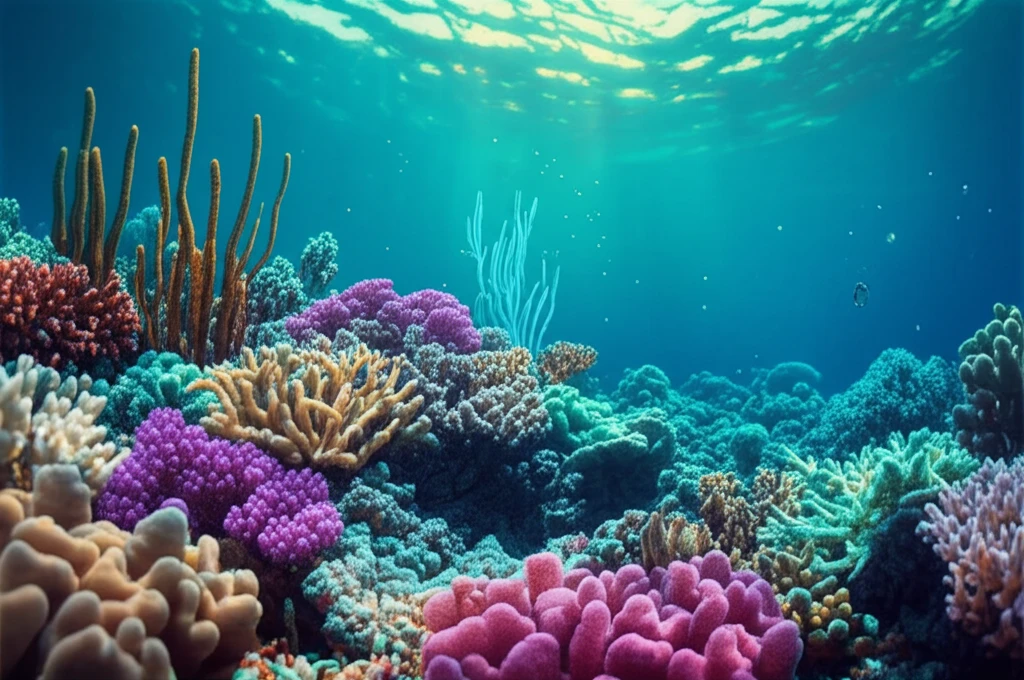
Reef Revival: How Algal Turf Sediments Hold the Key to Coastal Reef Health

"Uncover the crucial role of algal turf sediments in maintaining the health of the Great Barrier Reef and other coastal reefs. Learn how managing these sediments can help protect these vital ecosystems from terrestrial threats."
Coral reefs, vibrant ecosystems teeming with life, are under increasing threat. Among the most pressing dangers is the surge in sediment runoff, a consequence of coastal development, agriculture, and dredging. Sediments, while a natural part of the reef environment, can become a major stressor when their quantity overwhelms the delicate balance. Increased sediment inputs cloud the waters, smother corals, and disrupt the intricate web of life that these underwater cities support. These stressors are often overlooked but significantly contribute to reef decline.
While the focus often remains on suspended sediments and direct sedimentation on corals, there's a hidden world of sediment dynamics happening within the epilithic algal matrix (EAM). The EAM, essentially the 'turf' of algae, sediment, and detritus that blankets much of the reef surface, acts as a major sediment trap. Understanding how this process works, especially in coastal reefs facing the brunt of terrestrial runoff, is critical for effective conservation.
A groundbreaking study published in "Marine Pollution Bulletin" sheds light on the critical role of algal turf sediments in coastal reef ecosystems, specifically along Australia's Great Barrier Reef (GBR). The research uncovers how these sediments differ dramatically between coastal and offshore reefs and how this knowledge can inform better management practices to protect these precious environments.
The Overlooked Role of Reef Sediments
Reef sediments and their associated bacterial communities are essential for reef productivity and stability, yet they are often overlooked in reef assessments. Recent work has examined bacterial communities and environmental properties in sediments closely associated with the coral Porites lutea to address this gap. On a Red Sea fringing reef under extreme environmental conditions, sediment grain-size distributions remained fairly consistent over time, even as parrotfish bites on Porites corals increased after 2006. Studies also track the seasonal variability of calcium carbonate precipitation and dissolution in shallow coral reefs, using surface seawater and pore water inorganic carbon chemistry measurements collected from the Bermuda coral reef platform between 2007 and 2012.
Measuring Sedimentation: Conventions and Gaps
Many methods have been developed to monitor different reef components, and major coral reef monitoring programs have refined and integrated protocols that researchers are encouraged to adopt. Sediment traps have become the standard method for monitoring sedimentation in coral reef environments, though their use and misuse have drawn criticism. One limitation is that sediment research has focused largely on quantifying production sources, suspended sediment, and trapping or accumulation rates while overlooking the role of hydrodynamics and reef morphology in determining these patterns. This matters because, globally, many coral reefs have fallen into negative carbonate budget states, where biological erosion exceeds carbonate production.
Foundations of Reef and Sediment Science
A coral reef is an underwater ecosystem formed of colonies of coral polyps held together by calcium carbonate, built largely by stony corals whose polyps cluster in groups. Reefs are often called the 'rainforests of the sea' because they are home to a spectacular variety of organisms. Foundational researchers such as David Stoddart helped establish reef science, including work on the nature and origin of coral reef islands published in 1977. Later sediment-focused studies, such as an examination of unconsolidated coral reef sediments from Maui Bay on Viti Levu, Fiji, describe the origin and characteristics of reef sediment deposits in a site declared a Marine Protected Area by traditional owners in 2000.
The Hidden World of Algal Turf Sediments
The study highlights a stark contrast between coastal and offshore reefs in terms of algal turf sediment loads. Coastal reefs, closer to land-based sediment sources, bear a significantly higher burden. The research team found that, on average, coastal reefs accumulate 9.4 times more sediment within their algal turfs compared to their offshore counterparts. This massive difference underscores the vulnerability of coastal reefs to land-based activities.
- Coastal reefs have significantly higher algal turf sediment loads than offshore reefs.
- Sediment composition varies greatly among coastal reefs.
- The type of sediment affects the health and function of the reef ecosystem.
- Proximity to rivers and local hydrodynamics influence sediment dynamics.
Reassessing Sediment as an Ecological Driver
Sediments are widely accepted as a threat to coral reefs, but current understanding of their ecological impacts is limited. Research on high-energy coral reefs has begun to probe the ecological consequences of sediment directly rather than treating it only as a physical stressor. Reviews of turbid coral reefs examine the interplay of turbidity, sedimentation, climate change, and resilience in reef systems. One practical limitation identified is that reef coring campaigns are often restricted to reef flats where equipment can be operated subaerially during low-tide windows, which has constrained the scope of sediment studies.
Land Management as the Missing Lever
A key counterargument is that reefs cannot be saved by marine-side measures alone and that land must be managed to protect them. Computer simulations of sediment released near coral reef areas for the present day and 2090, run under different scenarios of projected temperature and rainfall while also modeling the effect of reduced or increased forest cover, support this land-first view. Sedimentation runoff reduces the clarity of coastal waters and restricts the growth of light-dependent plants and animals, including corals. Because light is fundamental to coral growth and survival, the argument holds that controlling runoff at its terrestrial source may be more decisive than managing sediment within the reef itself.
Comparing Sediment Approaches Across Reefs
Direct comparisons of sediment-focused management and research approaches across reef systems are difficult because studies differ widely in methods, sites, and time scales. Available evidence generally suggests that the ecological significance of reef sediments varies considerably by setting, but the picture remains incomplete without more standardized comparative work. Any broad conclusions about which approach best protects reefs should therefore be treated as provisional.
Protecting Our Reefs: A Call to Action
The study serves as a critical reminder of the interconnectedness between land and sea. By reducing sediment runoff through sustainable land management practices, improved coastal planning, and responsible agricultural techniques, we can directly alleviate the pressure on these vulnerable ecosystems. Further research is needed to fully understand the long-term consequences of altered sediment dynamics and to develop targeted strategies for reef restoration and resilience. Protecting our reefs requires a holistic approach that considers the often-overlooked role of algal turf sediments and the critical link between terrestrial activities and marine health.
Microbiomes as a New Window on Sediment Health
Expert-led programs are bringing sediment analysis into reef management practice. Florida's Coral Reef Conservation Program, housed within the Office of Resilience and Coastal Protection, has conducted detailed analyses of sediments from Port Everglades Inlet, including microbiome characterization. To determine whether communities change over time, researchers combined the 2020 and 2021 microbiome datasets to assess temporal changes over a one-year period. Such multi-year microbial monitoring suggests a shift toward more integrated, data-rich assessments of sediment condition as part of coral reef conservation.
Decalcification and Resilience on the Horizon
Experimental coral reefs demonstrated the highest net calcification rates and lowest rates of coral mortality under preindustrial conditions, suggesting that business-as-usual CO2 emissions will drive future reef decalcification. Rapid ocean warming poses a key risk even if the goals of the Paris Climate Agreement are achieved. Projections of future ocean warming and the associated increased frequency of coral bleaching make coral reefs highly susceptible to further decline. In the Pacific, sediment plumes attributed to logging activities have been linked to reduced coral growth in some locations.
Sediment Dynamics in a Shoreline Protection System
Coral reefs protect shorelines by reducing the impact from waves, storms, and floods, helping prevent loss of life, property damage, and erosion. When reefs are damaged or destroyed, coastal communities can suffer increased damage from severe storms. Sediment dynamics are central to these systemic functions, as resuspension of sediments can exert a fundamental control on the survival of some coral reefs. In a daily rhythm, sediments resuspended during higher-energy daytime conditions settle during the calmer evenings only to be resuspended again the next day.
The Human Stakes of Sediment-Driven Reef Decline
Researchers warn that coral reef sediments around the world will trend toward dissolving when seawater reaches a tipping point in acidity, which is likely to occur well before the end of the century, putting reef ecosystems that support tourism at risk. Understanding event-driven sediment transport, such as the impact of Hurricane Irma on reef sediments, is essential to assessing impacts on reef species, habitats, restoration, and mitigation, yet a global knowledge gap remains due to limited quantitative studies. Much of the existing research on sedimentary dynamics in reef environments has focused on terrestrial sediment runoff and its impact on coral health, leaving the economic and human consequences of sediment-driven reef loss only partially understood.