
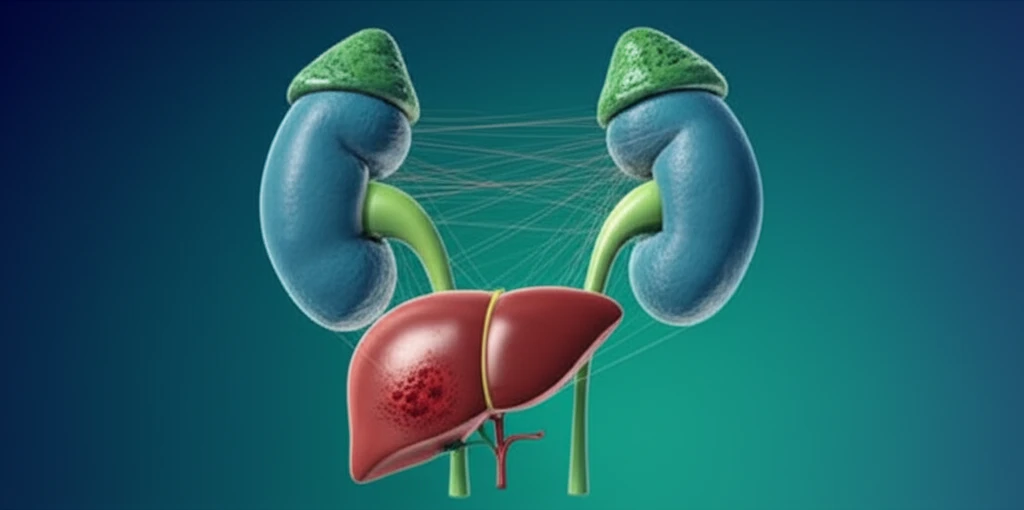
Rare Case Studies: When Liver Cancer Spreads to the Adrenal Gland

"Uncommon Instances of Adrenal Metastasis Following Liver Cancer Treatment Highlight the Importance of Vigilant Monitoring"
Liver cancer, also known as hepatocellular carcinoma (HCC), is a major health challenge worldwide. The good news is that advances in diagnostic techniques and treatments have significantly improved survival rates for liver cancer patients. With patients living longer, doctors are paying closer attention to how liver cancer can spread, or metastasize, outside the liver.
Metastasis isn't uncommon in liver cancer, with the lungs being the most frequent site of spread. Other areas, like the lymph nodes, bones, and adrenal glands, are also sometimes affected. Usually, when liver cancer spreads, it's found alongside the original tumor in the liver. However, it's rare to find metastatic liver cancer after the primary tumor has been successfully treated.
Treating liver cancer recurrence or metastasis can be difficult, and outcomes are often poor. Doctors have several options for managing liver cancer that comes back within the liver, including repeat surgery, chemoembolization (blocking blood supply to the tumor), injecting alcohol directly into the tumor, and using heat to destroy the cancer cells. But when liver cancer spreads outside the liver, especially when there's no recurrence within the liver itself, deciding on the best course of action can be complicated. This article explores rare cases where liver cancer spread to the adrenal glands after the primary tumor was removed, offering valuable insights into monitoring and treatment strategies.
Clinical Rarity and Disease Burden
The adrenal gland is described as a common metastatic site for hepatocellular carcinoma (HCC), yet adrenal metastases are rarely seen in clinical practice because HCC has lower metastatic potential than other malignancies. One reported case involved adrenal metastasis as the first presentation of HCC in a 76-year-old man with markedly increased tumor markers but no initial liver masses. By contrast, adrenocortical carcinoma is a rare malignant tumor with poor prognosis; local recurrence or distant metastases occur in more than 50% of cases, and fewer than 15% of patients with metastases have 5-year survival.
Tracing Origins and Recognition
Reports describe liver-to-adrenal metastases as extremely uncommon and emphasize detailed evaluation of the liver and other potential metastatic sites. Molecular studies have identified adult hepatocytes as the cell of origin for liver cancer, supporting research into carcinogenesis and therapeutic options. Broader analyses report that secondary liver malignancies are 18 to 40 times more frequent than primary liver cancer and mainly arise from metastases of tumors located in the gastrointestinal tract, breast, and other sites.
Understanding Adrenal Metastasis in Liver Cancer
The adrenal glands, located above the kidneys, are potential sites for cancer to spread from other organs. However, adrenal metastasis from liver cancer is not very common. When it does occur, it's often detected either when the primary liver tumor is diagnosed or simultaneously with the recurrence of liver cancer within the liver.
- Rarity: Adrenal metastasis without any recurrence of liver cancer in the liver is extremely rare.
- Detection: It is usually found when the primary liver cancer is diagnosed or alongside intrahepatic recurrence.
- Significance: Reports of such cases can help doctors understand the behavior of liver cancer and improve treatment strategies.
Isolated Adrenal Recurrence
A case report and literature review described one of the few reported cases in the United States of an isolated contralateral adrenal metastasis occurring two years after resection of a primary right hepatic lobe HCC. Another report documented adrenal metastasis from HCC without intrahepatic recurrence after hepatic resection. In that case, fluorodeoxyglucose positron emission tomography/computed tomography detected the adrenal metastasis.
Clinical Context and Complications
A single-center study in southern Turkey evaluated 226 patients with liver cirrhosis, of whom 35 were diagnosed with HCC on first admission or during follow-up between 1999 and 2002. A separate report found that ruptured HCC occurred in 4.7% of 85 patients. These studies address different clinical features and populations, so their figures should not be interpreted as directly comparable measures of adrenal metastasis.
The Importance of Vigilant Monitoring and Treatment Strategies
The occurrence of liver cancer spreading to the adrenal glands after successful liver resection underscores the necessity for ongoing monitoring and customized treatment approaches. Although such instances are infrequent, they emphasize the significance of recognizing and addressing unusual patterns of cancer dissemination. By sharing these experiences, medical experts can enhance their comprehension of liver cancer and refine treatment protocols for improved patient results.
Improving Metastatic Control
Adrenocortical carcinoma liver metastases are described as having particularly aggressive biology, with higher growth rates than metastases to other sites. Current systemic therapy regimens have low response rates, while multiple studies have documented benefits from local control, including metastasectomy. A separate study analyzed future trends in metastatic cancer incidence, 5-year survival after diagnosis, and the locations to which cancers spread, highlighting the importance of tracking both outcomes and metastatic patterns.
Individual Cases, Complex Decisions
A 2024 case described a 65-year-old man with suspected metachronous left-sided adrenal metastasis seven years after bisegmentectomy for HCC. He had also undergone trans-arterial chemoembolization for multifocal intrahepatic recurrences while listed for liver transplantation beyond Milan criteria. Another report described a 69-year-old Hispanic man with chronic hepatitis C and no history of malignancy whose solitary 5 cm adrenal mass was found incidentally during CT surveillance for high-risk liver disease; biopsy identified metastatic poorly differentiated HCC.