
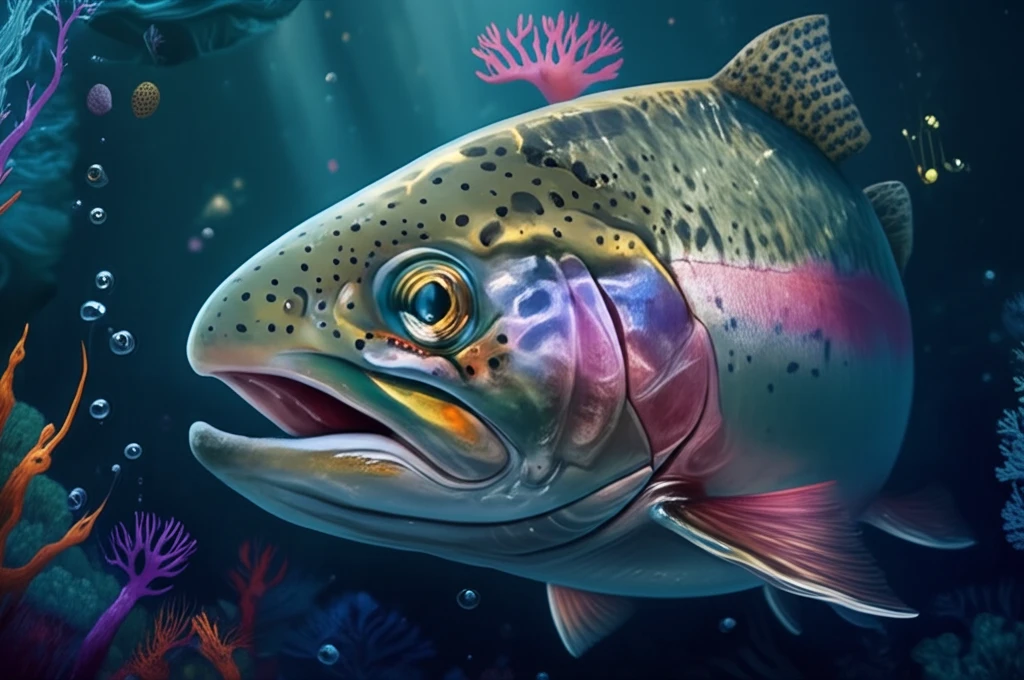
Rainbow Trout Vision: How Fish Eyes Reveal Secrets of Sight

"Uncover the hidden complexities of rainbow trout vision and how their unique eye functions can provide valuable insights into understanding visual processing in all species."
Understanding how living beings interpret visual information is fundamental to understanding their interaction with the world. Vision relies on precise mapping of retinal information in the brain. Local brain circuits encode specific features, interpreting the complexities of our surroundings. In non-mammalian species, the optic tectum is the primary target for these ganglion cell projections, making it a key area for studying visual processing.
While the basic topography of retinotectal projections—how the retina maps to the brain—has been documented, the dynamic aspects of visual processing remain less explored. How do spatial and temporal patterns of activity arise, and how do these patterns adjust to different backgrounds? Such questions drive current research into the functional organization of vision.
Recent studies combining electrical and optical recordings shed light on how ganglion cell projections map to the optic tectum in rainbow trout. These studies reveal the spatial and chromatic distribution of ganglion cell fibers responsible for interpreting increments (ON) and decrements (OFF) of light. These findings highlight a highly dynamic visual system, that is likely determined by a combination of biased projections and specific retinal cell distributions.
Trout Vision Across Species
Rainbow trout, brown trout, and brook trout all possess cone cells in their eyes that enable color vision, though their perception differs significantly from human vision. Research shows that these three species have different relative proportions of visual pigments in their retinae, suggesting each species is adapted to its specific photic environment. Brook trout, rainbow trout, and brown trout are noted to have labile binary visual pigment mixtures that may serve as useful adaptations for making adjustments to vision in variable light conditions. Their color perception, while present, is governed by a different arrangement of cone cells than what humans possess.
Methods and Limits of Measuring Trout Sight
Trout vision research has identified specific limitations in how trout perceive color. Green is particularly difficult for trout to see clearly, especially at a distance, though it is not invisible to them. At night, trout lose all color perception as the cone cells in their eyes disengage entirely, forcing reliance on rod cells that provide only black-and-white vision. While trout compensate for this nocturnal limitation through other senses, their night vision is not as acute as that of species like bass. These sensory shifts between day and night represent a key methodological consideration for anyone studying or observing trout behavior under different lighting conditions.
Rare Variations and Conservation Context
The scientific understanding of trout coloration and vision has evolved alongside broader conservation efforts. Blue trout, which range from sky blue to dark blue, represent a rare but naturally occurring genetic mutation primarily found in hatchery-produced rainbow trout, and even more rarely in brown trout. Meanwhile, native wild trout populations in regions such as Greece face mounting pressures from artificial barriers, changes to river channels and water flows, and illegal fishing, underscoring the importance of understanding trout biology in a conservation context. These twin threads of genetic variation and environmental threat frame the historical context in which trout vision research has developed.
Decoding the Retinal Map: Segregation of ON and OFF Pathways
The functional organization of the retina in rainbow trout is intricate, with distinct pathways for processing increases (ON) and decreases (OFF) in light. These pathways are not uniformly distributed; instead, they exhibit spatial segregation within the optic tectum. This segregation allows the fish to process visual information more efficiently, enhancing its ability to detect and respond to changes in its environment.
- Spatial Segregation: ON and OFF pathways are distinctly separated within the optic tectum.
- Chromatic Adaptation: Sensitivity and response latency of cone mechanisms are adjusted based on light conditions.
- Dynamic Patterns: Segregation of fiber types leads to dynamic patterns of visual input.
- UV Cone Specialization: Input from UV cone mechanisms is restricted to specific areas of the optic tectum.
Spectral Properties of Trout Visual Pigments
Studies of rainbow trout visual pigments have mapped spectral characteristics across the visible spectrum, building on foundational work by researchers including Dartnall, Lythgoe, and Bridges dating to the mid-twentieth century. Research published in Vision Research established that the relationship between visual pigment absorption and wavelength is linear for the red-green portion of the spectrum in trout. More recent work has examined both chromatic and monochromatic optical resolution capabilities in rainbow trout, contributing to a more complete picture of how these fish process visual information. The accumulation of spectral data across decades continues to refine models of trout retinal sensitivity.
Limitations of Current Knowledge
Understanding trout vision faces inherent challenges and gaps in current research. The field remains constrained by methodological limitations, and not all aspects of trout visual processing are fully understood or agreed upon by researchers. While the broad principles of trout color perception are established, specific questions about how trout integrate visual information with other sensory inputs in complex environments remain areas of active inquiry.
Vision, Lateral Line, and Species Differences
Comparative studies reveal that trout rely on a combination of visual and non-visual senses depending on environmental conditions. Research on rainbow trout in turbulent flow found that the lateral line, rather than vision, plays the larger role in affecting body kinematics when trout hold station in a vortex street. Trout also show a preference for Kármán gait in the light but not in the dark, a behavioral shift that may be attributed to physiological state rather than hydrodynamic or sensorimotor reasons. In terms of color perception, trout do not see green or yellow the way humans do; instead of perceiving these hues distinctly, trout see different shades of a muddy brown color.
Implications for Understanding Visual Systems
The functional organization of the retina in rainbow trout serves as a model for understanding visual processing in other species. The dynamic interplay between spatial segregation, chromatic adaptation, and cone mechanism specialization highlights the complexity and adaptability of visual systems. Further research into these mechanisms will continue to reveal the intricate ways that animals perceive and interact with their environment.
Converging Findings
Across the research literature, a consistent picture emerges: trout possess functional color vision that is distinctly different from human perception, with visual pigments tuned to the specific light environments they inhabit. The interplay between rod and cone cells gives trout a dual-mode visual system that shifts dramatically between day and night conditions. While specific details of trout visual processing continue to be refined, the foundational science points to a species highly adapted to its aquatic light environment.
Advancing Trout Vision Research
Ongoing research into trout vision continues to explore how these fish perceive their underwater world, including how turbidity and water clarity affect visual acuity. Future studies may further illuminate how trout integrate visual information with other senses like the lateral line to navigate complex aquatic environments. As research methods improve, a more nuanced understanding of trout visual ecology is expected to emerge, with potential applications in fisheries management and conservation.
Ecological Implications
Trout vision research sits within the broader context of aquatic ecology and fisheries science. Understanding how trout perceive their environment has implications for habitat management, as water quality and clarity directly affect the visual conditions under which trout feed, avoid predators, and navigate. Climate change and human alteration of waterways present ongoing systemic challenges that may alter the photic environments trout depend on, making continued research into their visual ecology an important component of conservation efforts.
Practical Applications of Trout Vision Science
Research into rainbow trout retinal sensitivity has revealed that these fish possess a secondary level of sensitivity in the ultraviolet portion of the spectrum, as demonstrated by measurements of the beta-band in retinal sensitivity. However, this UV sensitivity was observed only after removing the cornea, lens, and other ocular media, meaning the actual UV light reaching the retina in a living fish may be attenuated by these structures. This finding has practical implications for anglers selecting lures and for researchers studying how trout interact with their visual environment under natural conditions.