
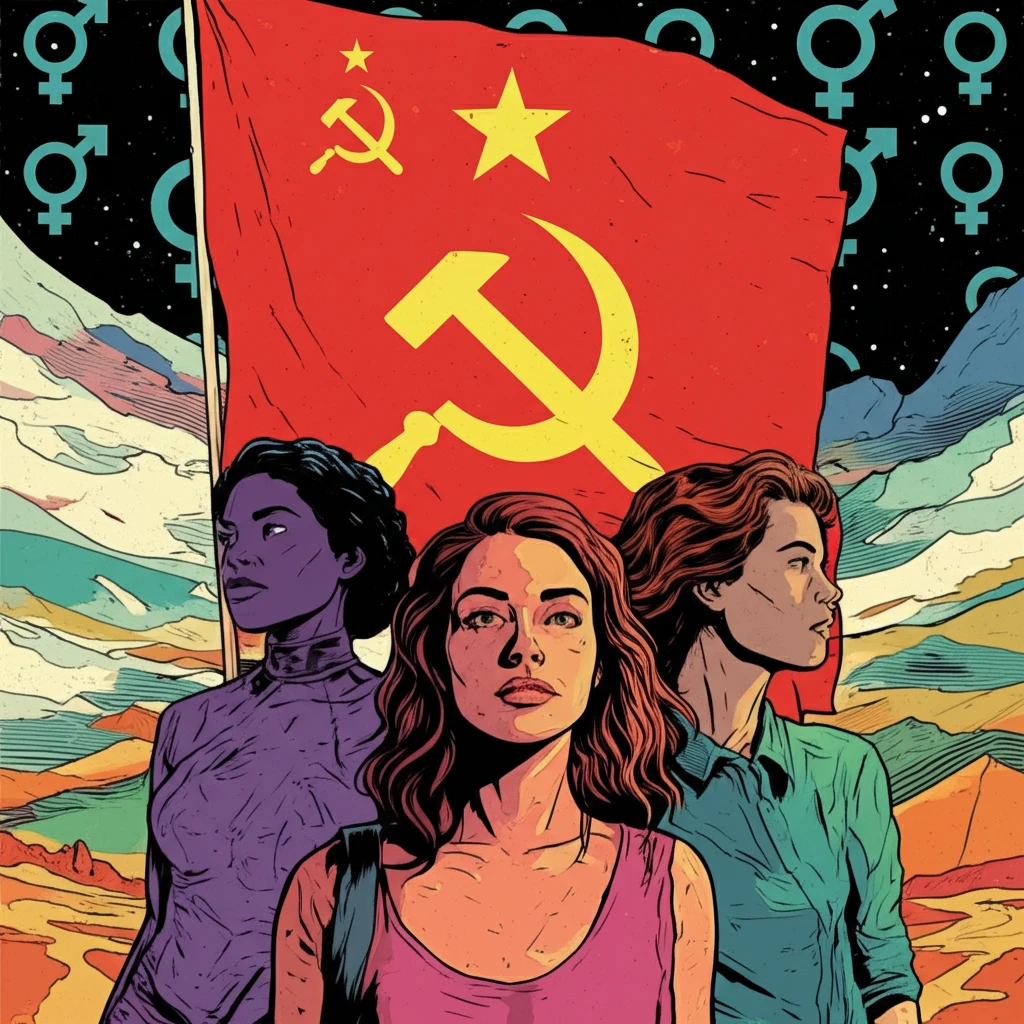
Radical Women: How Gender Shaped the Communist Party's Rise and Fall

"Uncover the untold stories of Dorothy Healey, Kendra Alexander, and Charlotte Anita Whitney and their impact on the CCP."
In the annals of history, the contributions of women are often overshadowed, their stories relegated to the footnotes of grand narratives. This is particularly true within the context of radical political movements, where the focus tends to be on ideologies and overarching strategies, rather than the individuals who shaped them. However, a closer examination reveals that women have played pivotal roles in these movements, bringing unique perspectives and approaches to the forefront.
Beth Slutsky's book delves into the lives of three remarkable women who held leadership positions within the Communist Party of California (CCP). Through their biographies, Slutsky explores the CCP's evolution, its relationship with the national structure, and the regional and national impact of each woman. By examining their experiences, the book seeks to understand whether gender played a distinctive role in shaping the radical doctrines and practices of the CCP.
The central question that emerges is whether gender truly made a difference in the CCP's radicalism. Did these women's experiences as women influence their leadership styles, their priorities, and their interactions within the party? The book navigates this complex terrain, offering insights into the challenges and triumphs of women in a male-dominated political landscape.
Current Statistics & Impact
Data on China's political elite from 1997 through July 2021 shows the composition of Central Committee members, provincial standing committees, and vice governors. In higher political bodies like the NPC Standing Committee, women constitute only 16.6%, with participation declining as political influence increases. Research across 80 countries from 1991-2015 examines how communist legacies shape women's political rights and gender equality. Globally, women remain underrepresented at all decision-making levels, with gender parity in political life still far from reach.
Standard Approach, Accepted Methods & Their Limitations
The Communist Party's approach to women's issues was shaped primarily by Comintern directives and secondarily by its own analysis of working-class women's needs. The Communist Party of Canada established a Women's Department within two years, added a women's column to its newspaper, and formed the Women's Labor Leagues as a national organization. While communist parties introduced significant legislation improving women's rights, cultural attitudes and sexism persisted. Personal bravery of women confronting fascist violence and theoretical debates about gender equality remain part of this legacy.
Historical Perspective, Milestones, Foundational Discoveries
A global history of communist women centers 25 political biographies of activists like Fanny Edelman and Deng Yingchao who co-constructed communism while occupying leading positions. Historiography has often neglected these achievements, framing communist women as mere functionaries rather than leaders. These activists understood women's oppression intersectionally, advocating for political, social, and economic rights beyond narrow liberal feminist frameworks. The Communist Women's International launched in April 1920 as an autonomous offshoot of the Communist International to advance communist ideas among women.
Dorothy Healey and Kendra Alexander: Shaping the CCP from Within
The chapters dedicated to Dorothy Healey and Kendra Alexander stand out as particularly insightful. Slutsky aptly characterizes the CCP during Healey's tenure as 'Healey's Party,' underscoring the profound influence she wielded. Healey's distinct leadership style, priorities, and hands-on approach indelibly shaped and branded the organization. Her adept governance earned her the moniker 'Red Queen,' solidifying her reputation as a savvy and effective leader.
- The party's attitude toward gender equality remained largely unchanged despite their efforts.
- Feminism was often viewed as secondary to the party's broader goals.
- The party's structure and culture remained largely male-dominated.
Latest Research and Reviews
Recent scholarship continues to examine the complex relationship between communist movements and women's political advancement, though comprehensive syntheses remain limited. Emerging studies employ intersectional frameworks to reassess how gender, class, and party politics interacted across different national contexts. Methodological debates persist about how to measure women's agency within highly structured party hierarchies. The field would benefit from more comparative work that traces both continuities and ruptures in communist gender policies over time.
Counter Arguments and Failures
The legacy of communism on women's political representation is contested, with historical legacies playing a significant role in post-communist outcomes. After 1989, women's political representation did not improve; limited legal protections from the communist era eroded, causing dramatic drops in parliamentary representation. In the West, feminism operated as a social movement pushing for change, while in the Communist Bloc, women's emancipation was driven by state and party institutions rather than autonomous organizing. This institutionalized approach may have created fragile gains that collapsed with regime change.
Comparative Analysis
Comparative research on communist women's movements across national contexts reveals both shared patterns and significant variations in how gender politics were integrated into revolutionary projects. Different parties interpreted Comintern guidance through local conditions, producing diverse organizational forms and policy outcomes. The tension between universalist communist rhetoric and culturally specific gender regimes shaped women's experiences in complex ways. More systematic cross-national work is needed to map these variations and their long-term consequences.
A Missed Emphasis: Gender as Peripheral in Revolutionary Movements
While Slutsky rightly emphasizes the valuable leadership roles of these women, her analysis of feminism's role is somewhat misplaced. Gender was not a central struggle for revolutionaries, and women's issues often remained peripheral to the cause. Her work provides a trenchant examination of womanhood within the California Communist Party, and that should have been her primary focus. The book serves as a reminder of the complexities and challenges faced by women who sought to make their mark in radical political movements.
Synthesis & Expert Commentary
Women members of the Communist Party USA have made major contributions to a wide variety of people's struggles and victories throughout U.S. history. Their activism spans labor organizing, civil rights, anti-fascist resistance, and feminist movements, demonstrating the breadth of communist women's political engagement. The party's own educational materials highlight these contributions through historical quizzes that test knowledge of key figures. This recognition underscores the ongoing relevance of communist women's historical legacy.
Future Outlook & Next Frontiers
Building women's participation in leadership requires grounding analysis in Marxist understanding of women's conditions under capitalism to fight for working-class unity. Developing analysis of the current political moment at local, national, and international levels is seen as essential. In China, the party faces demographic crisis and economic slowing while pushing women back into domestic roles, calling on them to rear children amid what it views as a stubborn rise of feminism. This tension between state pronatalist policies and women's autonomy signals ongoing contestation over gender roles in communist contexts.
Broader Context & Systemic Challenges
Women's political power globally shows uneven progress despite an overall rise, with persistent barriers across a spectrum of nations. Structural obstacles to representation remain deeply embedded in political institutions, party systems, and cultural norms. The special issue literature highlights that formal gains in descriptive representation do not automatically translate into substantive influence. Intersectional inequalities compound these challenges for women from marginalized communities.
The Human Element & Real-World Impact
In the Communist Party of India (Marxist), formal rules and informal processes reproduce and contest hegemonic gender regimes, as revealed through Feminist Institutionalist analysis. The study examines how institutional belonging is negotiated through gendered expectations and power dynamics within the party structure. Women's experiences reflect both the transformative potential of communist organizing and the persistence of patriarchal norms within revolutionary movements. This micro-level analysis illuminates the lived reality behind macro-level statistics on representation.