
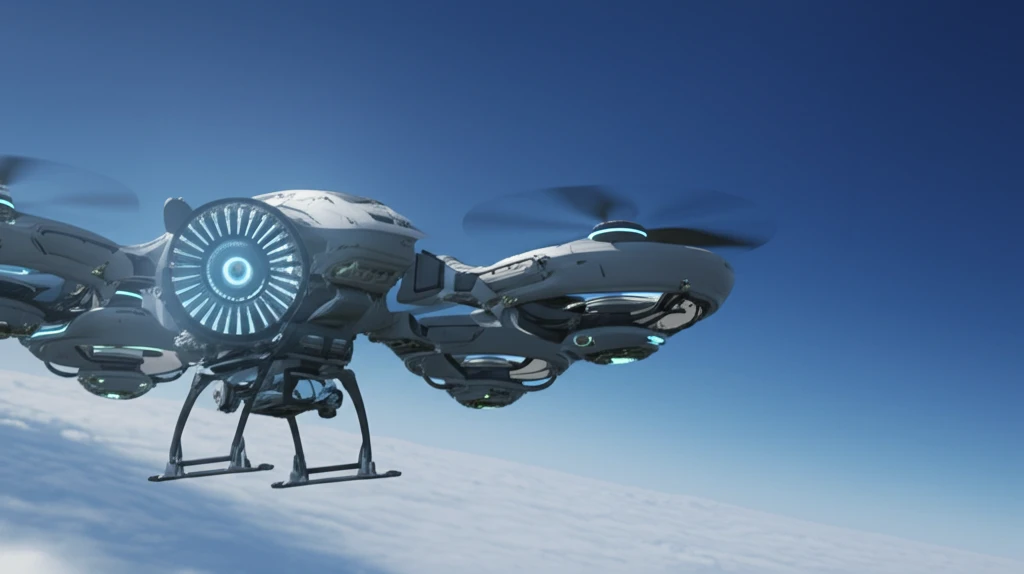
Power Up Your UAV: A Complete Guide to Propulsion Systems

"Discover the keys to efficient UAV flight! This guide covers everything from fuel-based engines to the latest in electric motor technology, ensuring your drone soars higher and longer."
In the dynamic world of unmanned aerial vehicles (UAVs), the propulsion system stands as the linchpin of successful flight. Whether you're an avid hobbyist or a seasoned professional, understanding the intricacies of UAV propulsion is crucial for achieving optimal performance. Every (non-glider) aircraft needs powerful, lightweight, and efficient ways to fly. For the small and medium UAVs, this means propellers. It's not easy to make propellers that change their angles, so usually, fixed-pitch propellers are used. Also, making new prime movers is expensive. This means that designers of small and medium UAVs often have to make hard choices to find the right propulsion from what's already out there.
The selection process involves navigating a landscape of trade-offs, balancing power, weight, efficiency, and cost. Long-endurance aircraft often benefit from gasoline-fueled internal combustion (IC) engines, leveraging multiple cylinders or engine configurations for sustained flight. Short-endurance systems, particularly those prioritizing low vibration, often favor battery-powered electric motors, a trend amplified by ongoing advancements in battery technology. Hybrid systems, combining IC engines and electric motors, offer yet another avenue for innovation, promising enhanced versatility and performance capabilities.
This article serves as your comprehensive guide to UAV propulsion systems, demystifying the technologies and strategies that power these remarkable machines. We'll explore the nuances of engine types, delve into the world of electric motors, examine the critical role of propellers, and shed light on the essential control systems that bring it all together. Let’s dive in.
The Growing UAV Propulsion Landscape
A UAV's propulsion system—comprising motors or engines, propellers, and electronic speed controllers—provides the thrust necessary to lift and maneuver the aircraft. Unmanned aerial vehicles can achieve greater mission flexibility, longer flight periods, and heavier payloads when equipped with purpose-built propulsion systems. Electric propulsion has gained significant traction in recent years, driven by advancements in battery technology, while hybrid, gasoline, and solar alternatives also serve the market. UAV assembly integrates the airframe, propulsion system, power system, and flight control and navigation systems into a single operational platform.
Component Selection and Integration Challenges
Selecting a propulsion system that delivers desired performance—matching motors, propellers, and batteries for electric UAVs—is a core engineering task, yet rigorous methods for doing so are not readily available in published literature. Hybrid propulsion approaches, such as engine-generator systems, have emerged to extend range, payload, and endurance beyond what electric-only systems offer. Commercially available kits like the T-MOTOR A6L, optimized for agricultural drones in the 16–33 kg class, illustrate how purpose-built ESC and propeller combinations target specific mission profiles. Identifying propulsion system behavior under off-nominal conditions, such as in-flight icing, remains an active area where simplified first-order models may not fully capture real-world dynamics.
Early Foundations of UAV Propulsion
UAV propulsion has evolved alongside broader advances in lightweight motors, battery chemistry, and small-engine design, though no single breakthrough moment defines the field's origin. The shift from hobby-grade radio-controlled aircraft to military and commercial platforms demanded propulsion solutions with far greater reliability and power-to-weight ratios. As battery energy densities improved over successive decades, electric multirotor configurations displaced earlier pneumatic and compressed-air concepts for small UAVs, reshaping the industry's technical trajectory.
Decoding Liquid-Fueled IC Engines
Liquid-fueled IC engines are a popular choice for small and medium-sized UAVs. These engines typically run on gasoline, methanol, or diesel, and come in two- or four-stroke configurations. When selecting an engine, key factors to consider include availability, weight, cost, power, and efficiency. Since developing custom engines is often cost-prohibitive, most UAV programs rely on commercially available options. For airframes weighing between 10 and 50kg, the selection of suitable spark ignition engines is limited, and diesel options are even scarcer. However, ongoing developments in UAV engine technology promise to expand these choices in the future.
- Fuel Type: Gasoline, methanol, or diesel.
- Engine Cycle: Two-stroke or four-stroke.
- Weight and Power: Balance for optimal performance.
- Fuel Efficiency: Essential for long-endurance flights.
Market Growth and Endurance Research
The global UAV propulsion market is projected to reach $10.76 billion by 2033, with the mini-UAVs segment expected to be the leading type according to BIS Research. Limited battery endurance continues to restrict mission duration and operational range, making energy management a central focus of recent reviews in agriculture, logistics, mapping, surveillance, and environmental monitoring applications. Rising procurement of unmanned aerial vehicles by defense forces is a key market driver, alongside expanding commercial use cases. A UAV's propulsion system works in concert with the flight platform, onboard electrical system, mission payload, control system, and communication system to deliver operational capability.
Reliability Gaps and Integration Pitfalls
Propulsion failures are rarely random acts without warning; more often, an operating margin is gradually consumed until a familiar physical failure mode appears, meaning reliability must account for far more than simple component lifespan. In many UAV programs, propulsion systems receive focused attention only at a relatively late stage—sometimes after the airframe design is finalized or after disappointment with an initial engine choice. Propulsion fundamentally determines the capability envelope of the entire UAV, setting the limits within which all other systems, from AI to autonomy, must operate. Real-world failures highlight that integration discipline, not just component quality, is the linchpin of mission success.
Two-Stroke vs. Wankel Engine Architectures
Sky Power has published a comparison outlining how two-stroke and Wankel rotary engine architectures differ in their influence on UAV integration, performance, and vibration characteristics. Each engine type presents distinct trade-offs in terms of weight, power output, reliability, and suitability for specific mission profiles. Vibration behavior is a key differentiator, as it affects sensor performance, structural fatigue, and overall platform design choices. System designers must weigh these architectural differences against mission-specific requirements such as endurance, payload, and environmental conditions.
The Future of UAV Propulsion
The world of UAV propulsion is constantly evolving, driven by the relentless pursuit of greater efficiency, power, and reliability. From advancements in battery technology to innovative engine designs and control systems, the future promises even more exciting possibilities for unmanned flight. By staying informed and embracing these advancements, you can unlock the full potential of your UAV and take your aerial endeavors to new heights. Keep exploring, experimenting, and pushing the boundaries of what's possible in the skies!
AI-Driven Propulsion and Market Momentum
The UAV propulsion systems market is progressing favorably, influenced by export and import policies that are supporting global market growth. Advanced propulsion systems now incorporate AI-driven energy control that adjusts thrust in microseconds, balancing temperature, drag, and acoustic output in real time. Hybrid engines represent a convergence point, using clean fuels while delivering the power output of conventional combustion when needed. The market was valued at $5.76 billion in 2023, propelled by increasing security concerns, expanding defense operations, and growing global demand for unmanned systems.
Autonomy, Range, and IC Engine Migration
The UAV propulsion system market is expected to evolve significantly through 2034 as UAV missions become more autonomous, longer-range, and energy-intensive. A notable trend is the migration of UAV operations from electric to internal combustion engine solutions, particularly for platforms requiring extended endurance. Emerging IC engine technologies are being tailored to specific UAV use-cases where electric propulsion alone cannot meet range or payload demands. Defense primes, drone OEMs, and systems integrators are investing in cutting-edge propulsion technologies to address next-generation mission requirements.
Market Scale and Demand Drivers
The UAV propulsion system market, valued at $5.76 billion in 2023, is propelled by a confluence of factors including increasing security concerns, expanding defense operations, and the growing demand for unmanned systems globally. Technological innovations in propulsion are enabling new applications across commercial and military sectors, broadening the addressable market. As drone adoption scales, supply chain maturity and component standardization will determine whether the industry can sustain its projected growth trajectory.
Battery Density and Operational Reality
Battery density—how much energy can be stored per kilogram or per liter—directly determines whether a drone can fly longer, carry more payload, or achieve both simultaneously. When density increases, the practical performance benchmarks for UAV propulsion systems shift upward, enabling missions that were previously infeasible. Researchers working with real-world electric UAV propulsion systems caution that simplified first-order models, while useful for initial design, may not fully capture behavior under off-nominal conditions such as icing. This gap between modeled and actual performance underscores the importance of validation testing in operational environments.