
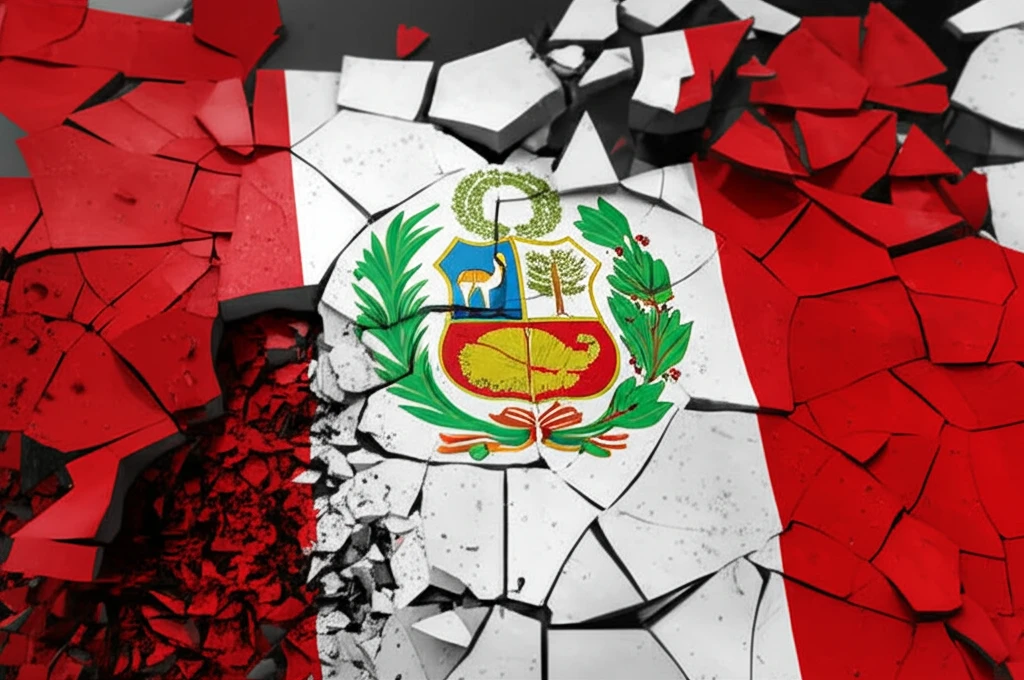
Peru's Political Earthquake: How Fujimori's Coup Shook Democracy and What We Can Learn From It

"Uncover the collapse of Peru's party system under Fujimori's authoritarian rule and its lasting impact on Latin American politics."
In the 1990s, a significant concern arose within Peruvian academia regarding the relevance of political parties as mediating institutions between the state and society. The weakening of these parties is viewed as a key factor contributing to a democratic crisis, impacting mechanisms for participation and representation within a democratic framework.
The decline of political parties manifests as a continuum, beginning with electoral realignment and culminating in the successful emergence of outsiders. This trajectory indicates a profound crisis of political representation that challenges the very persistence of the party system.
Peru's experience has garnered substantial attention from social scientists, both within the country and internationally, due to the early collapse of its party system. This collapse offers a critical case study for understanding the vulnerabilities of democratic institutions and the rise of authoritarianism in Latin America.
Measured Decline: How Peru Scores on Democracy Indices
The Polity data series, which classifies regimes on a spectrum running from full democracy to autocracy (-6 to -10), records Peru's democracy score at 2 in 2018 — the highest value across all 196 years on record — following an earlier peak of 2 in 1980 and a low of 0 in 1920. Yet aggregate indices tell only part of the story. According to LAPOP survey data, Peru is one of only four countries in the region — alongside Haiti, Honduras, and Paraguay — where a majority does not express support for democracy in the abstract. This gap between formal institutional scores and public sentiment helps explain why statistical measures of Peruvian democracy can appear stronger than the lived experience of its citizens suggests.
Measuring Democratic Health: Methods and Their Limits
Standard approaches to evaluating Peruvian democracy have centered on the impact of the Fujimori era, the state's violent conflict with Sendero Luminoso, and the persistence of political corruption. The WOLA report "Deconstructing Democracy" frames its analysis around the authoritarian practices of the Fujimori years, noting that the Peru inherited by Alberto Fujimori was far from democratic after the violence unleashed by Sendero Luminoso had ravaged the country. Meanwhile, scholarship such as Tamara Feinstein's The Fate of Peruvian Democracy examines how the legacies of those years shaped institutional life. These methods carry real limitations: analysts point to a repetitive cycle of authoritarian regimes, and observers note that while Peruvians favor democracy and want political representation, the disqualification of candidates such as Julio Guzmán in 2016 undermines confidence in the standard procedures meant to guarantee it.
A Fragile Constitutional Tradition
Peruvian democracy has historically been fragile, punctuated by coups and military rule. General Manuel A. Odría overthrew José Luis Bustamante y Rivero in a coup d'état on October 29, 1948, then governed for eight years. Even periods of civilian rule proved uneven: Fernando Belaúnde's administration, inaugurated on July 28, 1963, began with the kind of vocal popular support few Peruvian governments have enjoyed, but it did not secure lasting stability. The pattern helps explain why contemporary analysts describe Peruvian democracy as only twenty years old, noting that this remains the second-longest period of constitutional rule in Peruvian history — surpassed only by the 28 years from 1886 to 1913.
The Crisis of Representation and the Rise of Fujimori
The crisis of representation in Peru was characterized by a decline in voter identification with traditional parties, leading to increased electoral volatility and high rates of abstention. This was further exacerbated by the weakening of party structures and their inability to effectively channel citizen participation.
- The weakening of traditional political parties.
- A crisis of political representation.
- Exploitation of popular discontent with the established order.
- Strategic use of authoritarian measures to consolidate power.
Reassessing the Fujimori Years and Regional Patterns
Recent scholarship has revisited how the Fujimori era and the conflicts around it reshaped Peruvian politics. Tamara Feinstein's The Fate of Peruvian Democracy offers a comprehensive map of the rise and demise of the Left in Peru, drawing on research conducted while many of the historical actors in the book were still alive. Broader regional analysis places the Peruvian experience in a comparative frame: since World War II, Chile, Argentina, Paraguay, Uruguay, Brazil, Ecuador, Colombia, and Venezuela have all experienced coups, most of which involved the military — evidence that an unchecked military is a recurring threat to democracy across the region.
A Dysfunctional System Despite Formal Democracy
Critics argue that Peru's democratic shortcomings are less about the absence of elections than about systemic dysfunction. Analysts note that Peru's democracy scores low on critical issues such as checks and balances, corruption, and political participation, a finding echoed across multiple assessments. The result, in the words of one commentary, is a dysfunctional system in which those elected to govern fail to do so and public policies are inconsistent and ineffective. Even the country's named democratic forces illustrate the constraints on institutionalization: the Democratic Force, registered in 2004, exerted only limited influence on national politics, operating primarily as a minor player at the municipal and regional levels.
Delivering Less Than Neighbors Expect
Comparative assessments consistently find that Peruvian democracy underperforms in the delivery of basic goods and services. One review concludes that Peru's democracy has not only been unable to create a sound civil service scheme, but has also failed to deliver basic public services to its population. The trend has continued into recent years: a report from the Washington-based nonprofit Freedom House, cited by Al Jazeera, found that Peruvian democracy has continued to deteriorate more than a year after the removal of former President Pedro Castillo. Together, these findings suggest that Peruvian democracy is increasingly judged by its outputs — and is found wanting.
Lessons from Peru's Democratic Erosion
The story of Peru's democratic collapse serves as a reminder of the fragility of democratic institutions and the importance of vigilance in safeguarding them. The erosion of political parties, the crisis of representation, and the allure of authoritarian solutions are challenges that many countries continue to face. By understanding the factors that contributed to Peru's democratic breakdown, we can work to strengthen democratic resilience and prevent similar outcomes elsewhere.
Expert Pessimism and "Flawed Democracy"
Expert commentary on Peruvian democracy is dominated by pessimism. In an interview, Professor Carrión described himself as "very pessimistic about the prospects for Peruvian democracy," while exploring the enduring appeal of Fujimorismo, anti-establishment politics, regional divisions, and the persistent tensions between Lima and the provinces. Independent rankings reinforce this skepticism: The Economist Intelligence Unit's Democracy Index rates Peru as a "flawed democracy," and observers note the country scores low on checks and balances, corruption, and political participation. The convergence of expert judgment and index scores points to deep structural problems rather than a passing crisis.
Restoring Trust in a Fractured Polity
The outlook for Peruvian democracy hinges on restoring public trust in institutions, which analysts describe as more than dire. Rebuilding trust, further battling corruption, and tackling the economic slump as well as the pandemic will be critical to a positive outlook on Peru's democratic institutions. The immediate political stakes were dramatized when Francisco Sagasti became Peru's third president in six days, tasked with leading the country into elections and building a better democracy — a test, observers note, that Peruvian leaders largely failed 20 years ago.
The Regional Push for Democracy Promotion
Peru's democratic weaknesses are often studied through the lens of broader "anti-systemic" tendencies across Latin America, where democracy promotion has struggled to take hold. Academic work on curbing such tendencies in Peru draws on testimony such as Kenneth Wollack's 2005 statement before the House International Relations Subcommittee on Western Hemisphere Affairs, which addressed challenges to democracy in Latin America and the Caribbean. This framing treats Peru's problems as part of a regional pattern in which democratic institutions face recurring pressure from anti-systemic forces rather than as an isolated national failure.
Participation, Representation, and Everyday Politics
Beyond indices and institutions, scholars emphasize the human dimension of Peruvian democracy — how citizens contest representation and participate in governance. Research collected in Fractured Politics: Peruvian Democracy Past and Present examines contentious representation and its impact in contemporary Peru, highlighting how social contestation shapes democratic life. At the same time, Peru has been home to some of the world's most ambitious experiments in participatory democracy at the local level, which observers suggest American progressive and democratic socialist mayors should look to "for both inspiration and warning." Together these strands show a democracy that is not only strained at the ballot box but also serves as a laboratory for citizen engagement — with decidedly mixed results.