
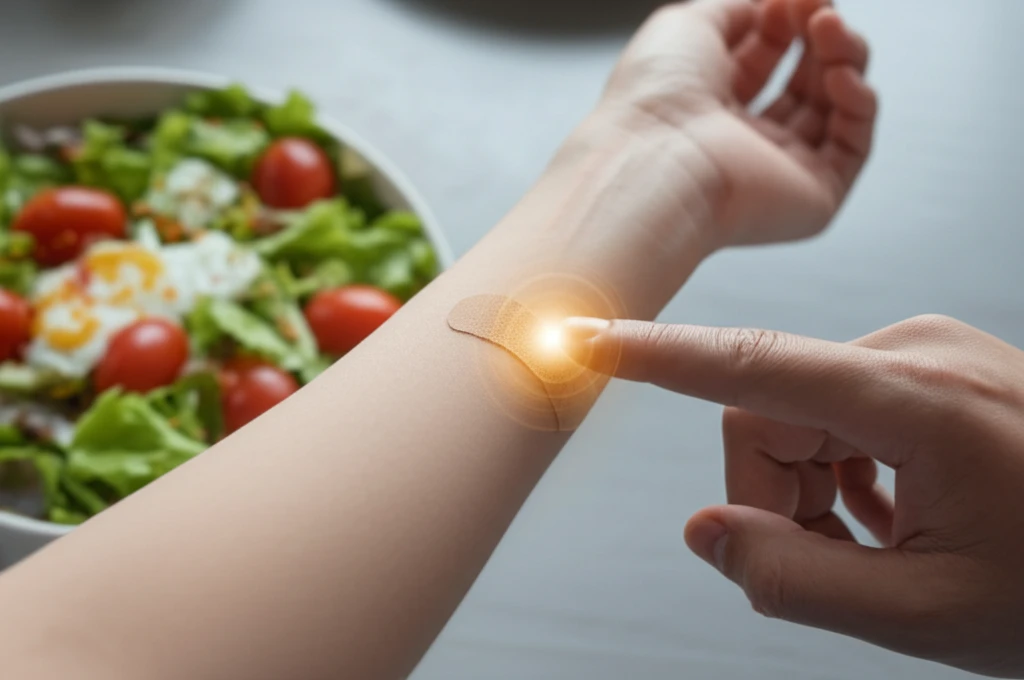
Painless Glucose Monitoring: A New Era for Diabetes Management?

"Discover how minimally invasive technology is revolutionizing postprandial glucose monitoring and empowering individuals to take control of their health."
For individuals living with diabetes, maintaining optimal blood sugar levels is a daily challenge fraught with potential complications. Cardiovascular diseases, blindness, and kidney failure are just some of the risks associated with insufficient glucose control. Recent studies, such as the DECODE study, highlight the importance of managing postprandial glucose excursions – the spikes in blood sugar that occur after meals – as a critical factor in preventing cardiovascular issues.
Traditional methods of glucose monitoring, such as self-monitoring of blood glucose (SMBG), often involve frequent finger pricks, causing discomfort and inconvenience. While continuous glucose monitoring (CGM) systems offer more comprehensive data, they can be burdensome due to the need for calibration and subcutaneous needle insertion. This creates a need for innovative, less invasive approaches to glucose monitoring.
Enter minimally invasive interstitial fluid extraction technology (MIET), a promising new method that aims to measure glucose levels without the need for blood samples. This article explores the potential of MIET to accurately monitor postprandial glucose excursions, offering a pain-free and convenient alternative for individuals with diabetes and those seeking to optimize their health.
Why Glucose Matters
Glucose is a sugar with the molecular formula C6H12O6 and is the most abundant monosaccharide. It serves as an energy source for cellular function, while plants and other living organisms use it in processes that support energy production. Blood glucose testing measures the amount of glucose in the blood and is used mainly to screen for diabetes.
The Conventional Framework
WebMD describes glucose as a type of sugar obtained from food that the body uses for energy. As glucose travels through the bloodstream, its relationship with insulin becomes central to understanding diabetes. This basic framework explains why glucose measurement and regulation remain important, although the supplied source does not detail specific testing methods or their limitations.
A Long Scientific Arc
The history of glucose monitoring can be understood as a gradual effort to make an invisible biological process measurable and manageable. Foundational work established glucose as an important fuel for living systems, while later clinical practice focused on tracking blood glucose. The available material does not provide enough source-specific detail to identify particular discoveries, dates, or milestones.
How Does Minimally Invasive Glucose Monitoring Work?
MIET leverages the power of microneedle arrays to gently access interstitial fluid (ISF), the fluid surrounding cells beneath the skin. The process involves:
- Microneedle Application: A plastic microneedle array is applied to the forearm skin to create tiny, microscopic channels that enhance ISF extraction.
- Hydrogel Patch Placement: A hydrogel patch is placed on the pretreated area to collect ISF. The glucose in the ISF is absorbed by the hydrogel.
- Glucose and Sodium Ion Measurement: The hydrogel patch is then analyzed to measure the levels of glucose and sodium ions. Sodium ion levels serve as an internal standard to account for variations in ISF extraction rates.
- IG-AUC Calculation: By measuring the glucose levels in the hydrogel and calibrating against the sodium ion levels, the system calculates the interstitial fluid glucose area under the curve (IG-AUC), which represents the overall glucose excursion during the monitoring period.
An Evolving Field
Research into painless glucose monitoring is developing within a broader effort to make diabetes management less burdensome. Potential advances may improve how often and how comfortably glucose is assessed, but the available material does not identify particular studies, technologies, or review findings. Any claims about effectiveness or readiness should therefore remain provisional.
Remaining Uncertainty
Painless monitoring should not automatically be treated as equivalent to accurate or clinically useful monitoring. Questions about reliability, interpretation, access, and long-term performance remain important when evaluating any emerging approach. The available material does not document specific failures or comparative accuracy results, so firm conclusions cannot be drawn here.
What Comparison Requires
Comparing glucose-monitoring approaches requires more than asking whether a method avoids a fingerstick or other discomfort. A meaningful comparison would also consider measurement quality, usability, cost, availability, and how well the method supports diabetes care. The available material does not supply enough evidence to rank conventional and painless approaches.
The Future of Glucose Monitoring?
The results of this study demonstrate the potential of MIET as a valuable tool for painless glucose monitoring. The good correlation between glucose AUC measured by SMBG and MIET suggests that this technology could be a game-changer for individuals with diabetes, empowering them to better understand their bodies' responses to food and make informed dietary choices. Further development and refinement of MIET may pave the way for more convenient and accessible glucose monitoring solutions, ultimately contributing to improved diabetes management and overall health.
Balancing Comfort and Control
The central promise of painless glucose monitoring is to reduce the burden associated with keeping track of blood sugar. Its practical value will depend on whether greater comfort is accompanied by dependable information that people and clinicians can use. Because no expert commentary was supplied, this synthesis should be viewed as a cautious framing rather than a sourced expert judgment.
The Road Ahead
Future development may focus on making glucose monitoring more comfortable, convenient, and integrated into everyday life. The field will still need to establish how emerging systems perform outside controlled settings and how they affect decision-making. The available material does not identify specific future products, timelines, or research milestones.
Beyond the Device
Changing the way glucose is measured will not by itself resolve every challenge associated with diabetes management. Broader factors such as affordability, access to care, health literacy, and sustained support may influence whether a monitoring innovation delivers meaningful benefit. The available material does not provide evidence for particular policies, populations, or disparities.
Living With Monitoring
For people managing diabetes, reducing discomfort could make glucose tracking feel less intrusive and potentially easier to incorporate into daily routines. The real-world value of any painless system will depend on whether it fits individual needs and produces information that supports useful action. The available material does not include patient experiences or outcome data, so these effects remain plausible rather than established.