
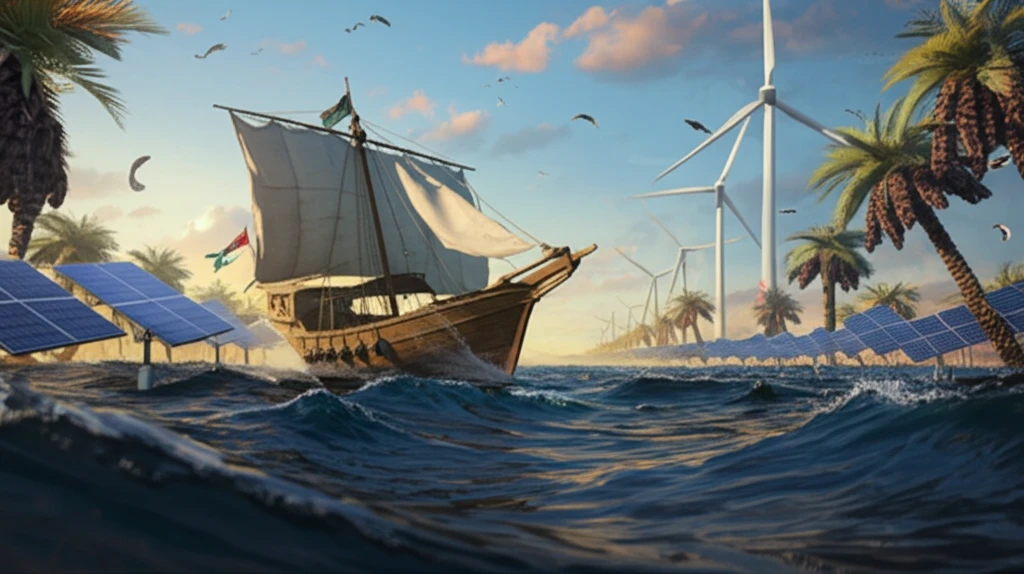
Oman's Economic Balancing Act: How the Sultanate is Navigating Oil Price Swings

"Discover how Oman is strategically diversifying its economy and adapting public policies to thrive beyond oil, ensuring stability and growth for its future."
For decades, the Sultanate of Oman has ridden the wave of oil and natural gas revenues, transforming its landscape with advancements in education, infrastructure, and urbanization. These resources fueled the nation's progress, underpinning nearly every aspect of its economy. However, this reliance created vulnerabilities, starkly revealed when oil prices plummeted in 2014 and 2015.
The dramatic drop in oil prices—from over $110 USD per barrel in June 2014 to below $30 USD in January 2016—sent shockwaves through Oman's economy. The immediate impacts included significant budget deficits, reduced governmental spending, and the difficult decision to reduce or cancel subsidies on essential services like fuel and electricity. The nation faced a critical juncture, compelling a re-evaluation of its economic strategy.
In response to these challenges, Oman has embarked on an ambitious journey of economic diversification. Through its ninth five-year plan (2016-2020) and beyond, the Sultanate is actively working to reduce its dependence on traditional oil and gas sectors, fostering private businesses, and exploring new avenues for sustainable growth. This article delves into the socioeconomic facts, policy changes, and future prospects shaping Oman's path to a more resilient and diversified economy.
Oil Dependence and Economic Exposure
Oman remains heavily dependent on hydrocarbon revenues, which historically have constituted the majority of government income and a substantial share of GDP. Fluctuations in global crude prices therefore ripple through public finances, trade balances, and growth prospects with notable directness. As a mid-sized Gulf producer whose reserves are less abundant than those of some neighbours, the Sultanate faces heightened sensitivity to price movements. This structural exposure has made oil-price management a central concern of Omani fiscal and monetary policy.
Diversification as Orthodoxy — and Its Limits
The conventional prescription for resource-dependent economies is economic diversification: expanding non-oil sectors such as tourism, logistics, manufacturing, and fisheries to reduce fiscal vulnerability. Oman has pursued this path through successive national development strategies and, most recently, Oman Vision 2040. However, diversification programs are capital-intensive, take years to bear fruit, and can be undermined by the very price volatility they aim to offset, since low oil revenues often coincide with reduced fiscal space for investment. These tensions illustrate the difficulty of executing long-term structural reform under short-term budgetary pressure.
From Discovery to Dependency
Commercial oil production in Oman dates to the early 1960s, but it was the post-1970s modernization drive under Sultan Qaboos that transformed hydrocarbons into the backbone of the state's fiscal model. Successive booms and busts — notably the price collapses of the 1980s, 1998, 2008–09, and 2014–16 — repeatedly underscored the risks of mono-resource dependence and spurred efforts at economic reform. Each downturn prompted fresh commitments to diversification, yet the underlying structural reliance on oil has proven remarkably persistent. This cyclical pattern of crisis and renewed reform ambition is a defining feature of Oman's modern economic history.
The Lay of the Land: Understanding Oman's Geography and Demographics
The Sultanate of Oman, nestled on the southeastern tip of the Arabian Peninsula, is a medium-sized Arab nation with a rich maritime history thanks to its extensive coastline stretching approximately 3,165 km. Bordered by the United Arab Emirates to the northwest, Saudi Arabia to the west, and Yemen to the southwest, Oman's strategic location has long influenced its economic and political dynamics.
- Geographic Overview: Oman covers an area of 309,500 square kilometers and is strategically located with access to three major bodies of water: the Arabian Gulf, the Gulf of Oman, and the Arabian Sea.
- Demographic Diversity: Expatriates, largely from India, Bangladesh and Pakistan, make up nearly half the population, contributing significantly to the workforce.
- Population Growth: Oman's population has grown eightfold since 1960, reflecting rapid development and urbanization.
Oil–Price Transmission and Macroeconomic Vulnerability
Recent research underscores the tight linkage between global oil-price movements and Oman's domestic economy. A 2025 policy brief from the Oman Centre for Economic Research notes that under the Sultanate's fixed exchange-rate regime, co-movements between oil prices and the US dollar are directly transmitted into the domestic economy, with the peg providing a credible nominal anchor at the cost of constrained monetary flexibility. Separately, a 2024 study published in the International Journal of Social Sciences and Management Review documents a persistent positive relationship between oil prices and key Omani economic indicators, highlighting the country's vulnerability to price volatility and its measurable impact on GDP growth and government revenues. An additional study in the International Research Journal of Economics and Management Sciences examines the symmetric and asymmetric effects of oil prices on Omani growth using quarterly data from 2010 to 2023, framing the analysis within the objectives of Oman Vision 2040. Taken together, these studies confirm that oil-price swings remain the dominant driver of macroeconomic performance in the Sultanate.
Where the Consensus Breaks Down
While the oil-dependence narrative is widely accepted, some analysts argue that it can obscure meaningful progress in non-oil sector growth and fiscal reform. Oman's introduction of value-added tax, subsidy rationalization, and the establishment of sovereign wealth vehicles represent structural shifts that pure oil-price analyses may undervalue. At the same time, diversification efforts have yet to fully decouple government revenue from crude markets, suggesting that policy reforms remain works in progress rather than proven solutions. The gap between reform ambition and realized fiscal independence continues to invite debate.
Oman Among Gulf Peers
Compared with larger Gulf producers such as Saudi Arabia and the UAE, Oman possesses smaller proven reserves and a narrower fiscal buffer, amplifying its exposure to price shocks. Unlike Saudi Arabia, which can leverage massive spare production capacity and a far larger sovereign wealth portfolio, Oman's stabilization tools are comparatively modest. The Sultanate's fixed exchange-rate peg to the US dollar further differentiates its policy toolkit, simultaneously offering currency stability and limiting independent monetary responses to external shocks. These structural differences mean that strategies effective in wealthier Gulf states do not always translate directly to the Omani context.
Charting a Course for Tomorrow: Oman's Economic Vision
Oman stands at a pivotal moment in its economic history. The fluctuations in oil prices have highlighted the urgent need for diversification and sustainable economic strategies. By fostering new industries, streamlining business regulations, and investing in its people, Oman aims to build a resilient economy that can weather global economic shifts. The journey is complex, but the Sultanate's commitment to progress ensures a promising future for generations to come.
Reading the Evidence Together
Across the available research, a consistent picture emerges: Oman's economy is structurally tied to oil-price dynamics, and this dependence is reinforced — rather than offset — by the fixed exchange-rate regime. Experts broadly agree that Vision 2040's diversification agenda is the correct long-term response, yet they caution that execution risk remains high given the fiscal constraints imposed by price volatility. The challenge, as the literature frames it, is less one of diagnosis than of sustained implementation under conditions that frequently undermine the reforms themselves.
Technology, LNG, and Strategic Growth
Looking ahead, Oman's oil and gas sector is expected to focus on technological advancement and digitalization across upstream, midstream, and downstream operations, with major international players — including Shell, Occidental Petroleum, BP, TotalEnergies, and China National Petroleum Corporation — alongside the national champion Petroleum Development Oman driving investment. The LNG segment, including liquefaction and regasification capacity, represents a key growth area as Oman seeks to monetize its gas resources more fully. Industry analyses also highlight the importance of SWOT-driven strategic planning to navigate both the opportunities presented by evolving energy markets and the risks posed by global decarbonization trends. Investment trends in midstream and downstream infrastructure will be shaped by broader economic conditions and the Sultanate's ability to attract capital amid shifting global energy dynamics.
Structural Headwinds Beyond Oil Prices
Oman's economic balancing act does not occur in a vacuum; it is shaped by global energy-transition pressures, shifting trade alliances, and the fiscal demands of a growing domestic population. Climate commitments and international decarbonization targets introduce long-term uncertainty into the valuation of hydrocarbon assets. Simultaneously, regional geopolitics and evolving OPEC+ production agreements add layers of unpredictability to revenue forecasting. These systemic factors compound the domestic challenges of diversification and fiscal reform, making Oman's path forward contingent on navigating multiple, interlocking uncertainties.
Lives Shaped by the Barrel
Behind the macroeconomic data, oil-price swings translate into tangible effects on employment, public-service delivery, and household welfare in Oman. Government spending on infrastructure, healthcare, and education — sectors that directly affect living standards — fluctuates in step with hydrocarbon revenues. Youth unemployment and private-sector development remain pressing social concerns that diversification programs must address if broader prosperity is to be achieved. Ultimately, the success of Oman's economic balancing act will be measured not only in GDP figures but in the material well-being of its citizens.