
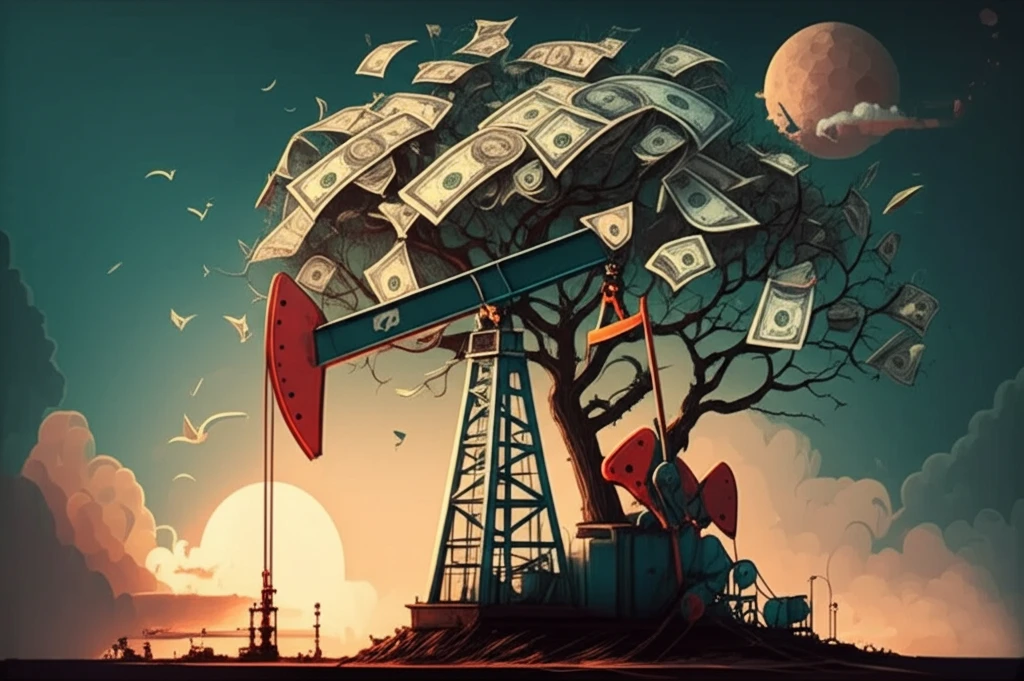
Oil and Inequality: Is the Resource Curse Real?

"New research challenges the conventional wisdom, revealing complex links between oil wealth and income distribution."
For decades, the 'resource curse' has been a dominant narrative: countries rich in natural resources often struggle with economic instability, corruption, and social strife. But what about income inequality? Does oil wealth automatically translate to a greater divide between the rich and poor? Surprisingly, this link hasn't been thoroughly investigated – until now.
A recent study, using the Standardized World Income Inequality Database (SWIID), dives deep into this complex relationship, challenging some long-held assumptions. The findings reveal a nuanced picture, suggesting that oil wealth doesn't always lead to increased inequality, and, in some cases, can even contribute to a more equitable income distribution.
This article will break down the study's key findings, exploring the surprising ways oil wealth can impact income inequality. We'll also examine the factors that determine whether a country experiences the 'resource curse' or manages to harness its oil wealth for the benefit of all its citizens.
Income Inequality in the Oil Era
Income inequality remains a persistent challenge globally, with measures such as the Gini coefficient used to quantify disparities. The relationship between oil wealth and inequality is complex, as oil revenues can both increase national wealth and exacerbate distributional gaps. Standard income definitions, including gross and net income, provide frameworks for measurement but may not fully capture the nuances of resource-driven economies.
Measuring Income and Inequality
Economists typically measure income inequality using metrics like the Gini coefficient, which ranges from 0 (perfect equality) to 1 (perfect inequality). Standard approaches differentiate between gross income (total earnings before deductions) and net income (take-home pay after taxes). These methods, while useful, often fail to account for informal economies or wealth derived from natural resources, potentially underestimating inequality in oil-rich nations.
The Resource Curse Concept
The resource curse hypothesis, first formally articulated in the 1990s, suggests that countries with abundant natural resources like oil often experience slower economic growth, higher inequality, and weaker democratic institutions compared to resource-poor nations. This counterintuitive phenomenon has been attributed to factors such as Dutch disease, rent-seeking behavior, and institutional decay. Early studies highlighted cases like Nigeria and Venezuela, where oil wealth correlated with persistent poverty and inequality.
Does Oil Wealth Automatically Mean More Inequality?
Conventional wisdom suggests that oil wealth concentrates power and resources in the hands of a few, exacerbating existing inequalities. Oil revenues might benefit political elites or specific geographical regions, leaving the majority of the population behind. This can happen through various mechanisms, including:
- Rent-seeking behavior: Competition for oil riches can lead to corruption and policies that disproportionately favor specific interest groups.
- Neglect of other sectors: An over-reliance on oil can stifle the development of other industries, leading to job losses and economic instability for those not involved in the oil sector.
- Limited transparency: Oil-rich governments may lack transparency and accountability, making it easier for elites to capture the benefits of oil wealth.
Contemporary Studies on Oil and Inequality
Recent research continues to examine the oil-inequality nexus, with some studies suggesting that oil revenues can reduce inequality when effectively channeled into social programs. However, other analyses indicate that oil wealth often concentrates power and wealth among elites, widening inequality. The impact appears contingent on governance quality, with strong institutions mitigating the curse.
Challenging the Resource Curse Narrative
Critics argue that the resource curse is not inevitable, pointing to exceptions like Norway, which has managed oil wealth successfully through sovereign wealth funds and transparent governance. Some scholars contend that the curse stems from poor policies and institutions rather than resources themselves. These counterarguments suggest that with appropriate reforms, oil wealth can be leveraged to reduce inequality.
Oil's Dual Effect on Inequality
Research indicates that oil can have dual effects on income inequality. Studies find that oil abundance is generally associated with lower income inequality, except in high oil-rich economies where the effect reverses. This suggests that oil improves human capital and institutional quality, mitigating inequality, but oil price volatility can exacerbate economic disparities. The relationship appears nonlinear, with moderate oil wealth benefiting distribution while extreme dependence harms it.
Harnessing Oil Wealth for a More Equitable Future
The research underscores the importance of good governance, transparency, and diversification in oil-rich economies. Countries that manage their oil wealth responsibly, invest in education and healthcare, and promote economic diversification are more likely to avoid the 'resource curse' and create a more equitable society for all their citizens. It also points to a potential for intentional under-reporting of data. Further research into the methods to discover data accurately will be required.
Expert Consensus and Ongoing Debates
Scholars generally agree that the relationship between oil and inequality is context-dependent, shaped by governance, policy choices, and economic structure. While the resource curse is a real risk, it is not deterministic. Experts emphasize the importance of institutional reforms, transparent revenue management, and diversified economies to harness oil wealth for equitable growth.
Emerging Research Directions
Future research is likely to focus on the intersection of oil wealth with climate change policies, as energy transitions may reshape inequality dynamics. Additionally, the role of digital technologies and new governance models in managing resource revenues will be critical areas of study. Long-term longitudinal analyses could provide deeper insights into how oil impacts inequality across generations.
Systemic Barriers to Equitable Oil Wealth
The resource curse reflects broader systemic challenges, including global economic inequalities, neocolonial power structures, and domestic political failures. Addressing oil-driven inequality requires tackling these interconnected issues, from international trade frameworks to local governance reforms. Without systemic change, individual country efforts may yield limited success.
Lived Experiences of Inequality
Behind the statistics are real human experiences: communities displaced by oil projects, workers facing precarious employment, and citizens excluded from decision-making. Inequality manifests in unequal access to education, healthcare, and opportunities, perpetuating cycles of disadvantage. Centering human stories in policy discussions is essential for developing equitable solutions.