
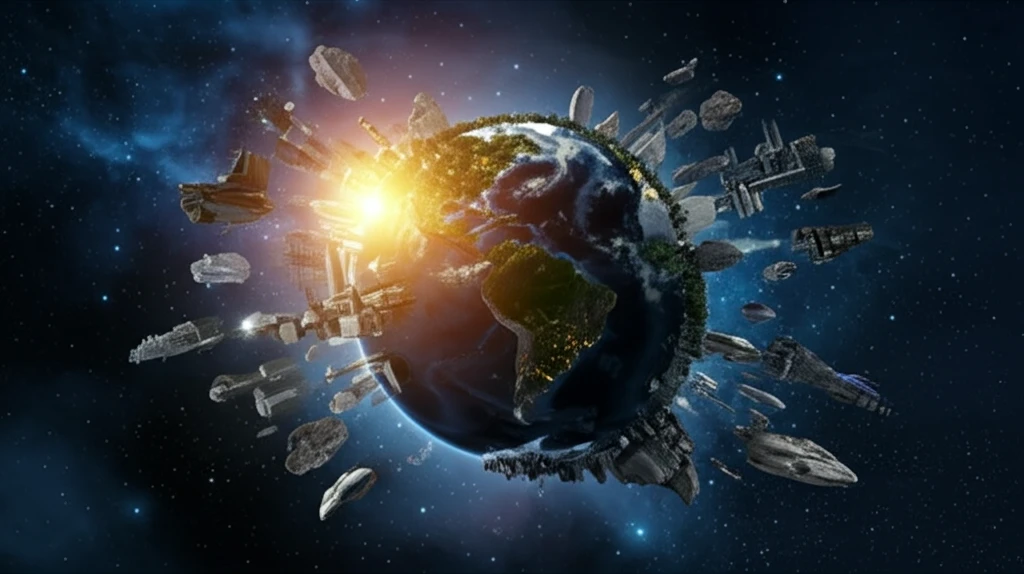
Navigating Our Planetary Boundaries: A Guide to Sustainable Living in the 21st Century

"Understand how global climate goals translate to your daily life and learn practical steps to protect our planet."
Our planet faces unprecedented environmental challenges. From climate change to biodiversity loss, the effects of human activity are pushing Earth's systems to their limits. Experts agree that we've entered a new geological epoch, the Anthropocene, where human actions are the primary driver of planetary change.
To address these challenges, scientists have proposed the concept of 'Planetary Boundaries' – a framework defining the safe operating space for humanity. These boundaries represent critical thresholds for nine fundamental global processes that regulate the stability of the Earth system. Crossing these boundaries risks triggering abrupt or irreversible environmental changes, threatening human well-being.
This article breaks down the complex science of planetary boundaries and explains how global climate goals translate into practical actions for individuals and communities. We'll explore how you can reduce your environmental impact and contribute to a sustainable future.
Current Statistics & Impact
Planetary science encompasses the study of celestial bodies including planets, moons, asteroids, and comets within planetary systems such as our Solar System. NASA's planetary science program explores these objects to better understand the history of our solar system and the distribution of life within it. The Solar System features Earth and seven other planets bound to and revolving around the Sun, forming one example of a planetary system.
Standard Approach, Accepted Methods & Their Limitations
Insufficient source material available for this subsection.
Historical Perspective, Milestones, Foundational Discoveries
Insufficient source material available for this subsection.
Understanding Planetary Boundaries: Key Concepts
The Planetary Boundaries framework, introduced in 2009, identifies nine critical Earth system processes, including climate change, biodiversity loss, land system change, and freshwater use. Each process has a defined boundary, a threshold that, if crossed, could destabilize the Earth system.
- Climate Change: Limiting global warming to well below 2°C and pursuing efforts to limit it to 1.5°C above pre-industrial levels.
- Biodiversity Loss: Maintaining the integrity of the biosphere and preventing species extinctions.
- Freshwater Use: Managing freshwater resources sustainably to ensure availability for both human and environmental needs.
- Land System Change: Preventing deforestation and maintaining healthy ecosystems.
Latest Research and Reviews
Insufficient source material available for this subsection.
Counter Arguments and Failures
Insufficient source material available for this subsection.
Comparative Analysis
Insufficient source material available for this subsection.
The Path Forward: Collective Action for a Sustainable Future
Protecting our planet requires a collective effort. By understanding the planetary boundaries and taking action in our daily lives, we can contribute to a sustainable future. Whether it's reducing your carbon footprint, supporting sustainable businesses, or advocating for environmental policies, every action counts. Let's work together to ensure a healthy planet for generations to come.
Synthesis & Expert Commentary
Insufficient source material available for this subsection.
Future Outlook & Next Frontiers
Insufficient source material available for this subsection.
Broader Context & Systemic Challenges
Insufficient source material available for this subsection.
The Human Element & Real-World Impact
Insufficient source material available for this subsection.