
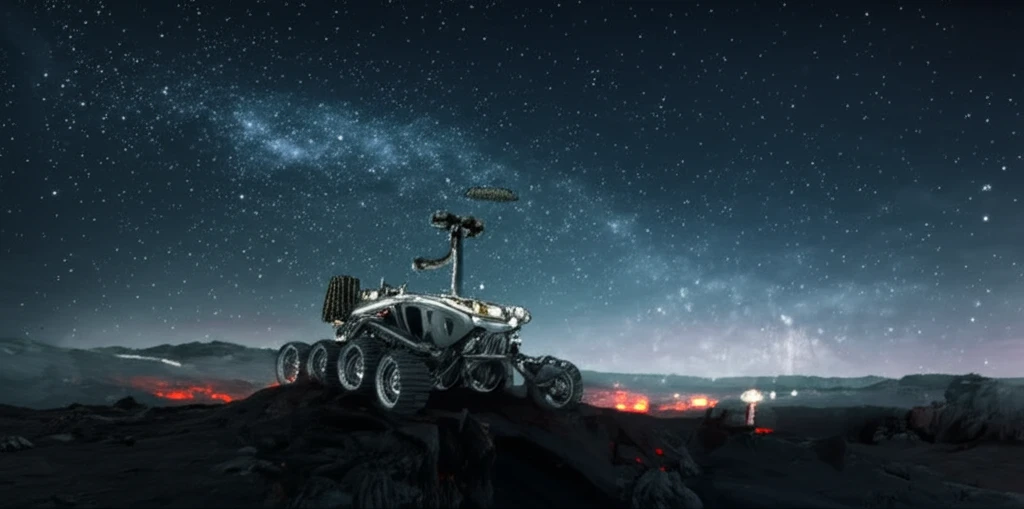
Moonshot Mobility: How Lunar Rover Tech is Shaping the Future of Off-Road Innovation

"From Hawaii's volcanic slopes to Canadian engineering labs, explore how lunar rover analogue missions are driving cutting-edge advancements in vehicle design and robotics."
For years, space agencies like NASA and the Canadian Space Agency (CSA) have been investing in the design and development of lunar rover prototypes. These aren't just theoretical exercises; they involve real-world analogue deployments, testing these rovers in environments that mimic the harsh conditions of the Moon. The goal? To refine rover design, validate operational capabilities, and push the boundaries of what's possible in off-road mobility.
These analogue missions take place in diverse locations, from the volcanic landscapes of Hawaii to aggregate production facilities in Ontario. Each site offers unique challenges and opportunities to assess rover performance, identify weaknesses, and drive innovation. But what exactly are these missions, and how are they shaping the future of vehicle technology?
This article delves into the world of lunar rover analogue missions, exploring the technology, the testing environments, and the surprising ways these efforts are influencing terrestrial vehicle design. Whether you're an engineer, a space enthusiast, or simply curious about the future of mobility, there's something here for you.
Lunar Innovation With Earthbound Payoff
Programs like the Moonshot Museum's Mobile Moonshot demonstrate how innovations propelling humanity to the Moon are also improving life on Earth, with low-gravity environments driving research across fields from medicine to materials science. Moonshot Pirates similarly point to smart glasses acting as personal driving assistants, self-healing roads, and AI-driven road safety as mobility breakthroughs on the horizon. A planned 2029 lunar mission will see NASA field multiple rovers and instruments near the Moon's south pole to study its chemical composition, illustrating the scale of lunar-tech investment.
Analogue Missions as Testbeds
Space agencies, companies, and universities use analogue missions as testbeds to study solutions that will enable human exploration of the cosmos, as demonstrated by the IGLUNA lunar analogue mission. Rover prototypes such as Scarab are designed as lunar prospectors, using a deep coring drill and soil analysis instruments to measure the abundance of elements in polar craters. The Artemis JR rover extends this approach as a lunar analogue in-situ resource utilization platform. Because terrestrial stand-ins can only approximate lunar conditions, analogue testing carries inherent limitations that must be weighed against flight experience.
From Juno's Field Tests to Modern Rovers
The Juno multipurpose rover platform, first developed in Canada in 2008, stands as an early milestone in lunar rover analogue engineering, with its evolution documented by Visscher et al. (2011a, 2011b, 2012). Field tests conducted with these platforms produced the results that shaped subsequent analogue mission deployments. This lineage of progressively refined testbeds underpins the modern generation of lunar rover research.
From Lunar Dreams to Earthly Innovations: How Rover Development Works
The CSA, since 2008, has been at the forefront of lunar rover prototype development. These efforts focus on mobility platforms, designed in collaboration with companies like Ontario Drive & Gear (ODG). The rovers undergo rigorous testing in analogue environments, provided by the CSA, to mirror lunar conditions. Hawaii, with its volcanic terrain and geological similarities to the Moon, serves as a prime location, in partnership with the Pacific International Space Centre for Exploration Systems (PISCES).
- Enhance mobility in challenging terrains.
- Improve power efficiency and energy management.
- Develop robust and reliable navigation systems.
- Integrate advanced sensors and payloads.
MoonRanger and the IGLUNA Testbed
Carnegie Mellon's MoonRanger rover is slated to fly on a 2029 lunar mission, in what NASA describes as the first use of multiple rovers and instruments near the Moon's south pole to study its chemical composition. The mission, rendered with Firefly Aerospace's Blue Ghost lander, marks a leap in coordinated lunar surface operations. Meanwhile, the IGLUNA analogue mission continues to serve as a testbed for autonomous navigation research, letting universities, companies, and space agencies refine rover technology before flight.
When Off-Road Plans Go Awry
Field trials in harsh terrain demonstrate that even premium off-road machinery struggles in real-world conditions. In one Moab test, a Land Rover Discovery's off-road excursion absolutely did not go as expected, a reminder that capability claims do not always survive contact with difficult ground. Such outcomes echo the challenges of analogue testing, where terrestrial proxies cannot fully reproduce lunar dust, gravity, or terrain.
Blurred Lines in Vehicle and Autonomy Classes
On the consumer side, passenger vehicles with off-road capability or styling are typically classified as off-road vehicles, sports utility vehicles, or crossover SUVs, yet there are no commonly agreed boundaries between these categories. Autonomy adds another layer of comparison: at Level 1 the driver and automated systems share control, while Level 2 systems monitor the driver's eyes with cameras. Against this backdrop, lunar rovers represent the extreme end of the spectrum, operating with minimal human oversight on unknown terrain.
The Road Ahead: Future of Lunar Rover Technology
The knowledge gained from these analogue deployments is already informing the next generation of vehicle technology. By scaling the data for reduced gravity environments, researchers can more accurately predict energy consumption and optimize rover mobility for lunar and Martian missions. Ongoing work focuses on enhancing thermal and environmental protection, reducing mass, and developing advanced communication and payload systems. Ultimately, these efforts are not just about exploring other worlds; they're about driving innovation here on Earth, creating more sustainable, efficient, and capable vehicles for all.
Moonshot Thinking Meets Mobility
The Moonshot Pirates megatrend view positions lunar ambitions as a forcing function for mobility innovation, from smart glasses that act like personal driving assistants to self-healing roads and AI-driven road safety. Experts argue that the discipline of designing vehicles for an unforgiving lunar environment produces technology that transfers directly to off-road and everyday driving on Earth. The connective thread is moonshot thinking: aiming at audacious targets to generate practical advances.
A 2029 Leap Toward the South Pole
The 2029 MoonRanger mission points to a future of coordinated multi-rover operations, with NASA fielding multiple rovers and instruments near the Moon's south pole to probe its chemical composition. The Moonshot Museum's Orbital Odyssey programming frames such missions as research engines that improve life on the Blue Planet, from medicine to materials science. As low-gravity research expands, expect the boundary between lunar and terrestrial mobility to keep blurring.
Classification and Control at the System Level
The off-road industry still lacks agreed-upon boundaries between off-road vehicles, SUVs, and crossovers, complicating regulation, marketing, and consumer expectations. Similarly, autonomous vehicle technology is still defined by a six-level ladder, where Level 1 systems share control with the driver and Level 2 systems use cameras to monitor the driver's eyes. Standardizing these frameworks is essential as terrestrial vehicles adopt navigation and autonomy approaches pioneered for lunar rovers.
Real Ground, Real Drivers
Even pristine showroom machines like a Range Rover meet their match on real trails, as a Moab test showed when a Discovery's off-road run did not go as expected. These experiences ground the moonshot narrative in human reality: drivers on Earth benefit from AI-driven road safety, personal-driving-assistant smart glasses, and the rugged engineering trickling down from lunar programs. Ultimately, lunar rover tech's promise is measured not on the Moon but in how it improves everyday mobility for real people.