
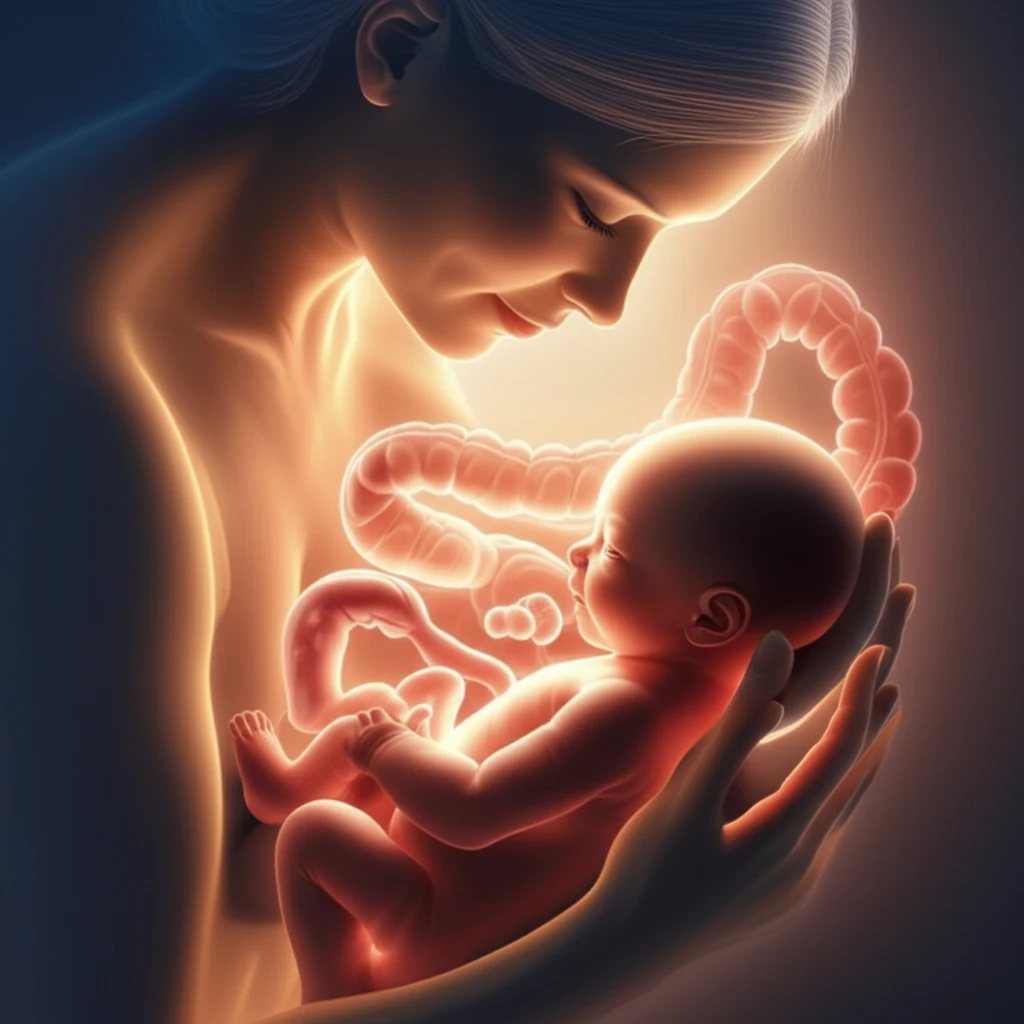
Mom's Health Boost for Baby: How Maternal Care Can Combat Newborn Ischemia

"Discover the groundbreaking research showing how maternal ischemic preconditioning can protect newborns from hypoxia-reoxygenation injuries."
Necrotizing enterocolitis (NEC) stands as a significant emergency in neonatal surgery, predominantly affecting premature infants with low birth weights. Despite advancements in medical science, NEC remains a leading cause of morbidity and mortality in this vulnerable population. Understanding the complexities of NEC is vital for developing effective prevention and treatment strategies.
Researchers have explored various mechanisms to unravel the origins and progression of NEC, yet its exact cause remains elusive. The condition is closely linked to ischemic events, particularly affecting the distal ileum and proximal colon, suggesting a localized disruption in the circulatory system. Premature infants are especially susceptible to intestinal ischemia and hypoxia due to their immature vascular control mechanisms.
Apoptosis, a form of programmed cell death, plays a crucial role in maintaining the architecture of the intestinal epithelium. It is the body’s way of responding to cellular stress, including the stress of intestinal cells. In addition, an imbalance in the production of prostanoids, regulated by cyclooxygenase (COX-1 and COX-2), further complicates the condition. While COX-1 helps maintain the intestinal lining, COX-2 can trigger apoptosis under stress.
Newborn Ischemia: A Growing Concern
Hypoxic-ischemic encephalopathy (HIE) remains a leading cause of neonatal mortality and long-term neurodevelopmental impairment worldwide. While precise global figures vary by region and reporting methodology, the condition continues to represent a significant burden on healthcare systems. Neonatal ischemia, defined as reduced cerebral blood flow to the newborn brain, can result from perinatal complications including cardiac disease, sepsis, and hypertensive disorders. The consequences range from acute neurological injury to lifelong disabilities, underscoring the critical need for effective maternal and neonatal care interventions.
Current Treatment Paradigms and Their Constraints
Therapeutic hypothermia has emerged as the standard of care for moderate to severe HIE, having improved outcomes in affected neonates. However, significant gaps persist in diagnosis, treatment, and long-term follow-up, particularly for mild cases of the condition. Current approaches often focus on managing acute symptoms rather than addressing underlying pathophysiology. Limitations in early detection and intervention strategies highlight the need for more comprehensive maternal care models that can prevent ischemic events before they occur.
Evolution of Maternal and Newborn Health Care
The history of maternal and child health in the United States traces back to organized efforts documented by the Maternal and Child Health Bureau, which established foundational frameworks for care delivery. Global milestones include commitments from governments and stakeholders that have contributed to historic lows in child mortality by 2022. Key events in monitoring maternal and newborn health outcomes have shaped current practices through international collaborative initiatives. The medical and cultural history of newborn care spans from antiquity to modern practices, reflecting evolving social and technical conditions guiding approaches to infant health.
What is Maternal Ischemic Preconditioning and How Does It Protect Newborns?
Ischemic preconditioning (IPC) is a method used to enhance tolerance to ischemia in both local and distant organs. Remote ischemic preconditioning (IPCr) has emerged as a promising strategy for fostering local and systemic resistance to hypoxia and reoxygenation. IPCr safeguards organs exposed to potentially damaging ischemia, offering protection akin to that of direct IPC. This protection is achieved through the release of biochemical messengers into the circulation or the activation of neuronal pathways.
- Study Design: The study involved newborn Wistar rats divided into three groups: a control group (CG), a hypoxia and reoxygenation group (HRG), and a remote ischemic preconditioning group (IPCrG).
- Hypoxia-Reoxygenation Protocol: The HRG and IPCrG groups underwent hypoxia and reoxygenation twice daily for three days. Hypoxia was induced with 100% CO2 for 10 minutes, followed by reoxygenation with 100% O2 for 10 minutes.
- Maternal IPCr: The mothers in the IPCrG group underwent IPCr 24 hours before delivery. This involved applying a rubber band tourniquet to the left hind limb to induce ischemia.
- Analysis: Segments of the colon were examined histologically and immunohistochemically to assess caspase-3 and COX-2 levels.
Advances in Understanding Neonatal Ischemia
Recent research emphasizes that HIE results from impaired oxygen delivery and reduced cerebral blood flow during the perinatal period, representing one of the leading causes of neonatal neurological complications. Studies highlight the complex interplay of maternal, intrapartum, and neonatal factors in HIE development, making early identification crucial for prevention. Despite improvements in perinatal care, HIE remains a global healthcare challenge requiring continued research. Detailed reviews of pregnancy history, maternal medical conditions, and labor progression are recommended before evaluating affected infants.
Challenges and Limitations in Current Care Models
Neonatal ischemia is often caused by cardiac disease, sepsis with vascular collapse, and hypertension, with conditions like twin-to-twin transfusion syndrome increasing stroke risk. Ethical dilemmas frequently arise in neonatal medicine, particularly regarding continuing or withdrawing intensive treatment in critically ill infants with HIE. Birth injuries from prolonged labor, abnormal fetal presentation, and maternal health conditions represent preventable complications. Quality improvement initiatives aim to broaden focus from access to care toward quality of care for maternal and newborn health to reduce preventable illness and deaths.
Evaluating Approaches Across Healthcare Systems
Comparative effectiveness research in neonatal care remains an evolving field with varying outcomes across different healthcare settings. Evidence suggests that integrated maternal-newborn care models may offer advantages over siloed approaches, though direct comparisons are limited. Resource availability significantly influences treatment options and outcomes, creating disparities between high and low-resource settings. Future research should focus on standardizing metrics to enable meaningful cross-system comparisons of maternal care interventions and their impact on newborn ischemia prevention.
The Future of Newborn Care: Harnessing Maternal Health
Maternal IPCr shows promise as a protective measure for newborns vulnerable to hypoxia and reoxygenation, reducing inflammation and morphological damage in the colonic mucosa. By reducing morphological alterations and mitigating the inflammatory response, maternal IPCr emerges as a promising strategy for enhancing newborn health. Further investigations are warranted to fully elucidate the underlying mechanisms and optimize its clinical application.
Expert Perspectives on HIE Management
Expert commentary indicates that while therapeutic hypothermia has improved outcomes for moderate to severe HIE cases, critical gaps persist in addressing mild HIE. Inconsistencies in diagnostic criteria and treatment protocols continue to challenge clinicians worldwide. The disproportionate effects of HIE in low-resource settings highlight the need for adaptable intervention strategies. Research experts emphasize that comprehensive follow-up systems are essential for optimizing long-term neurodevelopmental outcomes in affected infants.
Emerging Directions in Neonatal Ischemia Research
The future of neonatal ischemia prevention likely lies in predictive analytics and early intervention technologies that can identify at-risk pregnancies before complications arise. Personalized medicine approaches may enable tailored interventions based on individual maternal and fetal risk profiles. Integration of artificial intelligence in monitoring systems could enhance early detection capabilities. Continued investment in both high-tech solutions and community-based care models will be essential for reducing the global burden of neonatal ischemia.
Systemic Barriers to Optimal Maternal and Newborn Care
Systemic challenges in maternal and newborn health include financing siloed or vertical health initiatives, particularly in crisis-affected areas. Disconnects between maternal and newborn health capacity development create gaps in continuity of care. Aligning new initiatives with existing health sector strategies requires coordinated policy frameworks. Sustainable progress depends on addressing structural inequalities that limit access to quality care for vulnerable populations worldwide.
Personal Stories and Global Health Implications
Case studies demonstrate that HIE represents a devastating consequence of antenatal and birthing complications, with multifactorial etiology involving neural tissue destruction from oxygen deprivation. Real-world implementations of newborn health policies highlight the importance of alignment with broader maternal health and primary care strategies. Research tracking systems like the MoNITOR Technical Advisory Group work to establish measurement norms for improving outcomes. Recent adjunct therapies, including xanthine-oxidase inhibitors, show promise in reducing neuronal injury when combined with therapeutic hypothermia.