
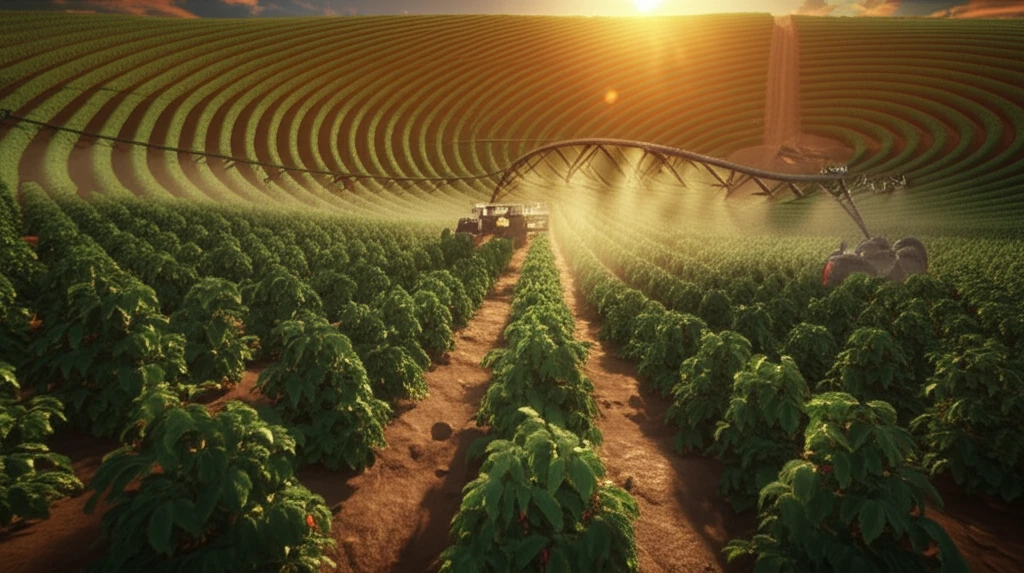
Maximize Your Coffee Harvest: A Simple Guide to Circular Planting

"Unlock the secrets to efficient mechanized coffee harvesting with circular planting systems. Learn how to optimize your yield and minimize plant stress."
Mechanized coffee harvesting is transforming coffee production, offering significant benefits to producers. However, the success of this technology hinges on careful planning, proper crop development, and precise harvester adjustments. Without these, mechanized harvesting can stress the plants more than traditional manual methods.
A study conducted in Patos de Minas, MG, Brazil, explored these challenges. The research focused on assessing the impact on plant health and the quality of mechanized harvesting of coffee grown in a circular planting system under a center pivot irrigation setup. The study also examined two different rod vibration frequencies and employed statistical process control to analyze the results.
The aim was to identify best practices that ensure efficient and gentle harvesting. Whether you're a seasoned coffee farmer or new to the industry, understanding these insights can help you optimize your operations and improve your coffee yield. Let’s dive into the findings and explore how to make the most of mechanized harvesting in circular planting systems.
Efficiency Gains and Operational Risks in Circular Planting
Mechanized coffee harvesting is one of the main technological advances benefiting producers, and new trends report increases in efficiency and cost reductions of approximately 50% compared to manual harvesting. However, in circular planting systems, problems with planning for planting and crop development, along with faults in harvester adjustment, can reduce the efficiency of the operation. Research on mechanized harvesting in circular planting found that the harvested coffee volume and stripping and gathering efficiency showed asymmetrical data distribution by the Anderson-Darling test, requiring transformation of the data for analysis.
Manual vs. Mechanized: Methods, Markets, and Quality Trade-Offs
Manual coffee harvesting involves handpicking cherries and is divided into two types: selective picking and strip picking, where strip picking harvests all cherries on a branch at once from base to tip. Farms targeting the specialty market collect only ripe cherries through multiple passes, which produces sweeter and more compound flavors in the cup. Mechanized harvesting is common in Brazil, Hawaii, and on large farms, and is associated mainly with commodity coffee. The choice between hand-harvested and machine-harvested techniques significantly affects the quality of the final product.
The Brazilian Origins of Mechanized Harvesting
The evolution of mechanized coffee harvesting began in Brazil during the 1970s, when Japanese émigré mechanic Shunji Nishimura developed the first prototypes of what would become the Jacto coffee harvester. Since then, harvest operations have come to span manual, semimechanized, and mechanized approaches, with studies comparing their productivity and the amounts of coffee left on the ground or dropped in the machine. The deeper history of coffee itself remains partly legendary, as multiple anecdotal origin stories lack contemporary corroboration and are regarded as folklore.
Understanding Circular Planting Systems and Harvest Quality
The research revealed several key findings regarding the impact of circular planting on coffee harvests. One notable observation was the effect of negative bienniality on the coffee crop. Bienniality refers to the tendency of coffee plants to produce high yields in one year followed by low yields in the next. The study found that negative bienniality reduced the initial coffee load, effectively eliminating the influence of varying insolation conditions.
- Negative bienniality reduces initial coffee load, minimizing insolation effects.
- Harvest quality indices show asymmetrical distribution, indicating high variability.
- Stripping efficiency is influenced by axle positioning and remains statistically stable.
- Plant damage from harvesting is within acceptable limits and under statistical control.
Field Studies on Harvesting Limits and Equipment
Recent research on mechanized harvesting examines both operational limits and equipment performance. One study reports that all mechanized operations can be carried out normally except harvesting, due to harvesters being limited to areas with a maximum slope of 20%. In field trials, a Jacto KTR harvester built in 2003 with approximately 4,000 hours of functioning was used, operating displaced and attached to the hydraulic system of a three-point Massey Ferguson 265 tractor, illustrating the equipment configurations studied in mechanized coffee harvesting research.
Quality Claims and First-Crop Restrictions
Claims about mechanized harvesting's benefits are countered by concerns over quality and plant damage. One industry source reports that mechanized coffee harvesting makes the operation cheaper and guarantees better quality of the harvested product, while other sources report that mechanized harvesting of a crop's first harvest has restrictions on its use, with assumptions that it can increase plant damage and the amount of coffee falling on the ground. High-end specialty lines require perfection, consistency, and uniform ripeness across the entire batch, which lies at the heart of the debate over whether machine- or hand-harvested beans deliver superior quality.
Portable Harvesters and the Shift Away from Manual Labor
Comparative research has examined the performance of commonly used portable coffee harvesters against traditional methods. Sources report that in Brazil, the substitution of manual harvesting by mechanized alternatives has become evident and extensive over the last 30 years. Such comparisons typically weigh efficiency, labor needs, and harvest quality across portable and full-size mechanized equipment.
Optimizing for the Future
This research underscores the importance of understanding the nuances of mechanized coffee harvesting within circular planting systems. By focusing on statistical control and careful monitoring, producers can maintain stable and acceptable harvesting practices. Further research and technological advancements will likely continue to refine these methods, paving the way for more sustainable and efficient coffee production.
Weighing the Evidence on Mechanized Harvesting
Across the sources examined, a consistent picture emerges: mechanized harvesting offers real cost and labor advantages, yet its suitability depends heavily on terrain, planting systems, crop maturity, and equipment adjustment. Opinions on quality outcomes vary, with some reporting equal or better quality and others cautioning that the uniform ripeness demanded by specialty markets remains harder to guarantee with machines. Overall, the evidence suggests that circular planting and mechanized harvesting are complementary tools whose results are shaped by careful planning and operation rather than a single universally superior approach.
Market Growth and Adoption Drivers to 2033
Market analyses point to significant growth for coffee harvesters from 2026 to 2033, driven by evolving consumer demand, technological advancements, and global industry trends. Mechanized harvesters, particularly on large commercial plantations, are being adopted to address labor shortages and reduce the time and cost associated with manual harvesting, aided by continued advances in harvester technology. Financing options and government subsidies in certain regions are expected to further propel the adoption of dual-head harvesting technology, with key opportunities lying in innovation, strategic partnerships, and expansion into emerging markets.
Three Harvest Systems and the First-Crop Challenge
Coffee harvesting can be conducted manually, semi-mechanized, or fully mechanized, with the manual method relying solely on workers without machine assistance except for transportation. A significant systemic challenge is the mechanized harvesting of first-crop coffee, since the plant still has a reduced structure and the machines face greater difficulties. Yet in the South of Minas Gerais, mechanized harvest has been reported to promote better product quality and loss reduction while increasing producer profit, with studies comparing its productivity against manual harvesting.
Engineering Machines Around Plant Biology
Developing efficient machines for coffee harvesting requires solid knowledge about the dynamic behavior of the coffee plant. The mechanized process works through the transfer of vibrational energy and impact to achieve the detachment of coffee fruits. Understanding how the fruit-peduncle-branch system responds to vibration is therefore central to designing harvesters that detach fruit effectively while limiting damage to the plant.