
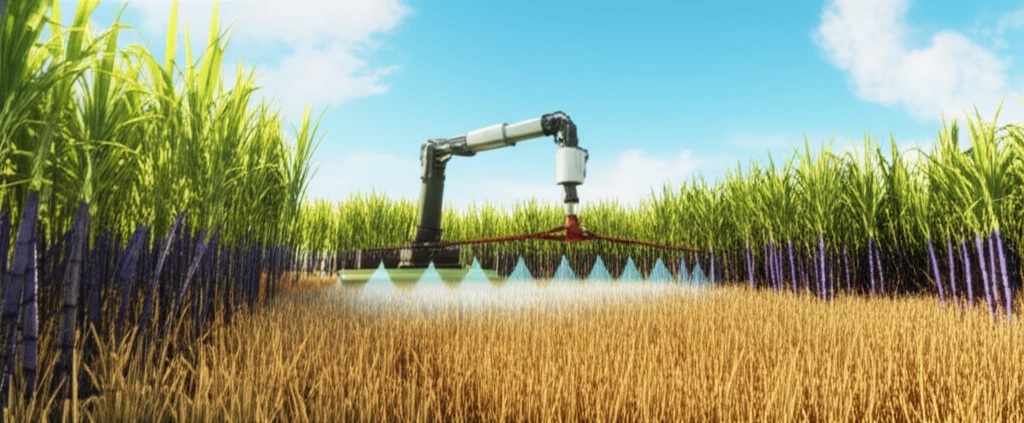
Maximize Herbicide Efficiency: Nozzle Tech for Sugarcane Straw

"Unlock the secret to effective weed control in sugarcane fields by optimizing herbicide application techniques in heavy straw conditions."
The shift towards harvesting sugarcane without burning has led to a significant increase in crop residue, or straw, left on the soil surface. While this mulch layer offers environmental benefits, it also presents challenges for weed management. The straw acts as a physical barrier, hindering herbicide contact with the soil and potentially reducing its effectiveness.
Achieving optimal herbicide deposition through sugarcane straw is crucial for effective weed control and minimizing herbicide usage. Selecting the right spray nozzle can make a significant difference in herbicide penetration and coverage.
This article explores research on how different spray nozzle types impact herbicide deposition through varying amounts of sugarcane straw. We'll break down the findings to help you choose the best nozzle for your specific field conditions, maximizing herbicide efficiency and improving weed control.
Weed Pressure and Herbicide Use in Sugarcane Production
Sugarcane farmers face significant weed pressure that demands extensive herbicide applications to protect yields. Research evaluating postharvest straw management shows that different straw amounts maintained on soil surface (0, 5, 10, and 15 Mg ha⁻¹) interact with herbicide treatments to affect weed control outcomes. The USDA tracks pesticide use across agricultural sectors, documenting application rates, number of applications, and total amounts of active ingredients applied. Studies on sugarcane herbicide programs demonstrate that herbicide combinations applied at planting and followed by post-emergence treatments are standard practice for managing weeds in large-scale sugarcane fields.
Conventional Weed Management Practices
Sugarcane growers typically rely on pre-emergence and post-emergence herbicide programs to control weeds throughout the growing season. These programs often involve multiple herbicide applications timed to different growth stages, requiring careful scheduling and resource allocation. While herbicides remain the primary weed control method in commercial sugarcane production, the interaction between crop residues and herbicide efficacy presents ongoing challenges for optimizing application strategies.
Evolution of Sugarcane Weed Control Research
Weed management in sugarcane has evolved from manual labor-based approaches to chemically-intensive programs as farming operations scaled up. Research into straw management emerged as harvest mechanization increased, creating questions about how crop residues affect herbicide performance. Understanding the relationship between straw cover and herbicide behavior has become increasingly important as sustainable farming practices gain attention in the sugarcane industry.
Why Nozzle Choice Matters: Herbicide Delivery Through Sugarcane Straw
Research conducted at the Universidade Estadual de Maringá investigated the effectiveness of various spray nozzles in delivering herbicides through different quantities of sugarcane straw. The study evaluated eight nozzle types across seven straw densities, measuring the amount of spray solution that reached the soil surface.
- Anti-Drift Fan Nozzles (AD 110 02): These nozzles, designed to reduce drift, also demonstrated excellent herbicide delivery through the straw.
- Air Induction Cone Nozzles (CV-IA 02): These nozzles create air-filled droplets, which proved effective in penetrating the straw layer and depositing herbicide on the soil.
Advances in Understanding Straw-Herbicide Interactions
Recent studies have examined how sugarcane straw on the soil surface influences herbicide dynamics and weed control outcomes. Researchers are investigating the physical and chemical mechanisms through which straw layers affect herbicide availability to germinating weeds. These investigations aim to optimize herbicide application timing and rates to account for varying straw amounts present after harvest. The field continues to develop as new herbicide formulations and application technologies emerge.
Challenges and Limitations in Straw-Herbicide Systems
Research on tebuthiuron behavior in sugarcane straw reveals that herbicide dynamics vary with rainfall intensity and time after application, presenting challenges for consistent weed control. Studies evaluating the relationship between straw and herbicide for controlling Ipomoea species show that while control percentages can approach 100%, the absence of both straw and herbicide treatments results in inferior sugarcane productivity. Weed species compete with sugarcane for water, light, and nutrients, demanding precise control measures that account for straw management decisions. Some research indicates that straw maintenance on soil surface can reduce weed infestation potential by limiting temperature variation and forming physical barriers to germinating weeds.
Evaluating Different Weed Control Approaches
Various weed control strategies in sugarcane production involve trade-offs between chemical inputs, straw management, and long-term field productivity. Research continues to compare the effectiveness of different herbicide combinations and application timings under varying straw cover conditions. These comparisons help inform management decisions that balance immediate weed control needs with sustainable production practices.
Optimize Your Spray Strategy: Key Takeaways for Effective Weed Control
Selecting the right spray nozzle is critical for effective weed control in sugarcane fields with heavy straw cover. Anti-drift fan nozzles (AD 110 02) and air induction cone nozzles (CV-IA 02) have shown promise in delivering herbicides through the straw layer.
Integrating Straw Management with Herbicide Programs
Effective weed control in sugarcane requires coordinating herbicide applications with postharvest straw management decisions. Research demonstrates that straw amount on the soil surface significantly influences herbicide performance and weed suppression outcomes. Optimizing this interaction represents a key opportunity for improving herbicide efficiency while maintaining productive sugarcane cultivation systems.
Emerging Directions in Sugarcane Weed Management
Future research will likely focus on precision application technologies that account for variable straw cover across fields. Integration of real-time straw assessment tools with herbicide application systems could enable more targeted and efficient weed control. Development of new herbicide formulations designed to perform effectively under varying straw residues represents another promising avenue for advancing sugarcane weed management.
Sustainability Considerations in Herbicide Use
Sugarcane herbicide programs operate within broader agricultural sustainability frameworks that increasingly emphasize reducing chemical inputs while maintaining productivity. The interaction between straw management and herbicide efficacy connects to soil health, carbon sequestration, and environmental stewardship goals. Balancing weed control effectiveness with these broader sustainability objectives presents systemic challenges for the sugarcane industry.
Practical Implications for Sugarcane Growers
Sugarcane farmers must make practical decisions about herbicide application and straw management based on their specific field conditions and production goals. Understanding how straw amounts affect herbicide performance can help growers optimize their weed control programs for their individual operations. These management decisions ultimately affect farm profitability, environmental impact, and the long-term viability of sugarcane production systems.
Consider the amount of straw in your fields when choosing a nozzle. As straw density increases, nozzle selection becomes even more important for ensuring adequate herbicide deposition. Monitor herbicide efficacy and adjust your spray strategy as needed to optimize weed control.
While managing sugarcane straw presents challenges, optimizing herbicide application techniques can help you overcome these hurdles and achieve effective weed control while maintaining the benefits of crop residue management.