
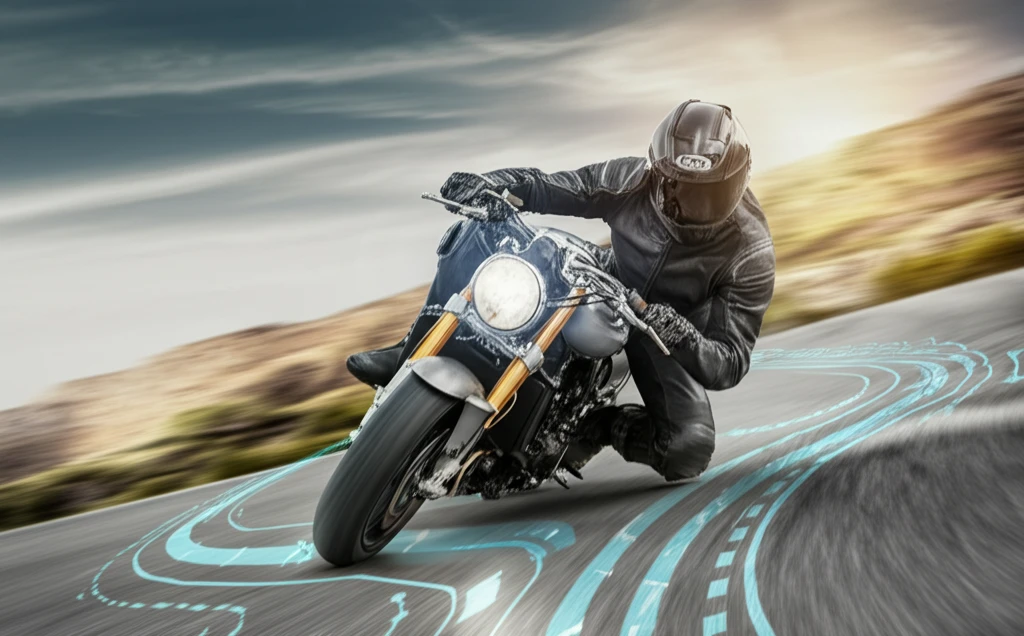
Mastering the Lean: How Motorcycle Stability Tech Can Save Your Ride

"Explore the innovative safety features and modeling techniques enhancing motorcycle stability, reducing accident risks, and keeping riders safe."
Motorcycle riding offers unparalleled freedom, but it also comes with inherent risks. According to recent statistics, motorcycle riders face a significantly higher risk of accidents compared to car drivers. For women, who are increasingly embracing motorcycling, understanding and mitigating these risks is crucial.
While the automotive industry has made significant strides in active safety systems—such as Antilock Braking Systems (ABS), Electronic Stability Control (ESC), and Traction Control Systems (TCS)—motorcycles have lagged behind. This gap isn't due to a lack of innovation, but rather the unique and complex dynamics of two-wheeled vehicles.
Unlike cars, motorcycles require riders to actively balance and control lean angles, making stability a far more nuanced challenge. Developing effective safety systems for motorcycles demands a deep understanding of these dynamics, which is why researchers are focusing on advanced modeling and analysis.
The Staggering Toll of Motorcycle Crashes
In 2024, 6,228 motorcyclists were killed on U.S. roads, representing 16% of all traffic fatalities despite motorcycles making up a small fraction of registered vehicles (NHTSA, 2024). Alcohol was involved in 42% of motorcycle fatalities in 2021, and riders with a blood alcohol concentration over 0.08% were five times more likely to be killed in a crash. Speeding contributed to 33% of motorcycle fatalities in 2022 data, underscoring how rider behavior compounds the inherent vulnerability of two-wheeled travel.
What the Encyclopedic Record Tells Us—and What It Doesn't
Motorcycles are produced with both two-stroke and four-stroke engines with up to four cylinders, and most remain air-cooled, though a few are water-cooled, with engines generally limited to roughly 1,800 cc (Britannica). Manufacturers like Honda have leaned into approachable ergonomics, lowered seat heights, and user-friendly power delivery as standard design goals for modern cruisers and commuter models. Yet these encyclopedic and manufacturer-level descriptions reveal a persistent gap: standardized safety engineering for motorcycle stability is rarely discussed at the same depth as engine specs or chassis geometry.
From Bicycle Origins to Power-Driven Design
In the early period of motorcycle history, many producers of bicycles adapted their designs to accommodate the new internal combustion engine, a transitional phase documented across several historical sources. As engines became more powerful and designs outgrew their bicycle origins, the number of motorcycle manufacturers increased rapidly, laying the groundwork for the diversity of form factors we see today. This evolution from adapted bicycles to purpose-built machines is the foundational story of motorcycle engineering, though the stability challenges inherent in two-wheeled travel persisted throughout.
The Science of Motorcycle Stability
The core challenge in designing stability control for motorcycles lies in their distinct dynamics. Cars primarily move in longitudinal, lateral, and yaw motions, but motorcycles add steering and roll angle dynamics to the mix. When a motorcycle leans into a corner, its longitudinal and lateral motions become intertwined, increasing the complexity. This is especially critical during extreme maneuvers or when encountering precarious road conditions.
- Advanced Modeling Techniques: Creating detailed simulations that account for the interplay of forces and motions.
- Tire Behavior Analysis: Understanding how tires interact with the road surface under different conditions.
- Active Safety Systems: Developing technologies like enhanced ABS and ESC tailored for motorcycles.
- Real-World Testing: Validating models and systems through rigorous testing in controlled environments.
New Safety Sectors and the Research Pipeline
Recent motorcycle safety research has explored integrating Arduino Nano V3-based safety systems using the Waterfall development methodology, reflecting a growing interest in low-cost embedded rider aids. Media outlets such as Motorcycle News and Motorcycle.com continue to track industry developments, though much of the coverage skews toward MotoGP innovations like Acosta's reaction to a revised radio earplug design rather than street-level safety technology. The gap between motorsport R&D and everyday rider protection remains a defining feature of current motorcycle safety research.
When Safety Systems Fall Short or Go Unaddressed
Rail workers in the UK have continued strikes over safety faults with the Class 810 trains, demanding that the units be removed until fully safety compliant—a dispute that mirrors broader frustrations across transport sectors about systems deemed unfit for service. While the context is rail rather than motorcycle, the underlying tension between speed-to-market and verified safety standards is directly relevant to any discussion of under-tested rider aids. The challenge of convincing operators to trust—and not override—automated safety systems is not unique to motorcycles, but the consequences of failure on two wheels are arguably more acute.
Handlebar Mounts, Traction Control, and the Car-Motorcycle Safety Divide
A motorcycle handlebar mount remains one of the cheapest ways to add a recording or navigation device, but convenience and price are not everything when the real question is what happens at impact. Traction control and other electronic rider aids are increasingly compared across platforms, including with performance cars like the Ford Mustang, raising the question of whether four-wheeled safety innovations are translating effectively to two wheels. Comparison platforms now enable riders to evaluate features side by side, but meaningful safety comparisons require deeper data than spec sheets alone can provide.
The Road Ahead for Motorcycle Safety
While challenges remain, the future of motorcycle safety looks promising. Ongoing research and development efforts are paving the way for more advanced safety systems that can help riders stay in control, even in critical situations. As these technologies mature, they have the potential to significantly reduce accidents and make motorcycling safer for everyone.
Expert Warnings and the Rating Landscape
Bryan Lowes, a Vancouver-based motorcycle safety consultant, has publicly pushed back against the claim that obnoxiously loud exhaust systems improve rider safety, calling it a pretext for noise rather than a genuine protective measure. Helmet safety assessment programs like SHARP, run by the UK's Department for Transport, aim to help motorcyclists make informed purchasing decisions based on independent crash-test-style ratings. Meanwhile, academic research into motorcyclist safety assistant applications is expanding, though translating app-based advisory tools into reduced crash rates remains an open challenge.
ARAS, AI, and the Post-Crash Response Horizon
Advanced Rider Assistance Systems (ARAS) are being discussed as a near-term frontier in motorcycle accident prevention, though commercial deployment at scale remains uneven. The role of technology in post-accident response is also drawing new attention, suggesting that the safety lifecycle extends well beyond crash avoidance into outcomes after impact. Market analyses, such as those tracking Germany's summer motorcycle jacket segment, hint at a broader consumer shift toward gear engineered for protection rather than style alone.
Aftermarket Innovation and Helmet Science
Companies like INNOVV are pushing the aftermarket motorcycle safety market with dash cam integrations, CarPlay displays, and blind-spot detection systems designed specifically for two-wheeled platforms. Helmet technology itself continues to evolve, with MIPS-style rotational motion reduction systems now marketed as addressing a specific injury mechanism that traditional linear-impact testing may not capture. ARCH Motorcycle, meanwhile, represents the high-end design-innovation end of the spectrum, though how such boutique engineering scales into accessible safety improvements for everyday riders remains an open question.
Fatalities, Cases, and the Limits of Data
NHTSA's 2024 figure of 6,228 motorcyclist deaths in the U.S.—16% of all traffic fatalities—remains the starkest summary of the human cost. In-depth case analyses, such as that of Joe Benting's motorcycle accident, are being used to examine the physical and psychological impacts of crashes, the legal consequences involved, and how targeted safety campaigns can shape rider behavior. The gap between aggregate statistics and individual stories is where the real argument for better stability technology lives: the data points represent real people, and the trends are not improving fast enough.