
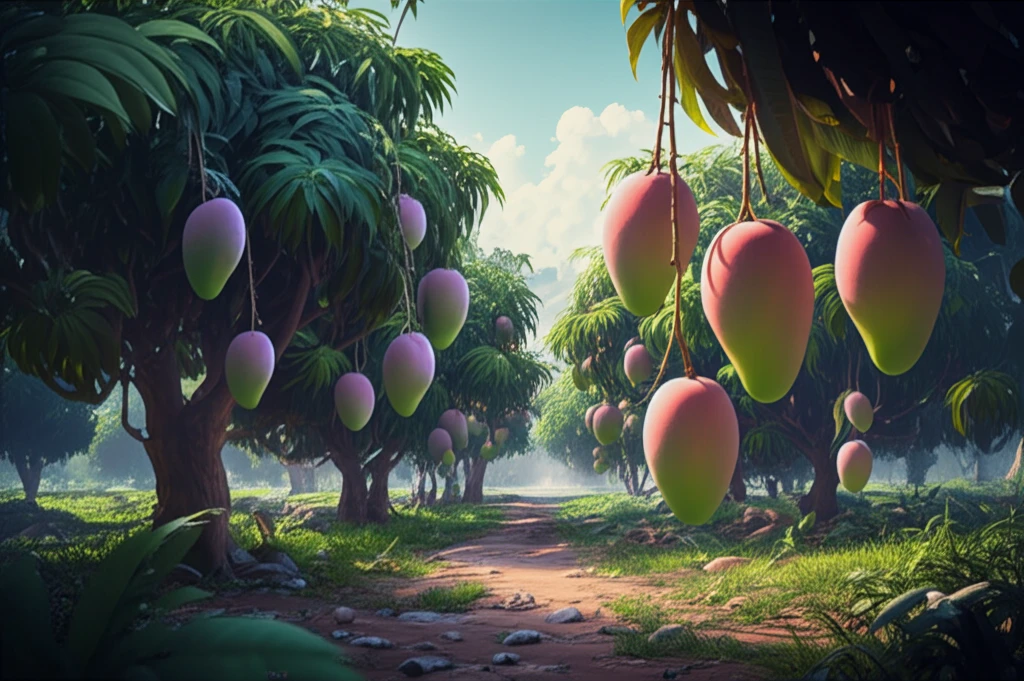
Mango Mania: Unlocking the Secrets to the Best BARI Varieties in Chittagong

"Discover the finest mangoes developed by the Bangladesh Agricultural Research Institute (BARI) and how they thrive in the unique climate of Chittagong."
Mangoes aren't just a fruit; they're a tropical treasure, celebrated worldwide for their luscious flavors, vibrant colors, and impressive nutritional value. Bangladesh, blessed with fertile lands, cultivates a diverse array of mangoes, each with unique characteristics. For those seeking the best mango experience, the varieties developed by the Bangladesh Agricultural Research Institute (BARI) stand out. These mangoes are the result of dedicated research, tailored to thrive in specific regions and offer superior quality.
Among Bangladesh's mango-growing regions, Chittagong holds a special place. Its hot and humid climate presents both opportunities and challenges for mango cultivation. This is where the BARI mango varieties truly shine, demonstrating their adaptability and exceptional performance. Understanding how these varieties fare in Chittagong's unique environment is key to unlocking the secrets of the region's best mangoes.
Whether you're a seasoned mango connoisseur or simply curious about exploring new flavors, this article dives into the world of BARI mangoes in Chittagong. We'll explore the specific qualities that make these varieties stand out, from their early flowering to their remarkable yields, and what makes them the perfect choice for the region's climate.
BARI Mangoes in Chittagong: Scale and Adoption
Bangladesh Agricultural Research Institute (BARI) has developed multiple mango varieties evaluated at the Agricultural Research Station (ARS) in Pahartali, Chittagong, with trials conducted from January to June 2012 across five selected varieties. A separate adoption study collected data from 72 mango orchards in the Chittagong region using random sampling, analyzing profitability through gross cost, gross return, and net return per hectare using a Cobb-Douglas production function. Adoption research further surveyed 200 randomly selected farmers across three upazilas in the Jamalpur district, applying Tobit-censored regression to determine the intensity of BARI Aam-3 adoption, indicating significant but uneven uptake of improved varieties at the farmer level.
Methods for Studying and Improving Mango Varieties
Conventional approaches to studying BARI mango varieties include field evaluation trials and image-based classification, such as the MangoImageBD dataset that uses leaf images to detect varieties like Bari-4 and Bari-11. BARI mango-13 was developed as a hybrid between the Amrapali and Palmer varieties, reflecting standard controlled breeding practices. However, significant limitations persist across mango cultivation: in Florida, disease pressure from anthracnose remains a major concern, with growers advised to select resistant varieties as the easiest mitigation strategy. Meanwhile, production and supply-chain constraints in developing regions include poor packaging, transportation infrastructure, and limited availability of fertilizers and pesticides, factors that likely affect BARI variety performance as well.
The Rise of BARI Mango Varieties in Bangladesh
New mango varieties developed by BARI have been steadily gaining ground among Bangladeshi consumers, who increasingly prefer cultivars noted for being tastier and more visually attractive than older, established ones. Adoption studies conducted across 28 villages covering 131 mango growers in three upazilas of Chittagong District have documented the spread and uptake of BARI varieties at the farmer level. Among the notable introductions, BARI Mango-14, sourced from Saudi Arabia, ripens to a maroon colour by late July and reaches an average weight of 550 grams with approximately 75.35% consumable flesh. BARI 4 has emerged as a widely recognized variety in Bangladesh, valued for its specific characteristics that have supported its adoption in mango-growing regions.
The Performance of BARI Mangoes in Chittagong: A Deep Dive
A study conducted at the Agricultural Research Station in Pahartali, Chittagong, from January to June 2012, evaluated five BARI-developed mango varieties: BARI Aam-1, BARI Aam-2, BARI Aam-3, BARI Aam-4 (Hybrid), and BARI Aam-8. The goal was to pinpoint the most suitable variety for the region. The findings revealed significant differences in their growth, flowering, and fruit characteristics, providing valuable insights for growers and mango enthusiasts alike.
- Flowering and Harvesting: BARI Aam-1 is the earliest, BARI Aam-8 the latest.
- Fruit Yield: BARI Aam-8 leads in fruit quantity, BARI Aam-4 in individual fruit weight.
- Edible Portion: BARI Aam-4 offers the highest edible portion.
- TSS Content: BARI Aam-3 boasts the highest TSS, indicating sweetness.
Recent Field Evaluations of BARI Varieties
A key recent study evaluated five BARI mango varieties at the Agricultural Research Station (ARS) in Pahartali, Chittagong, over the January to June 2012 growing period to identify the most suitable cultivar for the region. This research provides a localized assessment specific to Chittagong's agro-climatic conditions, which is significant given that the district is a major mango-producing area in southeastern Bangladesh. The systematic field trial design allows direct comparison of performance metrics among the BARI varieties under identical environmental conditions.
Postharvest Quality Challenges Across Growing Regions
Research on BARI Mango-4 has revealed that production location significantly impacts the postharvest physiochemical attributes of the fruit. Comparisons between mangoes grown in Rajshahi District and Sylhet District showed measurable differences in fruit quality after harvest, suggesting that the same BARI variety can perform inconsistently depending on where it is cultivated. This variability represents a notable challenge for standardizing fruit quality across Bangladesh and underscores that successful variety development alone does not guarantee uniform outcomes in diverse growing environments.
BARI Varieties vs. Commercial Cultivars in Composition
A comparative analysis of selected BARI mango varieties against the commercially prominent Langra cultivar examined physicochemical composition, antioxidant activity, and common phytochemical profiles. The study found that BARI mango varieties possessed a greater amount of total carotenoids compared to USA and Brazilian mango varieties, indicating a nutritional advantage for locally developed cultivars. This suggests that BARI breeding efforts have produced varieties that may be nutritionally competitive with or superior to widely traded international cultivars.
Embracing the Mango Diversity of Chittagong
The research underscores the diverse potential of BARI mango varieties in Chittagong. While BARI Aam-1 shines with its early yield and unique aroma, BARI Aam-3 and BARI Aam-8 demonstrate excellent suitability for cultivation in the region. By understanding these nuances, farmers and mango enthusiasts alike can make informed decisions, ensuring a delightful mango experience that celebrates the rich agricultural landscape of Chittagong.
Consolidating the Evidence on BARI Mango Varieties
The collective research on BARI mango varieties paints a picture of meaningful but uneven progress. While field evaluations in Chittagong have identified promising cultivars, postharvest studies remind us that location-specific outcomes remain a persistent variable. Nutritional analyses offer encouraging signs that locally developed varieties can rival international benchmarks in key phytochemicals. Continued rigorous, multi-location trials would help bridge the gap between laboratory promise and reliable farm-level performance.
What Comes Next for BARI Mango Development
Looking ahead, several frontiers emerge for BARI mango research. Large-scale, multi-year field trials across diverse agro-climatic zones could help clarify which varieties perform best where. Advances in image-based variety identification using machine learning may also streamline quality control and orchard management. Integration of postharvest science into breeding programs could produce varieties that not only taste good in the field but maintain their quality through market channels.
Structural Hurdles Facing Mango Improvement in Bangladesh
BARI mango development operates within broader systemic challenges common to agricultural research in South Asia. Constraints such as limited access to quality inputs, inadequate cold-chain infrastructure, and fragmented smallholder farming structures can all diminish the impact of improved varieties. Without parallel investment in extension services, farmer training, and supply-chain logistics, even the best-performing BARI variety may struggle to reach its potential at scale.
From the Lab to the Farmer's Hands
Beyond agronomic metrics, BARI mango varieties carry tangible value for Bangladeshi farmers and consumers. BARI Mango-4 and BARI Mango-6 have demonstrated strong antioxidant capacity, with low IC50 values of 0.59 and 0.71 µg/mg respectively, suggesting potential applications beyond fresh consumption including therapeutic uses. Meanwhile, the 10 most popular mango varieties in Bangladesh — including Gopalbhog, Khirsapat, Langra, and Fazli — reflect a deeply rooted cultural heritage where taste, tradition, and agricultural identity are inseparable from the fruit itself.