
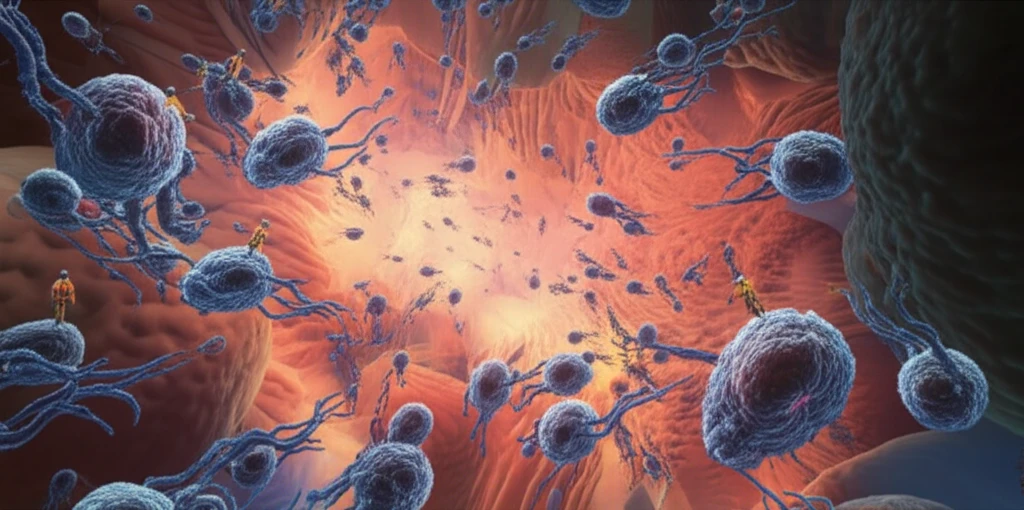
Macrophages: The Unsung Heroes of Your Body's Homeostasis

"Beyond fighting infections, these versatile cells play a crucial role in maintaining balance within your organs, influencing everything from temperature regulation to iron recycling."
For years, macrophages were primarily known for their role in combating infections and aiding tissue repair. However, groundbreaking research reveals that these cells perform a multitude of other essential functions, particularly in maintaining tissue balance (homeostasis) and ensuring organs function correctly. This discovery has led to a re-evaluation of the importance of macrophages in overall health.
Even Elie Metchnikoff, the scientist who discovered macrophages, had a broader understanding of their role, envisioning them as central to a multicellular organism. He believed macrophages could sense disturbances in tissues and respond to damage from both internal and external sources. Importantly, Metchnikoff recognized their vital role in reorganizing and maintaining tissue function by removing dysfunctional elements and unwanted intruders.
Distributed throughout the body in various organs, tissue-resident macrophages act as first responders. They detect stress signals and initiate and regulate both innate and adaptive immune responses, which are crucial for maintaining tissue homeostasis. This understanding emphasizes the need to view macrophages not only as immune cells but also as key players in maintaining overall physiological balance.
Macrophages in Homeostasis
Macrophages contribute to tissue repair, homeostasis, and immune regulation, although the signal-transduction details behind these functions remain incomplete. They are heterogeneous cells with tissue-specific distributions and dynamic polarization states that shape their responses to environmental cues. A 2023 analysis reported that macrophages are present in most tissues, account for about 10% of immune cells, and contribute nearly 50% of total immune-cell mass because of their large size. Research from the Chen Lab also describes transcription factors that establish tissue-specific macrophage identity and small molecules that can reprogram macrophages toward different functions.
A Complex Research Picture
Macrophage research commonly examines how these cells respond to tissue signals, inflammation, and changes in functional state. However, broad labels can oversimplify macrophage biology because their behavior varies across tissues and contexts. The field therefore continues to refine how macrophage states and functions are defined. Important mechanisms and the limits of current approaches remain incompletely resolved.
An Evolving Field
The study of macrophages has developed from viewing them primarily as engulfing immune cells toward recognizing their broader roles in tissue maintenance and immune regulation. Later work has emphasized their diversity, tissue distribution, and ability to change functional state. This historical progression has made macrophages central to modern investigations of immunity, repair, and disease. A complete account of the field's milestones requires more specific historical sources than those provided here.
The Multi-Faceted Roles of Macrophages: More Than Just Immune Cells
Macrophages are now recognized as regulators of diverse tissue environments and functions, making them vital in both health and disease. Research is uncovering the specific types of macrophages, the regulatory pathways they use, and their impact on organ function. This is not just important for basic science; it also holds significant potential for developing new therapies.
- Temperature Regulation: Macrophages have an unexpected role in thermogenesis (heat production) and maintaining body temperature.
- Metabolic Control: These cells play a key role in governing whole-body metabolism, influencing how the body processes energy and responds to insulin. In particular, macrophages drive obesity-induced metaflammation, which interferes with the metabolic effects of insulin.
- Iron Homeostasis: Macrophages are essential for recycling iron from old or damaged red blood cells, ensuring the body has the iron it needs.
- Electrolyte Balance: Recent research shows macrophages regulate electrolyte balance in the kidneys and other areas.
- Vascular Health: Macrophages interact with blood vessels, influencing angiogenesis (blood vessel formation) and contributing to vascular inflammation and hardening of the arteries.
- Tissue Maintenance: In tissues like the skin and cornea, macrophages help maintain the structure and function of these vital barriers.
Current Directions in Macrophage Biology
Recent reviews describe macrophages as versatile innate immune cells that can act as sentinels, warriors, and healers across virtually every tissue. Current work is examining their developmental origins and the organ-specific cues that establish tissue-resident and monocyte-derived programs. Research also focuses on how pathogens induce antimicrobial responses and use secreted molecules to evade host immunity. Other recent coverage highlights macrophage importance in development of the blood-forming and immune systems and in establishing immune tolerance early in life.
Limits and Unresolved Questions
Macrophage biology does not support a single universal functional profile because these cells vary by tissue and environmental context. Attempts to describe them with simple categories may therefore miss important intermediate or changing states. The molecular mechanisms governing their responses are still only partly understood. These limitations make it difficult to predict whether altering macrophage activity will produce the same result in different tissues or diseases.
Macrophages Among Immune Cells
Macrophages are innate immune cells that provide an early defense against pathogens and tumor cells while also participating in inflammation and tumor defense. Monocytes and macrophages are studied together in inflammatory settings, including the roles of chemoattractants, inflammasomes, and integrins. Dendritic cells and macrophages are both phagocytes with a shared ancestry, but they have developed distinct specialized roles in immune surveillance and response. Lymphocytes differ functionally from macrophages: macrophages engulf pathogens, dead cells, and debris while helping alert other immune cells to threats.
The Future of Immunophysiology: Understanding Macrophages for Better Health
The growing understanding of macrophages and their diverse roles has given rise to a new field: immunophysiology. This subdiscipline of physiology focuses on how the immune system, particularly macrophages, interacts with and regulates organ functions.
A Balance of Defense and Repair
Macrophages are best understood as adaptable regulators rather than as cells with one fixed job. Their potential to support defense, cleanup, repair, and immune regulation also creates complexity when their activity becomes poorly controlled. Their effects depend on tissue setting and the signals they receive. This perspective helps explain why macrophages are important to both normal homeostasis and disease research.
Targeting Macrophage Function
Future research is examining how macrophage diversity and tissue-specific biology can be used to design more precise interventions. Aging is a particular focus: one report describes attrition of tissue-resident macrophages alongside expansion of monocyte-derived populations, a shift associated with chronic inflammation and greater vulnerability to disease. In mice, Stanford researchers reported that declining ability of one immune cell to clear another may contribute to aging throughout the body, potentially informing future treatments for age-related decline. Other work is investigating how mechanical forces and biomaterial composition tune macrophage function for future modulatory therapies.
Macrophages Across the Body
Macrophages occur in many tissues, body cavities, and mucosal surfaces, where they form a vital part of innate host defense against pathogens and cancers. Their wide distribution means that macrophage biology is connected to multiple organ systems rather than to a single disease area. Research into their diverse functions may improve understanding of immune regulation and diseases marked by inflammation or immune dysfunction. It also creates a broad clinical challenge: useful immune activity must be preserved while harmful or dysregulated activity is controlled.
From Health to Disease
Macrophages are studied in both health and non-infectious disease because their functions affect ordinary tissue maintenance as well as pathological processes. Research from Tel Aviv University's Gray Faculty of Medical and Health Sciences reported that tumors can hijack a natural immune process after macrophages clear dead cells, promoting cancer progression. This example illustrates how an essential protective activity can have harmful consequences in a different biological context. Understanding that shift may be important for developing interventions that limit disease without eliminating macrophage functions needed for normal health.
By identifying the different types of macrophages, the pathways they use to communicate, and their effects on various organs, scientists hope to develop new ways to treat a wide range of diseases. Targeting macrophages could offer novel therapeutic approaches for metabolic disorders, inflammatory conditions, and even cancer.
The discoveries highlighted in this research mark immunophysiology as a crucial area for understanding overall physiology. Continued exploration of these versatile cells promises to unlock new strategies for promoting health and combating disease.