
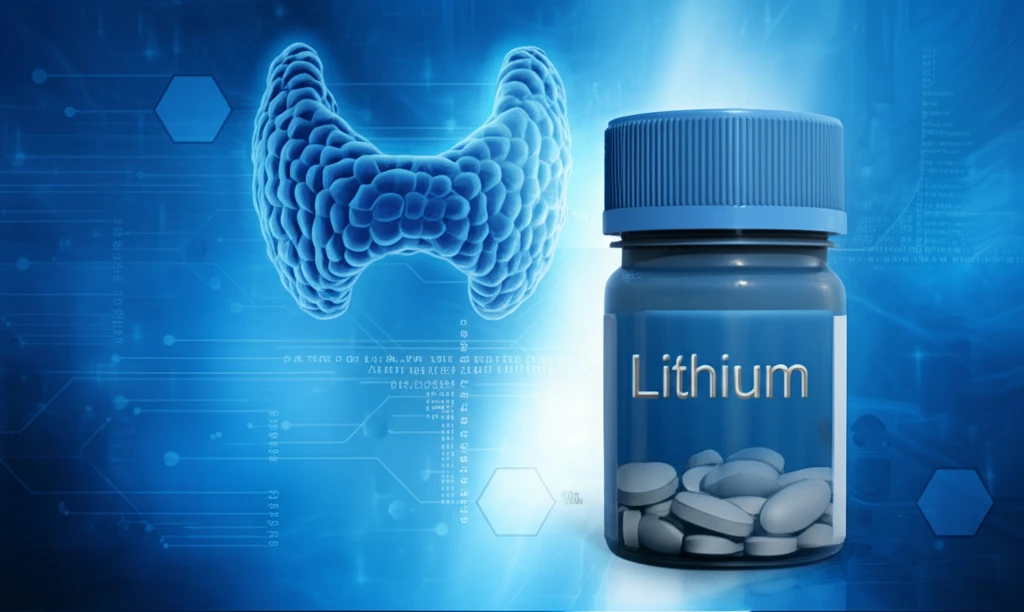
Lithium and Your Thyroid: What You Need to Know About Bipolar Treatment

"Exploring the Link Between Lithium Therapy, Thyroid Function, and Mental Wellness in Bipolar Disorder."
Bipolar affective disorder (BPAD), characterized by significant mood swings, affects millions worldwide. Effective management often involves long-term treatment with mood stabilizers, and lithium has long been a cornerstone of such therapy. While lithium can be incredibly effective, it's essential to be aware of its potential side effects, particularly those related to thyroid function.
The thyroid gland, responsible for producing hormones that regulate metabolism, can be sensitive to lithium's effects. This connection is particularly important for women, who are already at a higher risk for thyroid issues. Understanding the interplay between lithium, thyroid function, and bipolar disorder is key to optimizing treatment and minimizing potential complications.
This article will explore the findings of a hospital-based prospective study that investigated the correlation between serum lithium levels and thyroid function tests in individuals with bipolar disorder. We'll break down the key insights and offer guidance on how to navigate this aspect of your treatment plan, ensuring you stay informed and proactive in managing your health.
Lithium by the Numbers
Lithium is a soft, silvery-white alkali metal that, under standard conditions, is the least dense metal and the least dense solid element. Its supply chain is global: the majority of lithium is mined in South America, followed by China and Australia. Argentina alone holds roughly 20 million metric tons of lithium carbonate equivalent reserves, according to USGS 2023 data compiled in a 2026 research report. The U.S. Geological Survey's national minerals information center tracks these figures through historical statistics and commodity reviews.
Standard Methods and Their Limits
Accepted methods for testing lithium-based systems lean on standardized, repeatable protocols. For batteries, cycle-life testing commonly uses a constant current–constant voltage (CC/CV) charging approach, which produces stable, repeatable cycle-life data across lithium-ion chemistries; related sources describe CC/CV as one of the mainstream phased charging controls alongside constant power. Standardized battery pack designs, however, carry real limitations, including design constraints, customization limits, and energy density and regulatory hurdles. In clinical laboratories, the measurement of lithium in serum is itself standardized, with an automated ion-selective method assessed for linear measurement range, analytical variation, bias, and ongoing proficiency testing.
From 'Stone' to First Mood Stabilizer
Lithium takes its name from the Greek word 'lithos,' meaning stone, because it was first discovered from a mineral source, whereas sodium and potassium were found in plant sources. Interactive periodic table references and historical accounts alike trace the element's name origin to that mineral discovery and note its distinctive properties and early applications. The modern chapter most relevant to mood medicine began with lithium's development as the first mood stabilizer for bipolar disorder. That history, from stone to therapeutic staple, marks lithium as one of psychiatry's foundational discoveries.
Decoding the Lithium-Thyroid Connection: Key Findings
A study conducted at Father Muller Medical College evaluated 150 patients with BPAD undergoing lithium treatment for at least six months. The research aimed to identify correlations between lithium levels in the blood and thyroid function abnormalities. Serum lithium levels were measured using ion-selective electrode method, while thyroid function tests (TFT) were performed using electrochemiluminescence. The data was then analyzed using Karl Pearson Correlation Coefficient to determine any significant relationships.
- Hyperthyroidism (low TSH): 4% of patients (3 males, 3 females) had TSH levels below 0.27 mEq/l, with an average lithium level of 1.35 mEq/l.
- Hypothyroidism (high TSH): 6% of patients (5 males, 4 females) had TSH levels above 4.2 mEq/l, with an average lithium level of 0.44 mEq/l.
- Normal Thyroid Function: The majority (90%) of patients had normal thyroid function, with an average lithium level of 0.66 mEq/l.
Where Lithium Research Is Heading
Current lithium research spans everything from battery engineering to materials science, with news aggregators tracking breakthroughs on an ongoing basis. One notable thread is the study of magnetic field effects on lithium battery performance, where Springer highlights pioneering discoveries and new methods from leading researchers. Separate work on liquid lithium is being published for purposes that include manufacturing lithium CPS samples for further study. On the commercial research side, analysts report significant growth in the military button-type lithium manganese dioxide battery market, with demand running higher than pre-pandemic levels.
The Costs of the Lithium Boom
The lithium boom has drawn sharp counter-arguments focused on environmental and social costs. By far the biggest water impact of renewable energy development is expected to come from mining, and hard rock mining already provides about 63 percent of the world's lithium supply, according to reporting by Inside Climate News. At the same time, the EU's Critical Raw Materials Act, which came into force in 2024 to secure supply of lithium, cobalt, and rare earths, has been criticized for sidelining calls to reduce material use altogether. There are also practical safety concerns: exposure to burning lithium battery fumes carries documented symptoms and emergency-response protocols.
Lithium Versus Its Alternatives
Comparisons of lithium against competing technologies show trade-offs at every scale. Against alkaline chemistry, lithium batteries are positioned as the higher-energy option for household devices such as AAA-powered gear. Against graphene batteries, comparisons hinge on energy density, charging speed, lifespan, cost, and EV applications, with 2026 analyses weighing which chemistry leads. Beyond batteries, lithium as a medication has its own side-by-side comparisons against alternatives, covering uses, ratings, cost, side effects, and interactions. Whatever the domain, the element is rarely evaluated in isolation but always against a rival.
Practical Steps: Monitoring and Maintaining Thyroid Health During Lithium Therapy
If you're taking lithium for bipolar disorder, here's how to stay proactive about your thyroid health:Regular Monitoring: Work closely with your doctor to schedule regular thyroid function tests. These tests will help detect any changes early on. Dosage Adjustment: Be open with your doctor about any symptoms you're experiencing. They may need to adjust your lithium dosage to minimize thyroid impact. Lifestyle Considerations: Support your overall health with a balanced diet, regular exercise, and stress management techniques. These habits can positively influence both your mental and physical well-being. Open Communication: Maintain an open dialogue with your healthcare team. Share any concerns or changes in your health promptly. By taking these steps, you can manage your bipolar disorder effectively while protecting your thyroid health and overall quality of life.
Experts Weigh In on Lithium's Two Fronts
Expert commentary on lithium splits into two fronts: markets and medicine. On markets, opinions are leaning toward a rebound in lithium prices, with analysts expecting alternating surpluses and deficits rather than a single steady trajectory. Forecasting is proving difficult even for major banks; Goldman Sachs' oversupply projection has been openly questioned by experts in the field. On health, lithium is credited with helping prevent mood swings, acting as an anti-anxiety and antidepressant agent, promoting neurogenesis, and protecting against neurodegenerative disease, while some physicians argue experts increasingly recognize lithium's importance to human health.
A Market at a Crossroads
The outlook for lithium is one of growth colliding with constraint. Projections indicate the lithium battery market will see a multi-fold increase in demand over the next decade, while mining sits at a crossroads between dramatic expansion and the need for sustainability. In the near term, prices have been volatile: lithium carbonate fell to about CNY 151,000 in July, a near four-month low, on the outlook for higher global supply. On the technology frontier, next-generation chemistries such as lithium-sulfur are being benchmarked against lithium-ion across energy, lifespan, cost, and safety, with drones, EVs, and electronics as the battlegrounds.
Systemic Hurdles from Mine to Market
Bringing lithium from deposit to device faces systemic hurdles at nearly every step. In Bolivia, the gap between vast reserves and actual production reflects technical challenges, including high magnesium content in brines and the need to significantly modify the evaporation methods that work in Chile's Atacama Desert and Argentina's lithium triangle. Beyond the mine site, markets face the volatility of lithium prices and stringent regulations on transporting lithium batteries, which are flagged as major industry challenges. These technical, market, and regulatory constraints combine to slow the otherwise rapid growth of the lithium economy.
Communities, Wildlife, and the Recycling Gap
The human and ecological footprint of lithium is becoming harder to ignore. Chile has announced a tender for the additional exploration and production of 400,000 tons of metallic lithium outside the Salar de Atacama, while studies warn that expanding brine mining could threaten flamingo populations. Real-world operations vary widely, as a case study of two South American lithium brines - one legacy, one less than a decade old - illustrates, and it questions the old assumption of 1 million tons of demand by 2025. Recycling offers some relief but not a cure-all: one 2023 study estimated about 59 percent of end-of-life lithium-ion batteries are recycled globally, yet supply-demand modeling projects that less than 20 percent of lithium supply will come from recycling by 2050.