
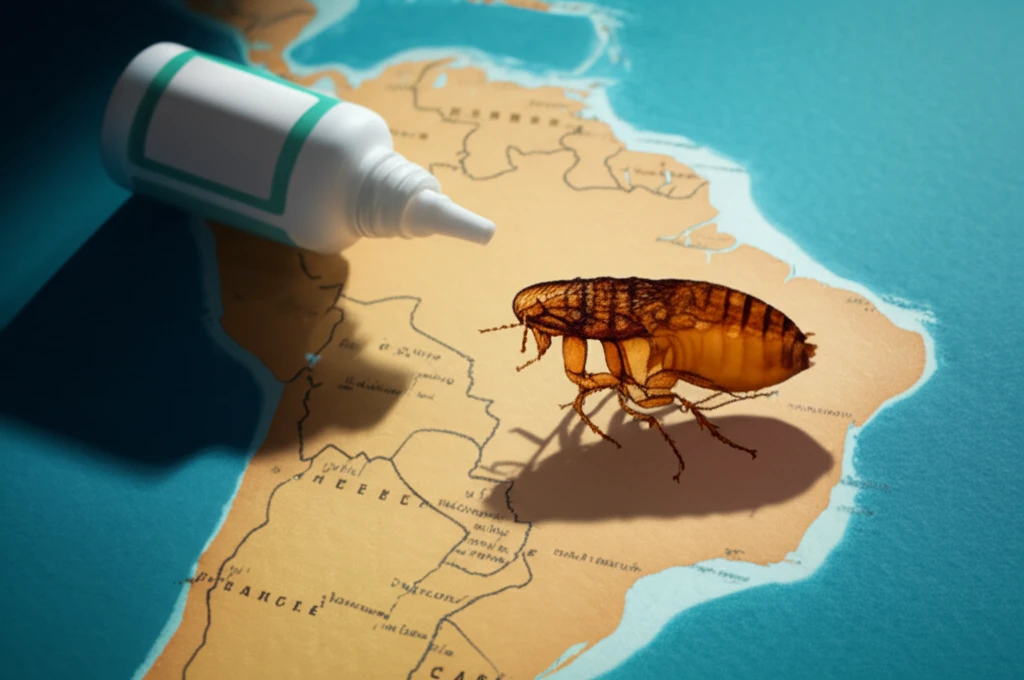
Kissing Bugs Beware: Can This Common Flea Treatment Save Lives?

"A new study reveals imidacloprid, found in flea treatments, as a potential weapon against Chagas disease-carrying kissing bugs, offering hope in pyrethroid-resistant populations."
Chagas disease, a parasitic illness caused by Trypanosoma cruzi, remains a significant health challenge in the Americas. Transmitted primarily by the 'kissing bug' (Triatoma infestans), this disease affects millions and poses a considerable burden on healthcare systems. The primary method of control has long relied on pyrethroid insecticides, but increasing resistance is threatening this approach.
In response to these rising resistance levels, researchers have been investigating alternative insecticides. One promising candidate is imidacloprid, a common ingredient in flea and tick treatments for pets. This readily available compound has shown potential in laboratory settings, prompting further investigation into its effectiveness and application.
A recent study published in Memórias do Instituto Oswaldo Cruz explores the effectiveness of imidacloprid against pyrethroid-resistant populations of Triatoma infestans in the Gran Chaco ecoregion. This research delves into the delayed toxicity of imidacloprid, the impact of insect feeding status on its efficacy, and the performance of various commercial formulations.
A Silent Killer Moving North
Chagas disease is a potentially life-threatening illness caused by the protozoan parasite Trypanosoma cruzi, which is typically transmitted by triatomine bugs of the Reduviid family. The infection begins with a bite by the triatomine bug and can result in serious heart problems. Fewer than 1% of affected individuals receive proper treatment, and current tools to fight the disease are outdated and inadequate. While Chagas is still relatively rare in the United States, climate change could help the disease spread by causing an increase in the number of triatomine insects across the nation.
Testing That Depends on the Stage
The diagnosis of Chagas disease depends on the clinical stage of the infection. In the acute stage, parasitemia is high, so direct microscopy to observe trypomastigotes or PCR is recommended; during this stage parasites circulate and invade a range of tissues, differentiating into intracellular amastigotes that replicate within host cells. In the chronic stage, however, the scarcity of the parasite renders these tests less useful. Serological testing, including CLIA, ELISA, IFA, and TESA-based assays, is used for reliable Trypanosoma cruzi testing.
One Doctor, a Complete Discovery
Chagas disease is named for Carlos Chagas, the Brazilian doctor who discovered it in 1909 and was twice nominated for a Nobel Prize. Chagas achieved an unprecedented feat in the history of medicine by including the whole cycle of the disease in his discovery: the etiological agent T. cruzi and its life cycle, the vector insect (kissing bug), its domestic reservoirs, and the pathology. In Argentina, the disease is also known as Chagas-Mazza disease, marking the contributions of Argentine doctor Salvador Mazza to its study. The World Health Organization classifies Chagas as a neglected tropical disease.
Imidacloprid: A New Hope Against Kissing Bugs?
The study evaluated the impact of imidacloprid on both susceptible and resistant kissing bug populations. Initial findings indicated that the toxic effects of imidacloprid remained consistent up to 72 hours post-exposure, irrespective of whether the insects had recently fed. This is a crucial finding because it suggests that the insecticide's effectiveness isn't significantly hampered by the insect's feeding behavior, simplifying application strategies.
- Spot-On Success: Only the spot-on formulation of imidacloprid demonstrated significant effectiveness.
- Dosage Matters: Nymphs feeding on pigeons treated with 20 mg or 40 mg of the spot-on formulation showed significantly higher mortality rates.
- Residual Effect: The treatment demonstrated effectiveness up to seven days post-application.
- Resistant Populations: The spot-on formulation proved effective against pyrethroid-resistant populations.
Ecological and Clinical Research Advances
Current work on Chagas disease spans both ecological and clinical fronts. Hamer's research and teaching at AgriLife Research broadly investigate the ecology and control of vector-borne infectious diseases in humans, wild animals, and domestic animals, including the vector-host interactions that lead to parasite amplification and increased disease risk. Alongside this, recent diagnostic reviews emphasize that testing depends on the clinical stage: in the acute stage parasitemia is high, making direct microscopy to observe trypomastigotes or PCR recommended, while in the chronic stage the scarcity of the parasite renders these tests less useful.
Why a Neglected Disease Stays Neglected
Chagas disease, also known as American trypanosomiasis, is a neglected tropical disease caused by the parasite Trypanosoma cruzi. Its status as a neglected disease reflects the reality that it has historically received less attention and fewer dedicated resources than other infectious illnesses. Guidance from Acibadem Health Point centers on recognizing the disease's symptoms and pursuing treatment, underscoring how delayed or missed care remains a defining challenge for patients.
Expert Comparison of Parasite and Disease
A comparative examination of Chagas disease is presented by Norma Andrews of the University of Maryland in the first part of her lecture on Trypanosoma cruzi and Chagas' disease. The presentation takes the parasite T. cruzi itself as the lens for understanding the disease it produces, from its biology to its clinical consequences. Such expert-led overviews help connect parasite-level mechanisms with the human disease burden, informing both treatment and prevention.
A Promising Step Forward
While the study highlights the potential of imidacloprid as a control agent, researchers emphasize that it should be integrated into a comprehensive pest management program. Its effectiveness is primarily limited to domestic and peridomestic animals, making targeted application crucial. Further research is needed to evaluate the spot-on formulation under real-world conditions and to optimize its integration into existing control strategies. The fight against Chagas disease is far from over, but this study offers a beacon of hope with readily available solutions.
A Silenced Disease Gains New Tools
Chagas disease is often referred to as a silenced disease because it typically affects low-income communities, leading to a lack of motivation to find effective treatments. At the same time, the application of new technological advances to drug development has led to new, robust, and standardized in vivo animal models that have contributed to a better understanding of host-parasite interactions. Expert commentary also highlights the value of understanding the Trypanosoma cruzi lifecycle when building both conventional and holistic, integrative care strategies around symptoms and prevention.
A Century Later, Control Efforts Continue
Just over a century ago, Carlos Chagas discovered American trypanosomiasis—named Chagas disease in his honor—and described its clinical aspects, laying the groundwork for what remains a worldwide health challenge. The future of Chagas disease control remains an active frontier in research. Pipeline analyses describe the disease as presenting in two phases: an initial acute phase that lasts about two months after infection, during which a high number of parasites circulate in the blood, though in most cases symptoms are absent, mild, or unspecific.
From Endemic Regions to Global Mother-to-Child Spread
Chagas disease is found mainly in endemic areas of 21 continental Latin American countries, spread by triatomine bugs, while globally it is most frequently transmitted during pregnancy or childbirth—though it can be prevented with earlier treatment. The infection presents with recognizable early signs, including swelling of one eyelid if the parasite enters through the eye, as well as rash or loss of appetite. During the chronic phase, it produces long-term impacts on the heart and body, underscoring why recognizing symptoms and seeking help early matters.
Bed Bugs: A New Household Risk
A study from Penn Medicine researchers in the Center for Clinical Epidemiology and Biostatistics demonstrated that bed bugs, like triatomines, can transmit Trypanosoma cruzi, the parasite that causes Chagas disease. The finding expands the range of household insects implicated in transmission beyond the classic kissing-bug route. Because Chagas is one of the most prevalent and deadly diseases in the Americas, transmission risks that reach into people's homes carry significant implications for public health.