
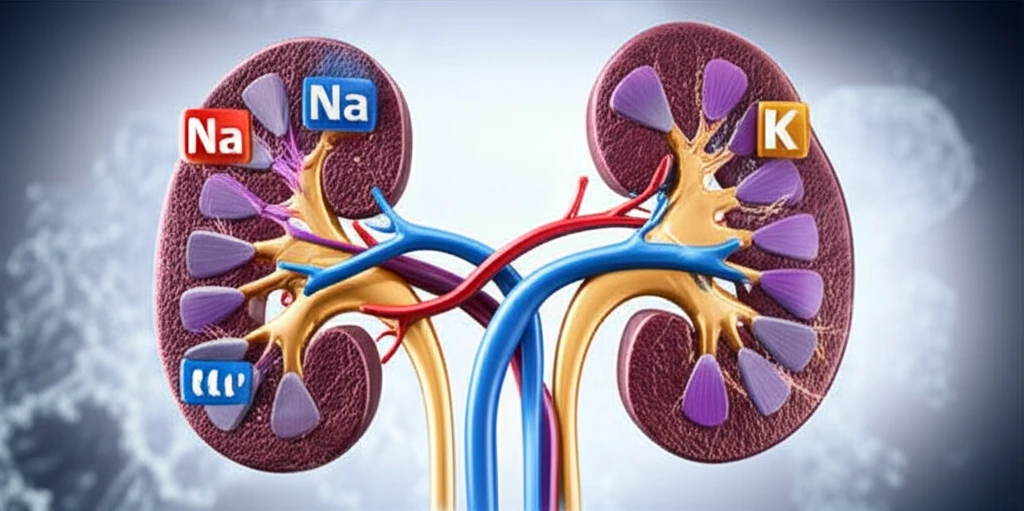
Kidney Health Alert: Are Sodium and Potassium Levels Affecting Your Uric Acid?

"New research reveals the critical link between sodium, potassium, and uric acid excretion in chronic kidney disease, particularly for those with hypertension. Learn how to manage your diet for better kidney health."
If you're managing chronic kidney disease (CKD), you’re likely familiar with the constant balancing act required to maintain your health. Among the many factors to consider, the relationship between hypertension, hyperuricemia (high uric acid levels), and the excretion of key minerals like sodium and potassium plays a crucial role. Recent studies shed light on how these elements interact, particularly in individuals with CKD.
Hypertension and hyperuricemia often go hand-in-hand, creating a complex cycle of cause and effect. High blood pressure can impact kidney function, leading to reduced uric acid excretion, which in turn can exacerbate hyperuricemia. Adding another layer to this intricate web, sodium and potassium levels—influenced by diet—can significantly affect blood pressure and kidney health.
New research published in Kidney Blood Pressure Research uncovers critical associations between urinary sodium and potassium excretion and renal uric acid handling in CKD patients. This article translates these findings into actionable insights, offering a clear understanding of how your dietary choices can impact your kidney health and uric acid levels.
Kidney Function and Disease Burden
Each kidney connects to a ureter, which carries excreted urine to the bladder. The kidneys help regulate body-fluid volume, fluid osmolality, acid–base balance, electrolyte concentrations, and toxin removal. Kidney problems include acute or chronic kidney failure, end-stage renal disease, kidney cancer such as renal cell carcinoma, kidney infections, and other forms of kidney disease.
Awareness and Recognition
The National Kidney Foundation reports that 37 million people in the United States have kidney disease, while only 10% know they have it. This gap highlights a limitation of relying on awareness or noticeable symptoms alone. Recognizing kidney disease therefore remains an important public-health challenge.
A Developing Medical Perspective
Understanding of kidney health has developed through efforts to explain how the kidneys regulate body fluids and remove waste. Medical knowledge now distinguishes among acute kidney problems, chronic kidney disease, infections, cancer, and kidney failure. The supplied material does not establish specific historical milestones or dates, so broader claims should be treated cautiously.
The Sodium-Potassium-Uric Acid Connection: What the Study Revealed?
The study, conducted with 428 CKD patients, explored the correlation between urinary sodium and potassium levels and how the kidneys handle uric acid. Patients were divided into two groups: those with hypertension and those without. Researchers used sophisticated statistical methods to analyze the relationships between these factors.
- Hypertension Matters: In hypertensive patients, higher fractional excretion of sodium (FEna) was linked to lower levels of uric acid in urine (24-hUur) and reduced uric acid clearance (Cur). Conversely, FEna was positively correlated with the fractional excretion of uric acid (FEur).
- Potassium's Role: Fractional excretion of potassium (FEk) also showed a positive correlation with FEur in hypertensive individuals.
- Sodium-Potassium Ratio: A higher urinary sodium/potassium ratio (Una/k) was associated with lower 24-h Uur and Cur but higher FEur.
- eGFR Impact: The relationships between FEna, FEk, and FEur were most pronounced in patients with lower estimated glomerular filtration rates (eGFR), indicating that kidney function significantly influences these dynamics.
- Non-Hypertensive Differences: In non-hypertensive patients, a higher FEna was only linked to lower 24-h Uur, with no significant relationships observed for Cur or FEur.
Current Evidence
Current discussions of kidney health commonly distinguish acute problems from chronic disease. However, the supplied material does not provide specific recent studies, review findings, or quantified evidence about how sodium and potassium levels affect uric acid. Any conclusions about that relationship therefore require additional, topic-specific research.
Limits of Available Evidence
The available material does not establish that sodium or potassium changes directly determine uric acid levels. It also does not provide comparative trials, failed interventions, or evidence resolving competing explanations. Claims about causation should therefore remain tentative without more targeted sources.
Comparing Kidney Conditions
The supplied sources describe several distinct kidney conditions, including acute and chronic kidney failure, infection, cancer, and end-stage renal disease. They do not provide a comparison of sodium or potassium patterns across those conditions or explain differences in uric acid. Such comparisons would require evidence beyond the listed material.
Practical Steps for Managing Your Kidney Health
Understanding the connection between sodium, potassium, and uric acid can empower you to make informed dietary choices that support your kidney health. Here are some practical steps to consider:
A Cautious Synthesis
The kidneys regulate fluid balance, acid–base balance, electrolytes, and toxin removal, making kidney function relevant to overall metabolic health. The supplied sources also show that kidney disease can be acute, chronic, infectious, cancer-related, or associated with complete loss of function. They do not, however, support a specific conclusion about sodium, potassium, and uric acid together.
Questions for Future Research
Future research could clarify how electrolyte regulation and uric acid metabolism interact in different forms of kidney disease. It could also distinguish patterns associated with acute kidney problems from those linked to chronic disease or end-stage renal disease. The supplied sources do not provide projections or identify established next-generation methods.
The Public-Health Challenge
The National Kidney Foundation reports that 37 million people in the United States have kidney disease, but only 10% know it. This reported gap suggests that underrecognition is a major systemic challenge. The available sources do not identify the causes of that gap or evaluate specific policy responses.
Recognizing Kidney Disease
Kidney disease may involve sudden problems, long-term impairment, infection, cancer, or complete loss of kidney function. The National Kidney Foundation provides information about common signs and symptoms and what they may mean for health. The supplied material does not establish which symptoms are specific to altered sodium, potassium, or uric acid levels.