
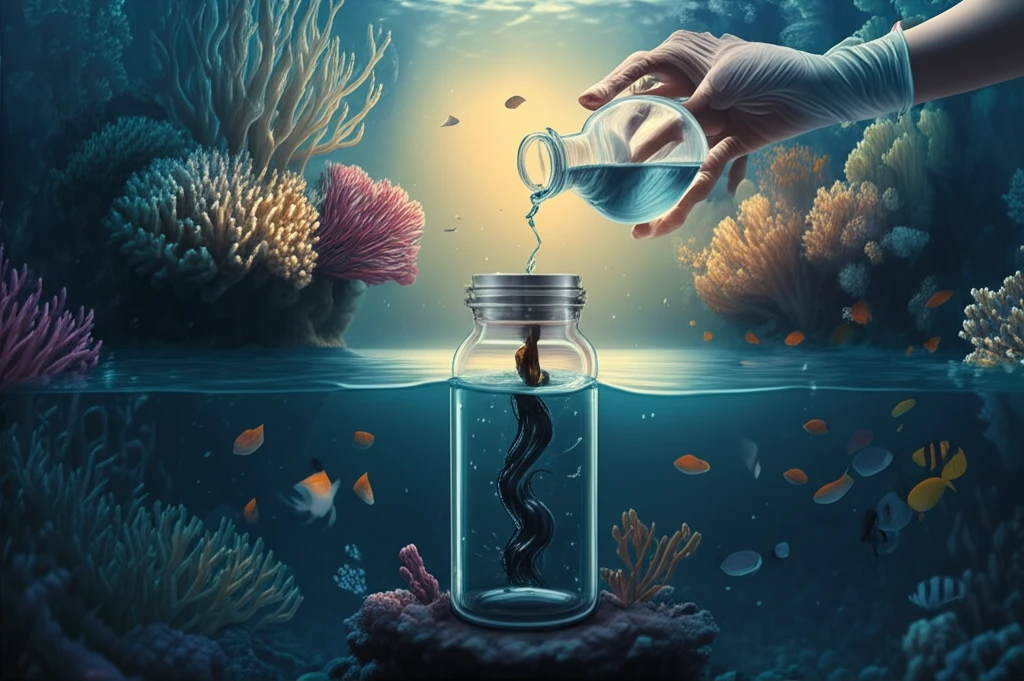
Is Your Water Safe? The Surprising Alternative to Toxic Preservatives in Seawater Samples

"Ditch the Mercury: Discover how benzalkonium chloride (BAC) could revolutionize seawater preservation, offering a safer, eco-friendly alternative for scientific research."
Imagine needing to collect seawater samples for crucial research, only to face the challenge of preserving them without harming the environment. For decades, scientists have relied on mercuric chloride (HgCl2) to inhibit microbial activity in these samples, ensuring accurate analysis back in the lab. However, this seemingly simple solution comes with a dark side: HgCl2 is highly toxic, accumulates in ecosystems, and requires costly, specialized disposal.
The environmental risks and financial burdens associated with mercuric chloride have fueled a global search for safer alternatives. Enter benzalkonium chloride (BAC), a widely used disinfectant found in everything from hospitals to household cleaners. But could this common antimicrobial agent effectively preserve precious seawater samples without the hazards of mercury?
A groundbreaking study published in "Ocean Science" investigates the potential of BAC as a suitable substitute for HgCl2. The findings could revolutionize how we approach seawater preservation, offering a pathway to more sustainable and environmentally conscious research practices. Let's dive into the details of this innovative research and explore the potential implications for our oceans and beyond.
Silver's Growing Role in Seawater Preservation
Silver-based preservation is emerging as a practical tool for keeping seawater samples stable without highly toxic chemicals. Experiments evaluating carbonate chemistry have used seawater with 25 μM silver nitrate added, at a salinity of 32.9 and pH of 8.1. Researchers report that silver preserves seawater carbonate chemistry as effectively as mercury for short-term storage, while noting that copper interferes with total alkalinity measurement. Preserved samples held at room temperature in the dark remained suitable for downstream analysis across storage windows of roughly 40 to 203 days after sampling. The appeal of silver is that it offers a less toxic route to reliable, long-lived samples.
The Toxic Preservatives Dilemma
Accepted methods for preserving seawater still lean heavily on chemical preservatives and cold handling, and that reliance is increasingly seen as a limitation. Researchers working on carbonate chemistry parameters such as DIC, pH, and alkalinity report that they are not aware of a way to preserve a sample non-toxically, highlighting a genuine gap in current practice. Standard field survey guides likewise list sample preservatives and storage bags among routine equipment for collecting specimens. For microbial work, the BioDry method has been proposed as an inexpensive, low-power alternative to conventional preservation. The absence of a widely accepted non-toxic option is exactly what drives the search for substitutes like silver.
From Natural Preservation to Laboratory Methods
Questions about how seawater chemistry and biology survive over time are as old as marine sampling itself. Foundational work on organic matter preservation has examined how natural organic material complexes with different clays, including a first-of-its-kind in-situ test using three types of clays along a seawater column. A separate milestone is the discovery of ancient seawater preserved from the last Ice Age, showing that natural geological processes can isolate and lock in ocean chemistry for thousands of years. These discoveries frame the modern debate about how best to stabilize collected samples without altering the very chemistry scientists want to measure.
The Mercury Problem: Why We Need a Change
Mercuric chloride's effectiveness as a preservative is undeniable. It halts microbial activity, preventing the alteration of key parameters like oxygen levels, inorganic carbon, and nutrients in seawater samples. This preservation is crucial for accurate analysis when immediate testing isn't possible. However, the cost of this convenience is steep.
- Environmental Hazard: Mercury contaminates aquatic environments, harming wildlife.
- Health Risks: Mercury exposure can lead to severe health problems in humans.
- Bioaccumulation: Mercury concentrates in the food chain, posing risks to top predators.
- Costly Disposal: Mercury waste requires specialized and expensive handling.
Freezing and Other Non-Chemical Routes
Recent work continues to test alternatives to chemical dosing, with freezing emerging as a candidate preservation technique. Researchers have evaluated freezing for the preservation of dissolved organic carbon, nitrogen, and phosphorus in water samples. For nutrient measurements, the addition of sodium hydroxide has likewise been examined as a preservation approach for soluble reactive phosphate, nitrite, and nitrate plus nitrite. Together these studies reflect ongoing efforts to cut reliance on toxic preservatives while keeping samples analyzable over time.
Why One Preservation Method Does Not Fit All
Not every preservation strategy translates cleanly across laboratories, regions, or sample types. Analysts note that field and laboratory practices diverge, with warm packs commonly used in the United States to keep specimens at temperature while water baths and other techniques are favored elsewhere. The stated goal is the same—preserving sample integrity and obtaining reliable results—but such variation can complicate comparisons across studies. This practical inconsistency is a reminder that sample preservation is as much a logistics challenge as a chemistry one.
Head-to-Head Tests of Preservation Alternatives
Direct comparisons of preservation methods are still relatively uncommon, but controlled studies are beginning to fill that gap. One investigation has examined alternative preservation methods for seawater reference samples used in pCO2 and dissolved inorganic carbon measurements. Preliminary results using Membrane Inlet Mass Spectrometry (MIMS) are helping to show which substitutes could plausibly replace toxic preservatives. Such comparative testing is a necessary step before any alternative method can be adopted with confidence across the community.
The Future of Seawater Preservation
The research on benzalkonium chloride as a seawater preservative marks a significant step forward in sustainable oceanographic research. While further studies are needed to fully understand its long-term effects and optimal applications, BAC holds immense promise as a safer, more environmentally friendly alternative to mercuric chloride. By embracing such innovations, we can minimize our impact on delicate marine ecosystems while continuing to unlock the mysteries of our oceans. The journey toward sustainable science is one small step at a time.
Building Best Practice for Long-Term Storage
When it comes to long-term nutrient storage, the field's experts are still converging on a recommendation. A EuroGO-SHIP pilot project was established specifically to compare and recommend methods for preserving seawater, with findings presented by marine chemist Malcolm Woodward. The initiative reflects a broader community push to identify methods that protect sample integrity without the toxicity of traditional chemicals. Recommendations emerging from such pilots could well become de facto best practice for long-term storage in the years ahead.
Monitoring a Changing Ocean
The future of seawater monitoring will be shaped by both new science and a new generation of ocean researchers. UNESCO's Intergovernmental Oceanographic Commission is advancing ocean science and capacity building, with initiatives such as Africa Week 2026 spotlighting water, youth, and peace, and programs engaging young people in marine investigations. Climate research meanwhile stresses the importance of planning for changing conditions, noting that California has recently recorded two of its driest three-year periods, two of its wettest years, and groundwater declines in nearly half of its wells. Reliable sample preservation underpins the long-term observation networks needed to track such shifts.
Preservation Within a Larger System
Beyond any single laboratory, the challenge of seawater preservation sits within broader systemic questions about environmental monitoring, chemical safety, and cross-national data comparability. Laboratories operate under different regulations, budgets, and levels of equipment access, which inevitably shapes which preservation methods are practical for them. Wider adoption of less toxic alternatives would depend on validation across many settings and on consistent standards that are not always in place. These institutional and logistical factors may matter as much as the chemistry itself, though they are not always well documented.
Ancient Water, Modern Questions
The stakes of understanding preserved seawater extend deep underground and far back in time. Researchers believe they have identified what may be the oldest large body of ancient seawater in the world, a briny deposit located far from the coast. People have known about and dug up this saltwater from hundreds of meters below the surface for decades, yet its scientific significance is only now coming into focus. Such finds illustrate how preservation—whether natural in the earth or deliberate in the lab—connects distant geological eras to today's questions about ocean chemistry and sample reliability.