
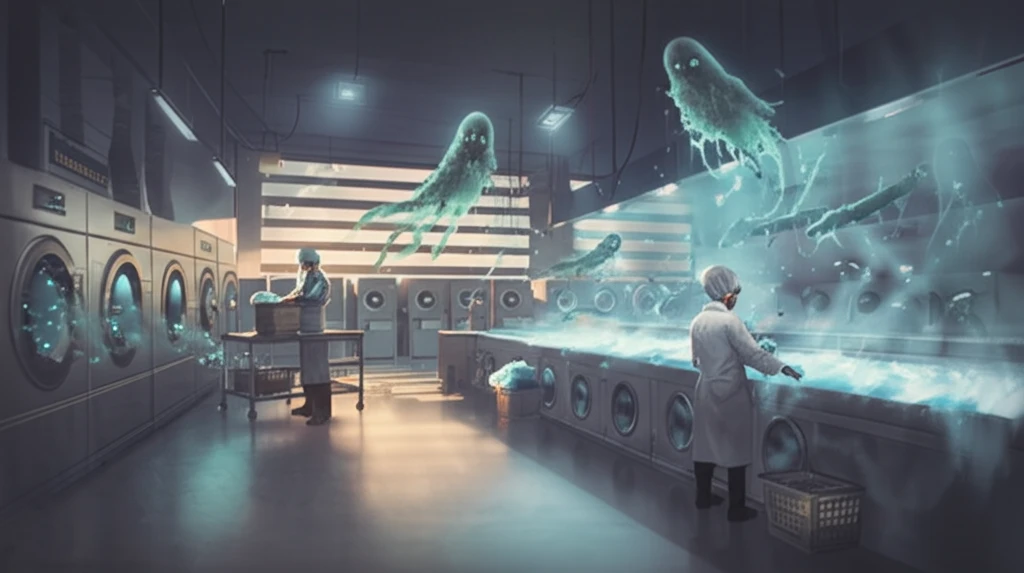
Is Your Laundry Making You Sick? The Hidden Dangers in Hospital Linens

"Uncover the alarming truth about environmental contamination in healthcare laundry facilities and how it impacts worker health."
For decades, hospitals have focused on meticulously cleaning patient rooms to prevent the spread of infections. Yet, a less visible but equally critical area has often been overlooked: the laundry facilities that process soiled clinical linens. These linens, teeming with potentially dangerous pathogens, could pose a significant health risk to the dedicated workers who handle them.
Clostridium difficile, methicillin-resistant Staphylococcus aureus (MRSA), and vancomycin-resistant enterococci (VRE) are not just scary names; they are real threats that can cause serious nosocomial infections. These pathogens have a knack for survival, lingering on surfaces and in dust for extended periods, defying standard cleaning protocols.
Imagine a scenario where laundry workers, day in and day out, are unknowingly exposed to these resilient microbes. They unload trucks filled with soiled linens, sort through contaminated materials, and operate machinery that churns and processes items teeming with bacteria. This isn't just about cleanliness; it's about occupational health and the potential for long-term consequences.
Contamination Is the Rule, Not the Exception
Hospital laundry can be contaminated with far more than bloodborne infectious agents: CDC guidelines note that contaminated textiles and fabrics often contain high numbers of microorganisms from body substances, including blood, skin, stool, urine, vomitus, and other body tissues and fluids. Research using published data has characterized laundry infection risks for respiratory and enteric pathogens relative to a single-user contact scenario, benchmarked against a 1.0 × 10⁻⁶ acceptable risk threshold. Assessments of laundry workers in health facilities also document routine exposure to workplace hazards, underscoring that those who handle soiled linens carry much of the burden. While home laundering is a different contamination scenario than hospital linen processing, commentary on laundry practices reinforces the broader point that chemistry can matter as much as heat.
PPE, Precautions, and the Limits of the Evidence
The accepted approach to hospital laundry rests on standard precautions, with guidelines stressing that workers handling contaminated laundry at any point in the process must wear appropriate personal protective equipment, and OSHA's Bloodborne Pathogens Standard specifies the PPE required for laundry handlers. Infection-control reviews likewise describe standard precaution measures, along with processes to remove microbial contamination from used and worn laundry, as important for reducing the risk of disease transmission to patients and staff. The evidence base, however, is built largely on clinical guidelines rather than high-strength trials, which limits how definitive the recommended practices can be. As the guidance itself emphasizes, choices in laundry handling and disinfection matter to the outcome.
From a Fatal Outbreak to a Culture-Based Fix
A landmark cautionary milestone came in Hong Kong, where contaminated laundry was tied to an outbreak of cutaneous and pulmonary zygomycosis that killed three immunocompromised patients and sickened three others at Queen Mary Hospital. Yet the CDC has long observed that few, if any, healthcare-associated infections have been linked to contaminated laundry, and that such laundry from isolation areas is typically segregated and handled with special practices — making the Hong Kong case a striking exception. A later study of a clinical laundry facility set out to determine how dirty linens from hospitals and clinics affected the laundry's own environment. That work pointed toward a practical milestone: targeted interventions guided by site inspections and step-wise culturing significantly reduced Mucorales-contaminated hospital linens delivered to the hospital.
The Sobering Reality: Pathogens in the Laundry
A recent study conducted at a hospital laundry facility in Seattle, Washington, sheds light on this often-ignored issue. Researchers meticulously assessed surface contamination, collecting 240 swab samples over several months. The results were eye-opening: all three pathogens—C. difficile, MRSA, and VRE—were present in both the 'dirty' (pre-wash) and 'clean' (post-wash) areas of the facility.
- C. difficile: OR = 15.5
- MRSA: OR = 14.8
- VRE: OR = 12.6
The Laundry Facility as an Extension of the Hospital
Recent research has turned attention to clinical laundry facilities themselves as potential reservoirs of infection. In a study at a Seattle facility that processes about 300,000 pounds of laundry each week from six area hospitals, 30 outpatient clinics, and the Washington National Primate Research Center, environmental samples were collected to examine how soiled linens affect the facility environment. The investigation identified contamination consistent with Clostridium difficile, suggesting that soiled clinical linens may contribute to the spread of the pathogen beyond patient rooms. Because of this, researchers have argued that laundry facilities should be considered an extension of the healthcare environment when planning infection prevention and occupational health programs.
Reassurance Versus Reality
Reasonable counterarguments exist. Some infection-control experts hold that the risk laundry poses is relatively small, given how rarely contamination has been linked to actual patient illness in routine practice, and they point out that environmental findings do not by themselves prove transmission. Others caution that sampling studies capture contamination, not infection, and that many pathogens found on linens are unlikely to survive typical handling and laundering. These perspectives argue for calibrating concern rather than treating every contamination finding as proof of harm, while still supporting prudent precautions.
Hospital Versus Home Laundry Risks
Meaningful comparison between hospital and household laundry is difficult because the two settings differ so much in scale, contaminant load, and oversight. Institutional linens tend to be heavily soiled, handled by trained staff under formal protocols, and processed at high volume, whereas home laundry involves smaller loads, variable practices, and far less monitoring. Differences in water temperature, detergent chemistry, and drying habits also shift outcomes, making blanket rules hard to apply across both settings. In the end, the comparison mainly reinforces that risk depends on how linens are handled and disinfected rather than on any single variable.
Taking Action: Protecting Laundry Workers
This study serves as a wake-up call, emphasizing that laundry facilities processing soiled clinical linens can indeed become reservoirs of contamination. Workers handling these linens face a heightened risk of exposure to dangerous pathogens. Thankfully, awareness is the first step, and this research has already prompted changes. Improved protocols for preventing and reducing environmental contamination have been implemented, offering a safer working environment for these essential personnel.
A Problem of Process, Not Panic
Across the evidence reviewed, hospital laundry is best framed as a process to be managed rather than a source of alarm. Contamination of soiled linens is common and well documented, yet confirmed patient harm from laundry appears to be rare, which suggests that handling and disinfection practices — not linens themselves — drive most of the residual risk. Where experts have weighed in, the emerging view treats laundry operations as deserving the same hygiene discipline as any other healthcare environment. The practical takeaway is to maintain standard precautions consistently, monitor for contamination, and treat anomalies as opportunities for investigation rather than dismissal.
Cleaner Chemistry and Smarter Monitoring
Going forward, hospital laundry is expected to rely even more on dedicated, specially trained staff and contracted laundry services that build infection control into everyday procedure. Attention is also turning to the chemistry of laundering itself, with detergent formulations emerging as a key frontier for reducing microbial load while preserving fabric performance. On the research side, the study of Clostridium difficile environmental contamination within a clinical laundry facility in the USA has pushed the field to view laundry facilities as an extension of the healthcare environment. That framing implies future work will tie environmental monitoring in laundries directly to hospital infection-prevention and occupational-health programs.
A Link in a Larger Chain
Hospital laundry sits within a broader infection-control system that also includes sterilization, surface disinfection, hand hygiene, and stewardship of antimicrobials, and its weaknesses often mirror systemic pressures such as staffing, training, and cost. The use of contracted laundry services, for example, can make oversight harder when facilities and providers share responsibility across an organizational boundary. Hard-to-kill organisms and shifting resistance patterns complicate standard approaches, while gaps between guideline expectations and day-to-day practice remain a persistent challenge. Lasting improvement therefore depends less on any single innovation than on coordination, training, and accountability across the whole chain.
The People Behind the Statistics
Behind the contamination data are people whose health hangs in the balance. In Hong Kong, contaminated laundry was linked to an outbreak of cutaneous and pulmonary zygomycosis that killed three immunocompromised patients and sickened three others at Queen Mary Hospital — a stark reminder of what these failures can cost. On the other side of the equation, an investigation of a laundry facility serving several Seattle-area hospitals suggested that soiled clinical linens may be a source of surface Clostridium difficile contamination, carrying implications for the workers who handle them every day. For immunocompromised patients and laundry staff alike, the stakes are real and the margin for error is thin.