
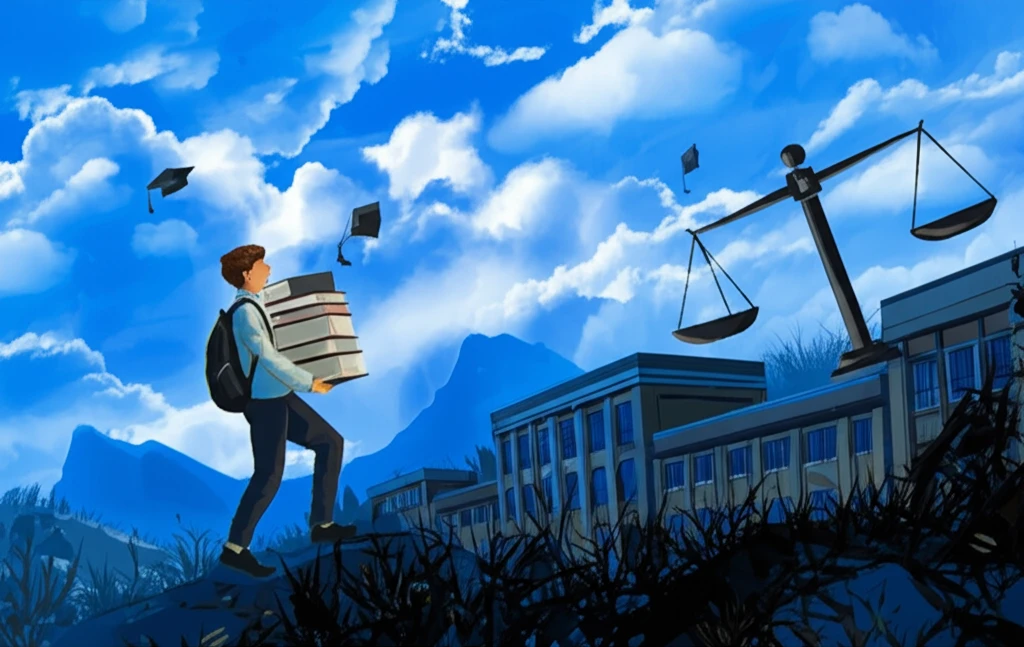
Is Your Kid Burning Out? How to Spot Academic Burnout and Help Them Thrive

"Effort, Reward, and Middle School Stress: Understanding the Link and What Parents Can Do"
In today's demanding educational landscape, the pressure on middle school students is immense. From rigorous testing to high parental expectations, young learners face a multitude of stressors that can significantly impact their mental and emotional well-being. Understanding the sources and consequences of academic stress is the first step in fostering a healthier learning environment for our children.
Academic burnout, characterized by emotional exhaustion, cynicism, and a sense of inefficacy, is a growing concern among students. This syndrome not only affects their academic performance but also their overall mental health, leading to potential issues like depression and suicidal thoughts. Recognizing the signs of burnout early on is crucial for timely intervention and support.
Recent research from Korea University sheds light on the critical relationship between effort-reward imbalance and academic burnout in middle school students. This study explores how students perceive the balance between their academic efforts and the rewards they receive, and how this imbalance can lead to burnout. Moreover, it examines the effectiveness of different coping strategies in mitigating these effects.
The Scale of Academic Burnout
Academic burnout is not evenly distributed among students, with roughly 40% of students maintaining good learning conditions while the remaining 60% experience some degree of burnout crowncounseling.com. The issue is widespread across higher education, with multiple verified datasets confirming it as a significant and growing concern wifitalents.com. College students in particular face intense and constant pressure that contributes to burnout rates, making it one of the most pressing challenges in student well-being zipdo.co. Burnout manifests differently across demographics and academic contexts, meaning there is no single profile of an at-risk student.
How Academic Burnout Is Identified Today
Academic burnout is distinct from ordinary exam stress and typically accumulates gradually through unrealistic expectations, poor sleep habits, ineffective revision methods, and insufficient downtime ibos.school. Recent research has focused on developing validated academic burnout scales to improve identification and measurement in higher education settings link.springer.com. Standard assessment tools are being refined because prior methods lacked the accuracy needed to capture the syndrome's multi-dimensional nature link.springer.com. Despite advances, challenges remain in distinguishing burnout from related constructs like depression and general stress .
The Origins of Burnout as a Concept
The concept of burnout originated in occupational psychology in the 1970s, coined by Herbert Freudenberger and later systematized by Christina Maslach washingtonpost.com. Academic burnout specifically refers to the form experienced by university students as a result of prolonged academic stress and demands, extending the original occupational framework en.wikipedia.org. The term entered mainstream consciousness prominently around 2021, when burnout became a dominant cultural conversation washingtonpost.com. Academic burnout is generally described as a response to sustained academic pressure, not a reaction to a single difficult period macaron.im.
The Effort-Reward Imbalance: A Key Factor in Academic Burnout
The study defines 'effort' as the time and energy students invest in their academic performance, while 'reward' encompasses good grades, recognition, and support from teachers, friends, and family. When students feel that their efforts are not adequately rewarded, it creates an imbalance that can lead to significant psychological distress.
- Open Communication: Encourage your child to express their feelings about their academic workload and the recognition they receive.
- Balanced Expectations: Help your child set realistic goals and avoid excessive pressure to achieve perfection.
- Celebrate Effort: Acknowledge and celebrate your child's efforts, not just the outcomes. Recognize their hard work and dedication, regardless of the final grade.
- Seek Support: If your child is struggling, don't hesitate to seek support from teachers, counselors, or other professionals.
New Findings on Burnout Profiles in Students
A 2026 study published in Frontiers in Public Health found that academic burnout among undergraduate nursing students is heterogeneous, with approximately one-third classified into a high-burnout profile frontiersin.org. The research identified professional identity as having a clear inverse gradient across burnout profiles — meaning students with weaker professional identity experienced more severe burnout frontiersin.org. This suggests that fostering a sense of professional purpose may serve as a protective factor against burnout. The study highlights that burnout cannot be treated as a uniform experience and requires nuanced, profile-based interventions.
Is Burnout a Disorder or a Structural Failure?
There is ongoing debate about whether burnout should be conceptualized as a mental disorder, with researchers, clinicians, and the public acknowledging it as a pervasive occupational difficulty while disagreeing on its classification pmc.ncbi.nlm.nih.gov. Some critics argue that framing burnout as an individual pathology risks obscuring the systemic and organizational causes that drive it pmc.ncbi.nlm.nih.gov. Others contend that without formal diagnostic status, burnout sufferers may struggle to access appropriate support and accommodations pmc.ncbi.nlm.nih.gov. The tension between individual-level and structural-level explanations remains unresolved in the literature.
Supporting a Burned-Out Student: Listening vs. Fixing
Academic burnout often becomes visible in social interactions — such as group chats — before it appears in grades or formal assessments nowserving.ph. When supporting a friend experiencing burnout, there is a natural tension between the impulse to fix the problem and the need to simply listen nowserving.ph. Effective support requires recognizing this balance and meeting the burned-out student where they are rather than imposing solutions nowserving.ph. This peer-level perspective complements clinical approaches by highlighting the everyday social dynamics in which burnout manifests.
Practical Implications and Future Directions
The findings of this study offer valuable insights for teachers, school psychologists, and parents. By recognizing the impact of effort-reward imbalance on academic burnout, educators can implement strategies to create a more supportive and equitable learning environment. Encouraging open communication, setting realistic expectations, and celebrating effort can help mitigate the negative effects of burnout and promote student well-being. Addressing burnout is a continuous effort. By fostering open communication, balanced expectations, and celebrating effort, parents and educators can help students navigate their academic journey with greater resilience and well-being.
Beyond Quiet Quitting in Academia
Expert commentary suggests that 'quiet quitting' — disengaging while remaining nominally present — does not solve the problem of burnout in academic settings insidehighered.com. The approach of simply slogging through each day with little enthusiasm, or leaving academia entirely, fails to address the root causes of burnout insidehighered.com. Scholars argue there must be a better approach that neither involves abandoning academic work nor enduring it in a state of chronic disengagement insidehighered.com. This perspective challenges both students and institutions to pursue meaningful structural change rather than surface-level coping strategies.
Burnout as a Defining Challenge for Students
Burnout has become what some describe as the 'common language among obsessive intellectuals,' reflecting how deeply it is embedded in academic culture theteenmagazine.com. Research defines academic burnout as a psychological syndrome characterized by chronic stress, emotional exhaustion, and a diminished sense of personal accomplishment in academic contexts academia.edu. As academic demands continue to intensify, addressing burnout will likely require integrated approaches that combine mental health support with structural reform theteenmagazine.com. The growing body of research suggests the field is moving toward more personalized, evidence-based interventions.
Systemic Roots of Academic Burnout
Although burnout is influenced by systemic issues, researchers emphasize that both individuals and institutions can take practical steps to reduce its impact linkedin.com. Self-esteem has been identified as a key factor in academic burnout, with social cognitive theory suggesting that an individual's self-confidence toward academic tasks directly influences burnout risk frontiersin.org. A 2025 Frontiers in Psychology study examined the relationship between stress and academic burnout, finding that systemic pressures compound individual vulnerabilities frontiersin.org. Addressing burnout effectively requires action at both the personal and institutional levels.
What Burnout Means for Students and Families
While academic burnout is a well-documented phenomenon, its real-world impact on individual students and their families remains difficult to quantify precisely, as experiences vary widely across contexts. What is clear is that burnout affects not just grades but relationships, motivation, and long-term well-being. Parents and caregivers often struggle to distinguish between normal academic stress and the more chronic, debilitating pattern of burnout. Open communication and early intervention remain the most consistently recommended approaches, though access to resources varies significantly across schools and communities.