
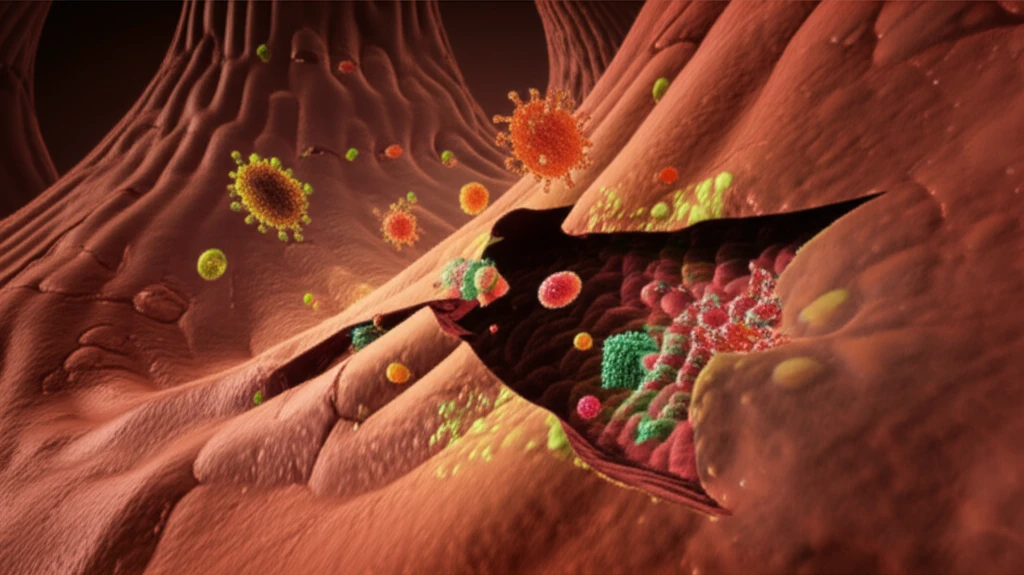
Is Your Gut Under Attack? The Hidden Dangers of Zearalenone

"Unmasking the toxic effects of a common food contaminant and its impact on your intestinal health."
In today's world, environmental pollutants pose a significant threat to our health, silently compromising our immune systems and paving the way for various ailments. Among these hidden dangers is Zearalenone (ZEA), a mycotoxin produced by Fusarium fungi, commonly found in grains worldwide. While its estrogenic effects are well-documented, the impact of ZEA on our intestinal health often goes unnoticed.
Your gut is the frontline defender of your overall well-being. It plays a crucial role in nutrient absorption and immune function. This article delves into the groundbreaking research that uncovers the toxic effects of ZEA on the intestinal microflora and mucosal immunity in mice, shedding light on the potential risks to human health.
We'll explore how ZEA exposure disrupts the delicate balance of the gut microbiome, triggers inflammation, and compromises the intestinal barrier. Understanding these effects is the first step in protecting ourselves from the harmful consequences of this pervasive toxin.
Measuring Zearalenone Reliably
Analytical methods for quantifying zearalenone (ZEN) are compared in a guide focused on accuracy and reliability. The guide highlights methods that use 13C18-Zearalenone (13C18-ZEN) as an internal standard. It also describes liquid chromatography-tandem mass spectrometry (LC-MS/MS) as a sensitive, selective, and reliable approach for simultaneously determining ZEN and its key metabolites in various matrices.
From F-2 Toxin to Zearalenone
Investigations into reproductive disorders in livestock, particularly swine, led to the discovery of a potent estrogenic metabolite in the early 1960s. It was initially designated F-2 toxin and later named zearalenone. The compound was identified as a non-steroidal estrogen produced by various Fusarium species, establishing an important chapter in mycotoxicology.
ZEA's Assault on Your Gut: A Microscopic Look
The study revealed a disturbing trend: ZEA inflicts significant damage on the intestinal lining. Microscopic analysis of mice intestines exposed to ZEA showed severe disruption of the intestinal villi, the finger-like projections responsible for nutrient absorption. This damage can impair the gut's ability to function correctly, potentially leading to malabsorption and other digestive issues.
- β-defensin: An antimicrobial peptide that protects the gut from harmful bacteria.
- Mucin-1 and Mucin-2: Proteins that form a protective mucus layer, shielding the intestinal lining.
- Interleukin-1β (IL-1β) and Tumor Necrosis Factor-α (TNF-α): Inflammatory cytokines that signal the immune system to respond to threats.
- Secretory Immunoglobulin A (sIgA): An antibody that neutralizes pathogens in the gut.
New Evidence on Gut Disruption
Recent research has examined how ZEN exposure affects intestinal microbiota and tissue integrity. A study summarized in Toxins reports that ZEN exposure severely disrupted the structural integrity of the mouse jejunal mucosa and altered the balance of gut microbiota. Another review describes recent advances in understanding ZEN occurrence, metabolism, toxicity, and detection, with implications for food safety, animal health, and modern exposure assessment.
Evidence Gaps and Research Limits
Research on ZEN safety includes studies of toxicokinetics, endocrine-disrupting effects, and intestinal health impacts. A 2022 review presents this work as an ongoing research area rather than a fully resolved account of risk. A separate report describes a rat study published in Ecotoxicology and Environmental Safety that linked ZEA exposure with intestinal damage through ferroptosis, but findings from such research should not automatically be treated as evidence of identical effects in humans.
Protecting Your Gut: Practical Steps You Can Take
While the research highlights the dangers of ZEA, it also empowers us to take proactive steps to protect our gut health. Here are some strategies to consider:
A Mechanism Still Being Mapped
An integrated multi-omics analysis describes ZEN as a widely encountered foodborne mycotoxin that can accumulate along the food chain. It identifies potential threats to public health and safety while emphasizing that the precise mechanisms by which ZEN causes tissue damage remain incompletely understood. Earlier EFSA material also places ZEA within broader concerns about mycotoxins and food-chain exposure, including reported contamination of feed production worldwide.
The Gut-Liver Connection
A 2024 study examined how ZEN affects the gut-liver axis in female and male rats. The reported results showed reduced farnesoid X receptor (FXR) expression in the liver and disruption of enterohepatic circulation of bile acids. The study also associated ZEN exposure with decreased food intake, highlighting bile-acid regulation and gut-liver signaling as areas for further investigation.
A Widespread Food-Chain Concern
Zearalenone is a mycotoxin produced by Fusarium fungi and is commonly found in grains worldwide. Its estrogenic effects are well documented, while its impact on intestinal health receives comparatively less attention. This broader context connects ZEA exposure with the persistent challenge of managing environmental and foodborne contaminants that may affect immune and gastrointestinal health.
Choose wisely: Opt for grains and cereals from reputable sources with strict quality control measures to minimize mycotoxin contamination. Read labels carefully and be aware of potential risks associated with certain products.
The key takeaway is that awareness and informed choices can significantly reduce your exposure to ZEA and safeguard your gut health. Stay informed, prioritize gut-friendly foods, and consult with healthcare professionals to address any concerns about mycotoxin exposure and its potential impact on your well-being.