
Is Your Concrete Fire-Resistant? Understanding Spalling and How to Protect Your Structures

"Explore the science behind concrete spalling and discover innovative methods to enhance fire resistance in buildings and infrastructure."
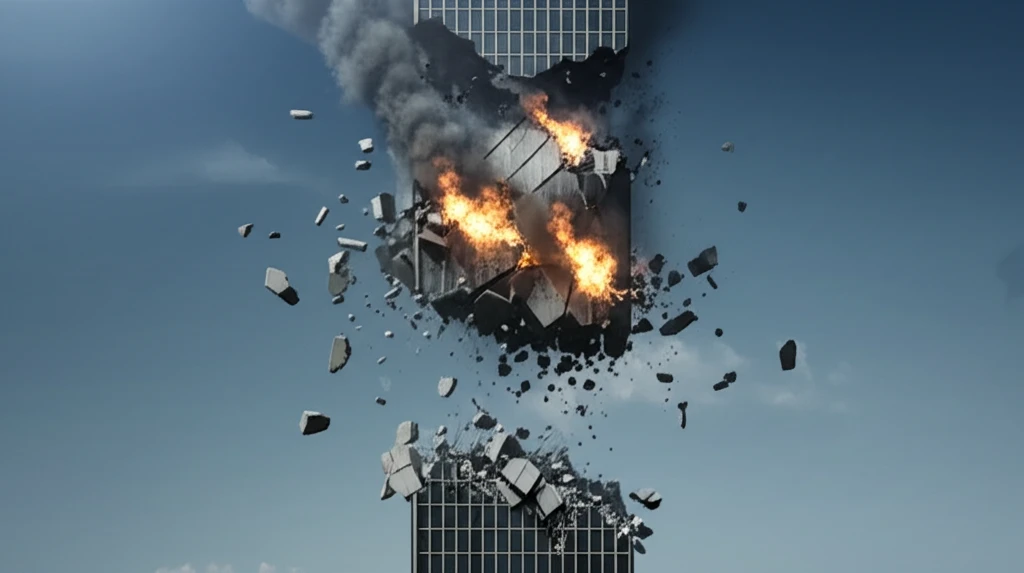
In the realm of construction and safety, the fire resistance of building materials is paramount. Concrete, a widely used construction material, is often considered inherently fire-resistant. However, under intense heat, concrete can suffer a phenomenon known as 'spalling,' where layers of the surface break off, potentially leading to structural failure. This poses a significant risk to the integrity of buildings and the safety of occupants.
Ultra-high performance concrete (UHPC), known for its superior strength and durability, is increasingly used in modern construction. Yet, even UHPC is susceptible to spalling under fire conditions. Understanding the mechanisms behind spalling and developing effective preventative measures are crucial for ensuring the safety and longevity of concrete structures.
Recent research has focused on innovative methods to enhance the fire resistance of UHPC, examining the role of various additives and microstructural properties in mitigating spalling. This article delves into the science behind concrete spalling, exploring the latest findings and practical strategies to protect your structures from the devastating effects of fire.
The Hard-to-Quantify Cost of Spalling
If concrete fire safety is measured in real-world harm, the picture is harder to quantify than it first appears. Concrete is widely regarded as one of the more fire-resilient building materials, yet spalling—the violent loss of surface concrete under intense heat—remains a recurring concern in structural fires. Reliable, broadly agreed figures on how often spalling occurs or how much it contributes to collapse are not settled, and reported estimates vary considerably across studies. As a result, the true scale of the impact is best described in terms of engineering risk rather than precise statistics.
Established Methods and Where They Fall Short
The standard approach to fire-resistant construction begins with concrete itself, a material so widely used that dedicated product categories exist for it at major building-material retailers. Concrete is not a single recipe but a family of mixes, ranging from conventional structural types to specialized variants such as ultra-high-performance concrete and low-density structural concrete, each with different behavior under fire. The commonly cited limitation is that heat and moisture trapped inside the material during a fire can trigger spalling—the destructive popping of surface layers—even in otherwise well-designed structures. Contractors working on the ground, such as driveway specialists operating under hot sun, rain, and heavy daily vehicle traffic, stress that real-world durability depends on how the material is mixed, placed, and maintained rather than on the material alone. In short, accepted methods serve well under ordinary fire scenarios, but their limitations emerge precisely where environmental stress and intense heat intersect.
A Long-Established Material With a Gradual Fire History
Concrete has a long and steady history as a go-to building product, and its central role in construction remains visible in the way it is stocked and sold today. One simple measure of that history is ubiquity: dedicated retail categories for concrete at major building-material suppliers reflect continuous, ongoing demand. Because concrete is so established, its fire behavior has been folded into codes and site practice gradually over many years rather than pinned to any single discovery. The historical record is therefore best summarized as an accumulation of incremental, real-world experience rather than a series of clean milestones.
What is Concrete Spalling and Why Does It Happen?
Concrete spalling is the fracturing and detachment of layers or pieces of a concrete surface when exposed to high temperatures. This occurs due to a combination of factors, primarily related to heat-induced stress and moisture within the concrete.
- Thermal Gradients: When concrete is exposed to fire, the surface heats up much faster than the interior. This creates a significant temperature difference, or thermal gradient, within the material. This gradient generates internal stresses as the hotter surface expands while the cooler interior resists deformation.
- Moisture Buildup: Concrete contains moisture in its pores. As the surface heats, this moisture turns into steam. If the concrete is dense and impermeable, the steam cannot easily escape. This leads to a buildup of internal pressure.
- 'Moisture Clog' Effect: As steam moves from the hot surface towards the cooler interior, it can condense in cooler regions, increasing saturation and creating a barrier. This "moisture clog" further obstructs the escape of vapor, intensifying the pressure.
- Tensile Strength Exceeded: When the internal pressure from the expanding steam and thermal stresses exceeds the tensile strength of the concrete, the surface layers fracture and spall off.
Emerging Findings on Fire Behavior
Researchers continue to study how concrete behaves under fire, with attention increasingly focused on the mechanisms of spalling and the microstructures that make some mixes more fire-resistant than others. Much of this work remains at laboratory or early-stage scale, so recent findings should be treated as promising rather than settled. A recurring theme in these investigations is that improvements often come from fiber reinforcement or refined mix design rather than from entirely new material families. Given the pace of the field, practical guidance is likely to keep evolving as larger-scale testing is completed.
Where Conventional Wisdom Has Failed
Fire protection for concrete is not without its counterarguments and documented failures. Critics point out that even code-compliant concrete can spall severely, sometimes within the first minutes of an intense fire, and that protective assumptions made in design do not always hold on site. Real fires have shown that factors such as moisture content, aggregate type, and restraint conditions can defeat strategies that look sound on paper. These failures do not imply that concrete is unsafe, but they argue for humility about how confidently any structure can be declared fireproof.
Weighing the Protection Options
Comparing fire-protection strategies for concrete surfaces brings the familiar tension between cost, simplicity, and performance into focus. Passive measures—such as thicker cover, added fibers, or insulating layers—tend to be cheaper and largely maintenance-free, while active or high-performance systems can add both cost and upkeep. No single approach dominates across all settings; the sensible choice usually depends on occupancy type, structural form, and budget. In practice, most buildings rely on layered defenses rather than on any one 'best' technology.
Protecting Our Structures: A Path Forward
The threat of concrete spalling during fires is a serious concern, but ongoing research offers promising solutions. By understanding the underlying mechanisms and implementing effective preventative measures, we can significantly enhance the fire resistance of concrete structures, ensuring the safety of our buildings and the people who occupy them. As new technologies and materials emerge, the future of fire-resistant construction looks brighter than ever.
Balancing Strength Against Real Vulnerability
Taken together, the evidence points to a balanced conclusion: concrete is a strong, generally fire-resilient material, but spalling is a genuine vulnerability that no single measure can design away. Commentary in the field tends to converge on managing risk through careful mix design, proper detailing, and realistic testing rather than chasing a perfect solution. The consensus view is that protection works best when it is matched to the specific fire scenario a structure is actually likely to face. Ultimately, fire-resistant concrete is a goal achieved through disciplined engineering practice, not by the material alone.
Where the Next Advances May Come From
Looking ahead, several frontiers could reshape how structures resist fire. High-performance and fiber-reinforced concretes are widely expected to mature from niche products into more mainstream options as costs fall. Smarter monitoring, such as embedded sensors that reveal how internal temperature and moisture evolve during a fire, may give engineers unprecedented insight into spalling risk. The direction seems to be toward more data-driven and materials-driven solutions. Any of these advances, however, will likely need years of validation before they become codified practice.
Fire Safety Inside a Wider Industry System
Fire safety in concrete sits within a broader set of systemic challenges for the construction industry. Codes tend to be reactive, updated largely after fires reveal gaps, and the economics of construction often favor minimum protective standards. Laboratory test methods do not always reproduce real fire behavior, which complicates reliable regulation. Addressing spalling therefore means confronting questions about testing realism, enforcement, and cost that extend well beyond any single material fix.
The Human Stakes Behind the Engineering
Behind the engineering, spalling has very human consequences. When concrete fails in a fire, the result can be falling debris, compromised exits, and, in the worst cases, loss of life or irreparable damage to buildings where people live and work. For design teams, a spalling event is often a reminder that the safety margins written into standards represent real lives. The most compelling argument for better fire protection is not statistical but personal: the difference between a structure that holds together long enough and one that does not.