
Is Your Concrete Crumbling? Unveiling the Secrets to Sulfate Resistance

"Discover how initial damage and environmental factors impact concrete durability and what you can do to protect your structures."
Concrete, the backbone of modern infrastructure, faces a relentless adversary: sulfate attack. This insidious process gradually weakens and degrades concrete structures, leading to costly repairs and potential safety hazards. While sulfate attack is a well-known threat, the complexities of its interaction with pre-existing damage in concrete have remained less understood.
Imagine concrete already bearing the scars of initial damage – perhaps from the stresses of its early hardening or exposure to harsh conditions. Now, introduce the aggressive forces of sulfate ions, penetrating through cracks and reacting with the concrete's core components. This is the reality faced by numerous structures, particularly in regions with aggressive environmental conditions.
Recent research published in the 'Journal of Sustainable Cement-Based Materials' sheds light on this critical intersection. The study meticulously examines how initial damage, combined with cycles of drying and wetting, accelerates sulfate attack in concrete. The findings offer invaluable insights for engineers, construction professionals, and anyone invested in the longevity and resilience of our infrastructure.
The Growing Threat of Sulfate Attack
Sulfate attack remains one of the most pervasive durability challenges facing concrete infrastructure worldwide, though precise global statistics on its economic toll are difficult to consolidate. Concrete structures in marine environments, groundwater-exposed foundations, and agricultural settings are particularly vulnerable to sulfate-induced deterioration. As aging infrastructure stockpiles continue to grow, the urgency of understanding and mitigating sulfate attack has only intensified. Estimates suggest durability failures contribute significantly to global infrastructure maintenance costs, though comprehensive, up-to-date figures vary widely across regions and studies.
Conventional Testing and Its Shortcomings
Standard methods for evaluating sulfate resistance typically involve immersing concrete specimens in sulfate solutions and measuring expansion, mass change, or compressive strength loss over time. Accelerated laboratory testing protocols, such as those outlined by ASTM and RILEM, provide benchmarks but may not fully replicate field conditions where multiple deterioration mechanisms act simultaneously. These approaches often struggle to account for long-term variability in concrete composition, environmental exposure severity, and the complex interplay of chemical and physical sulfate attack mechanisms. As a result, there is growing recognition that laboratory results alone can sometimes overestimate or underestimate real-world sulfate resistance.
Foundational Understanding of Sulfate Mechanisms
Early research established that sulfate ions attacking concrete can originate from within the material itself—when cement sulfate content is excessively high—or from external environmental sources such as soils and groundwater rich in sulfates. Two main forms of sulfate attack were identified, each producing expansive reaction products that compromise concrete integrity. More recent mechanistic studies have refined this understanding by demonstrating that sulfate-induced expansion develops in two distinct stages: an initial latency stage governed by crystallization pressure theory, followed by a significant expansion stage associated with volume increase theory. Researchers have also identified the possibility of thaumasite sulfate attack (TSA) at low temperatures, adding another dimension to the historical understanding of this phenomenon.
Decoding Sulfate Attack: What's Really Happening to Your Concrete?
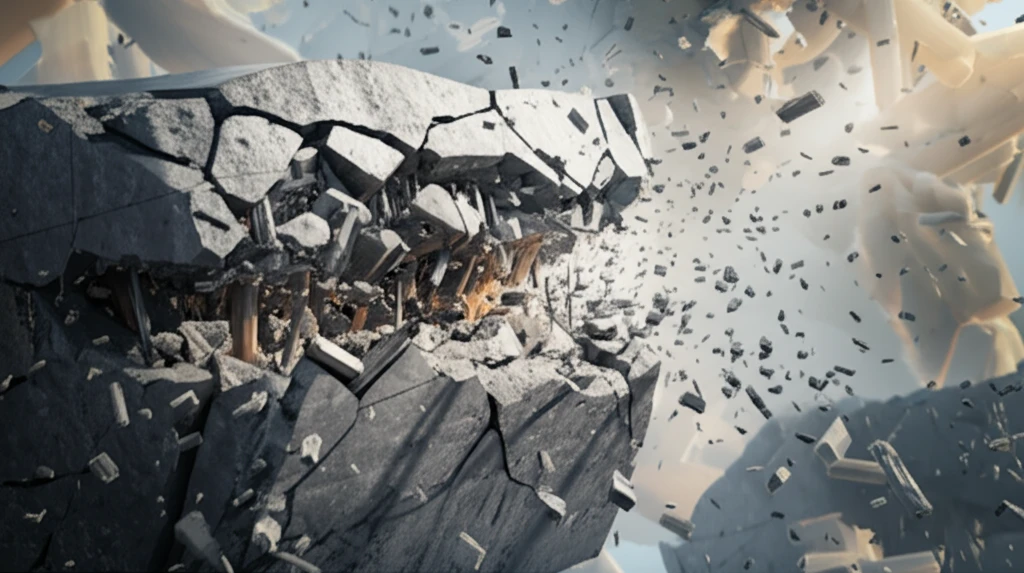
Sulfate attack occurs when sulfate ions, typically found in soil and groundwater, infiltrate concrete. These ions react with hydrated compounds in the cement paste, primarily calcium hydroxide and calcium aluminate hydrates. This reaction leads to the formation of expansive products like ettringite and gypsum. As these products accumulate within the concrete's pore structure, they exert internal pressure, causing cracking, spalling, and ultimately, structural failure.
- Damage Amplifies Degradation: Concrete with initial damage exhibited a much greater mass change and reduction in Erd compared to undamaged concrete, indicating accelerated deterioration.
- Slag's Double-Edged Sword: The study found that a high content of slag, a byproduct of steel manufacturing often used as a cement replacement, can either increase or decrease sulfate resistance depending on its content level. Concrete with higher slag content showed more resistance to sulfate attacks.
- Pore Structure is Key: As exposure time increased, the porosity and number of large pores in damaged concrete also increased, creating more space for expansive sulfate reaction products to accumulate.
- Corrosion Culprits: Internal corrosion products varied depending on the water-to-cement ratio. High water-to-cement ratios primarily led to gypsum formation, while low ratios favored ettringite.
Evolving Research Landscape
The body of literature on sulfate attack continues to expand, with recent reviews consolidating decades of experimental findings and proposing updated degradation models. Researchers are increasingly leveraging multi-scale analysis techniques to bridge the gap between microscopic chemical reactions and macroscopic structural damage. There is a growing emphasis on integrating field observation data with laboratory results to improve the predictive accuracy of sulfate attack models. While comprehensive state-of-the-art reviews remain valuable, the rapid pace of new findings means that established frameworks are continually being refined and, in some cases, challenged.
Disputed Findings and Unresolved Questions
Despite broad consensus on the general mechanisms of sulfate attack, significant debates persist regarding the relative importance of chemical versus physical crystallization processes in real-world conditions. Some researchers have questioned whether accelerated laboratory tests accurately represent the slow, multi-decade degradation observed in field structures, arguing that test durations and sulfate concentrations may skew results. Additionally, the role of internal sulfate sources in triggering or exacerbating attack remains contested, with some experts viewing internal sulfates as a secondary concern compared to external environmental exposure. These unresolved disagreements underscore the need for continued investigation and more nuanced testing methodologies.
Benchmarking Binders and Cement Types
Comparative studies have been instrumental in identifying which binder systems offer superior resistance to sulfate attack. In one benchmarking effort, researchers tested seven different binders—including Portland cements, blast furnace slag Portland cement, super sulfated ground granulated blast furnace slag cement, and sodium carbonate alkali-activated systems—under identical experimental conditions to assess their capacity to resist external sulfate attack. Separate research has confirmed that the variability in concrete characteristics, such as pore size distribution and chemical composition, has a significant impact on long-term performance under sulfate exposure. Studies examining the effect of different cement types on sulfate resistance further reinforce that material selection is a critical design parameter for ensuring durability in sulfate-rich environments.
Protecting Our Infrastructure: A Call to Action
The study underscores the importance of proactive measures to mitigate sulfate attack, especially in environments where concrete structures are susceptible to initial damage. Strategies include using sulfate-resistant cements, optimizing concrete mix designs (including careful consideration of slag content), and applying protective coatings to prevent sulfate ingress. Regular inspection and maintenance programs are also crucial for early detection and repair of damage, minimizing the long-term impact of sulfate attack and ensuring the safety and sustainability of our infrastructure.
Bridging Research and Practice
While sulfate attack is among the most studied concrete durability phenomena, translating laboratory insights into field-ready solutions remains an ongoing challenge. Experts broadly agree that no single mitigation strategy is universally effective, and that design decisions must account for site-specific exposure conditions, cement chemistry, and structural requirements. The growing body of research provides a strong foundation for evidence-based material selection and maintenance planning, but closing the gap between academic findings and construction practice continues to require coordinated effort across the industry.
Pathways Toward Enhanced Sulfate Resistance
Future research is expected to focus on deepening the understanding of how sulfate ions penetrate concrete's porous matrix via pore solution, driven by hydrostatic pressure and environmental exposure. Both chemical reaction pathways and physical crystallization effects will continue to be studied as distinct yet interacting degradation mechanisms in cement-based materials. The breadth of infrastructure at risk—spanning dams, concrete pavements, bridge piers, foundations, and tunnels—underscores the practical urgency of developing more resilient binder systems and protective strategies. Advances in multi-factor experimental design, which consider both external environmental factors and internal material properties, are anticipated to yield more robust performance control methods for sulfate attack mitigation.
Infrastructure Resilience in a Changing World
Sulfate attack does not occur in isolation; concrete structures face simultaneous threats from carbonation, chloride ingress, alkali-silica reaction, and mechanical loading, making durability a multi-faceted systems challenge. Climate change is expected to alter groundwater chemistry and increase exposure severity in many regions, potentially accelerating sulfate-induced deterioration. Addressing these systemic challenges requires interdisciplinary collaboration spanning materials science, civil engineering, environmental science, and public policy. Ultimately, the resilience of concrete infrastructure depends not only on material innovation but also on institutional commitment to long-term monitoring, maintenance, and adaptive management.
From Laboratory to Lives
Behind every deteriorating concrete structure are communities that depend on that infrastructure for safety, mobility, and economic wellbeing. Premature structural failures due to sulfate attack can impose significant repair costs on public budgets and disrupt essential services for populations that rely on them. Engineers and decision-makers play a critical role in translating sulfate resistance research into durable design specifications, quality construction practices, and timely maintenance interventions. As awareness of sulfate attack mechanisms grows, the challenge lies in ensuring that this knowledge reaches the practitioners and policymakers best positioned to act on it.