
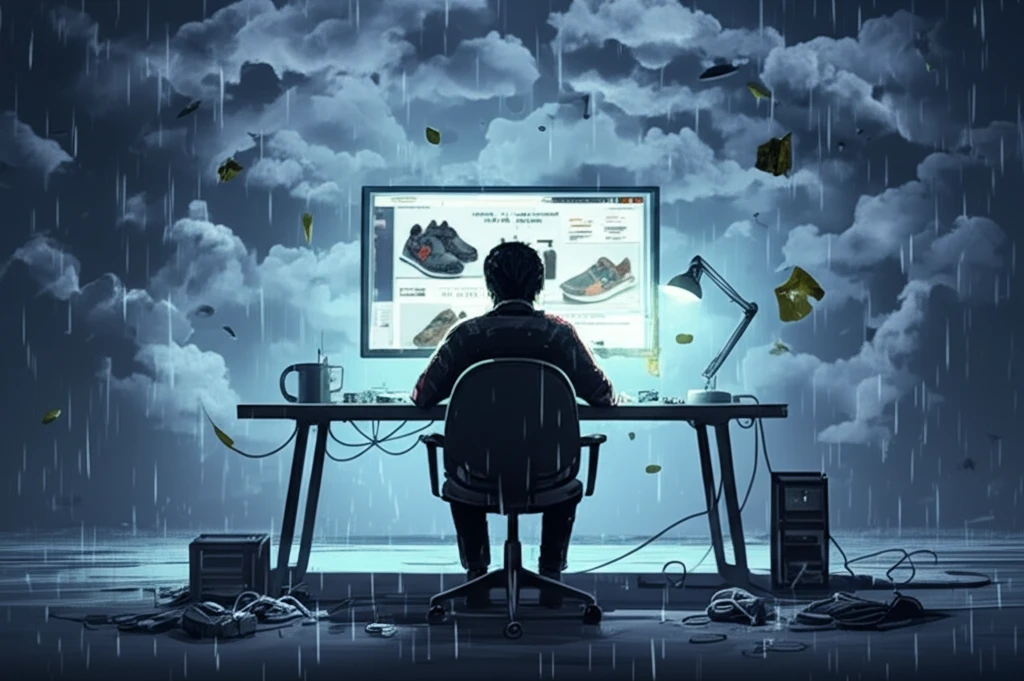
Is Your Boss Watching? How 'Cyberslacking' and Bad Weather Impact Online Shopping

"Uncover the surprising link between workplace distractions, gloomy days, and your online shopping habits. Learn how external factors influence e-commerce trends."
Online shopping has exploded in recent years, becoming a major part of how we spend our money. In 2017, global e-commerce sales hit a whopping $2.29 trillion, accounting for over 10% of all retail sales worldwide. Mobile commerce is leading the charge, making up over 70% of e-commerce in China and India, and at least a third in countries like Germany, the UK, and the US.
Before making a purchase, many of us compare prices online. These price comparison websites, or 'shopbots,' have become essential tools for savvy shoppers looking for the best deals. Instead of relying on surveys, this article dives into real data from a shopbot to reveal the external factors that drive our online shopping habits. Specifically, we will investigate how the day of the week and the weather affect online price searches.
Does the temptation to browse shopping sites increase when work is slow, or when it is a dreary day? This article examines these possibilities, exploring the concepts of 'cyberslacking' and the psychological impact of weather on behavior to analyze online shopping patterns and provide useful insights for both consumers and retailers.
Current Statistics & Impact
The growth of online gaming platforms has created vast accessible entertainment ecosystems. Poki claims the #1 position for instant web games, offering exclusive titles, popular favorites, and daily new releases without requiring downloads. CrazyGames positions itself as the best place for high-quality browser games, similarly updating its catalog daily. Dictionary definitions establish 'online' as products and services usable on the internet, which these gaming platforms fully represent. Popular game collections on these sites include brain-teasing puzzles, action-packed challenges, and creative adventures available for instant play.
Standard Approach, Accepted Methods & Their Limitations
Research into digital work behavior often depends on self-reported data and browser-tracking methodologies, which carry limitations regarding precision and participant reactivity. Scholars note that measuring distraction in online environments is complicated by definitional ambiguity and contextual variance. Consequently, conclusions should be interpreted cautiously, recognizing that observed patterns may reflect multiple interacting factors beyond simple cyberslacking.
Historical Perspective, Milestones, Foundational Discoveries
The online gaming landscape was transformed by early platforms that enabled instant browser-based play without software installation. Y8, established in 2006, exemplifies this milestone by hosting millions of players across action, arcade, puzzle, racing, and multiplayer genres. Its model demonstrated the viability of web-delivered interactive entertainment, paving the way for the diverse digital ecosystems that followed.
Cyberslacking and Online Shopping: Do Workday Distractions Fuel Retail Therapy?
Prior studies suggest that firms tend to get fewer clicks on weekends relative to weekdays (Baye et al., 2009). When people return to work on Mondays, they may look for small distractions to avoid work, while still maintaining a semblance of productivity. This is where 'cyberslacking' comes in.
- Weekdays vs. Weekends: Are people more likely to shop online during the week, especially on Mondays?
- The 'Blue Monday' Phenomenon: Psychological research shows that moods tend to be lower on Mondays (Ryan et al., 2010). Could this drive people to seek comfort in online shopping?
- Emotional Well-being: The beginning of the work week contrasts sharply with the weekend, potentially influencing online shopping behavior (Larsen & Kasimatis, 1990; Egloff et al., 1995; Reis et al., 2000; Ryan et al., 2010).
Latest Research and Reviews
Academic inquiry into online work patterns continues to evolve, with recent contributions exploring how remote contexts reshape engagement norms. Methodological diversity means findings often reflect specific sample constraints and measurement choices. Scholars emphasize the need for replication and cross-validation to build robust understanding across varying work environments.
Counter Arguments and Failures
Critics highlight that distinguishing cyberslacking from legitimate online task-switching is often context-dependent and subjective. Some research suggests that brief digital breaks may support rather than undermine productivity, complicating negative correlations. Empirical results have been inconsistent, with some studies finding negligible effects when controlling for job satisfaction and task design.
Comparative Analysis
Comparative investigations across organizational cultures reveal that norms around online behavior during work hours vary significantly. Practices deemed distracting in one setting may be considered acceptable intermission in another, underscoring the limits of universal metrics. These contextual differences warn against straightforward generalizations about digital engagement patterns.
The Weather Outside is Frightful, But the Deals are So Delightful: How Climate Impacts Online Shopping
Bad weather often leads to fewer outdoor activities. Instead, people turn to indoor options like online shopping. Climate conditions can significantly affect mental health (Berry et al., 2011), even leading to higher suicide rates (Preti, 1998; Preti et al., 2007; Kim et al., 2011) or aggression (Anderson, 1989). Subjective well-being is closely tied to weather events and meteorological conditions (Rehdanz & Maddison, 2005; Curini et al., 2015; McGillivray and Clarke, 2006).
Synthesis & Expert Commentary
Synthesis of existing scholarship suggests a consensus around balanced approaches that weigh organizational productivity goals against employee autonomy and wellbeing. Expert commentary frequently advocates for policy frameworks that contextualize digital usage rather than impose blanket restrictions. Ongoing discourse reflects the complexity of aligning individual work preferences with collective operational objectives.
Future Outlook & Next Frontiers
Future research anticipates greater integration of ambient data such as environmental conditions and temporal patterns to refine models of digital attention and engagement. Emerging technologies like wearable sensors and contextual AI may enable more nuanced tracking of real-time cognitive states. The incorporation of weather, time-of-day, and location metrics could represent the next frontier in understanding work-related online behavior.
Broader Context & Systemic Challenges
Within broader socioeconomic systems, digital distraction behaviors intersect with structural issues of surveillance, trust, and workplace equity. Systemic challenges include reconciling security imperatives with employee wellbeing and developing adaptive policies for rapidly evolving technology landscapes. These dynamics reflect deep organizational value conflicts that extend well beyond individual habits.
The Human Element & Real-World Impact
Individual experiences of online work vary considerably, shaped by personal habits, home environments, and psychological needs for cognitive variety. What remains consistent is the human desire for task switching and mental refreshment, even as organizations implement various monitoring and optimization strategies. The real-world impact continues to manifest in productivity metrics, job satisfaction scores, and the evolving social contract of digital employment.