
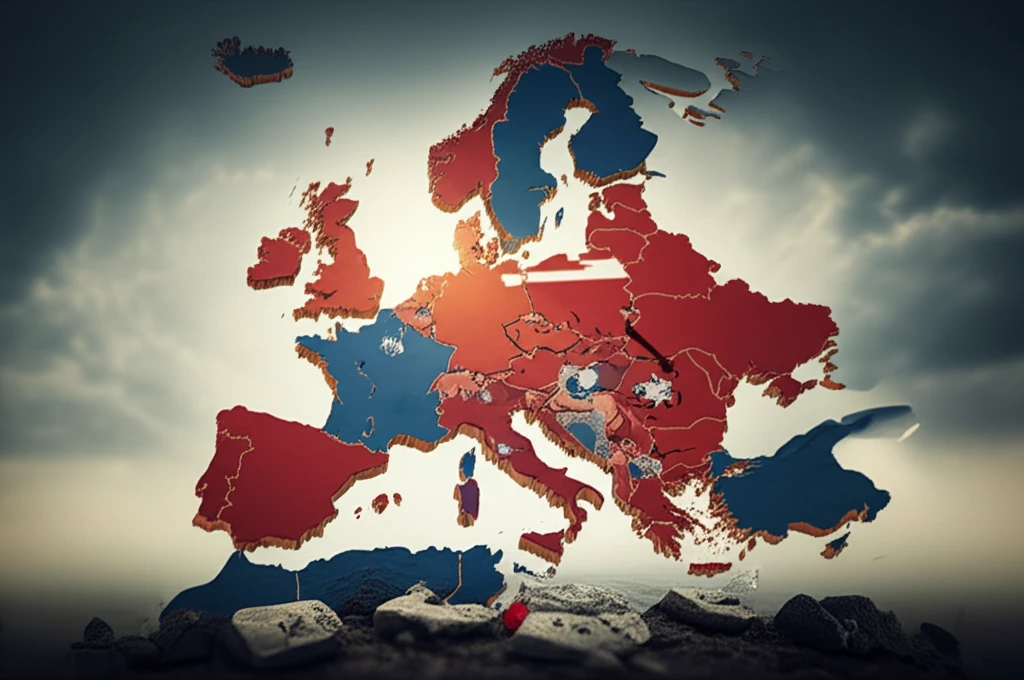
Is the Dream of a Borderless Europe Fading? The Future of Schengen

"Explore the challenges to the Schengen Agreement and what they mean for freedom of movement in Europe."
For many Europeans, the Schengen Agreement embodies the freedom to travel, work, and live without the constant hassle of border checks. This has fostered closer ties, boosted tourism, and made international business easier. But this symbol of European unity is under threat. What was once seen as an unshakable agreement is now facing persistent challenges that could fundamentally alter the way Europeans move across borders.
Over the past several years, events like the rise in terrorist activities and significant migration flows have led some member states to reinstate border controls. These actions, while presented as necessary for security, strike at the heart of the Schengen ideal. The question now is whether these measures are temporary fixes or signs of a more permanent shift towards a less open Europe.
This article examines the pressures on the Schengen Agreement, exploring the political, security, and social factors that are reshaping Europe's internal borders. Understanding these dynamics is crucial for anyone who values the principles of free movement and European integration.
27 Members, Two Mismatched Lists
The Schengen Area today counts 27 participants, a figure that mirrors the number of EU member states even though the two groups do not fully overlap: four non-EU countries — Norway, Iceland, Switzerland, and Liechtenstein — are part of the zone. That statistic sits awkwardly against current events, as Italy has suspended its Schengen arrangements with Spain in response to the influx of migrants into the Spanish-Moroccan exclave of Ceuta. Interior Minister Matteo Piantedosi said the suspension will remain in place until potential security risks have completely disappeared, ruling out any reconsideration of the measure before August. The episode is a reminder that internal border checks, though largely abolished, can be quickly reinstated between member states.
Trust at the Core, National Veto at the Edges
The Schengen Agreement was originally signed on June 14, 1985 by seven European countries — Belgium, the Netherlands, Luxembourg, France, Germany, Portugal, and Spain — creating a zone in which internal border checks are largely abolished. The accepted method of the system relies on shared trust among members, but its key limitation is that national governments can unilaterally reintroduce controls when they perceive a threat. Italy is doing exactly that: Interior Minister Matteo Piantedosi said the country will lift its Schengen ban on Spain only when the risks of a mass migrant influx into the Spanish-Moroccan exclave of Ceuta have completely disappeared. This reveals a structural weakness in the standard approach — that any member's security assessment can temporarily override the zone's promise of free movement.
From a Riverboat to a Continent
The Schengen Agreement was signed on June 14, 1985, aboard the riverboat 'Princess Marie-Astrid' on the river Moselle near the town of Schengen, Luxembourg, from which the agreement takes its name. It actually comprises two agreements, ratified in 1985 and 1990 respectively, which together abolished border controls and made transit through Europe considerably easier. The first major revision came in 1990 with the signing of the Schengen Implementing Convention. The agreement grew out of a European context in which immigration had increased substantially after World War II, even though the accord itself concerns movement among signatory countries rather than immigration from outside.
The Cracks in the Foundation
The Schengen Agreement, established to create a borderless zone within Europe, has faced increasing strain in recent years. While the agreement allows for temporary border controls in exceptional circumstances, several member states have extended these controls for prolonged periods, citing security concerns and migration pressures. This has led to debates about the long-term viability of the agreement and its core principles.
- Economic Impact: Border controls can disrupt trade and tourism, leading to economic losses for businesses and individuals.
- Social Impact: The reintroduction of borders can undermine the sense of European identity and create barriers between communities.
- Political Impact: Disagreements over border controls have strained relations between member states, highlighting divisions within the European Union.
A Zone Under Constant Headline
Ongoing reporting on the Schengen Agreement is aggregated in near-real time through Google News, where the latest items track member-state decisions, visa rules, and tensions over border controls as they develop. Detailed explainers outline the agreement's complete history and identify which European countries are part of the Schengen Area by signing it. Much of the current coverage is travel-focused, including questions about how to visit Europe without a Schengen visa and which destinations are quickly becoming popular. Taken together, this body of coverage shows that the agreement remains a central, frequently discussed feature of European life.
The Dream That Went Awry
Critics argue that the ambition of the borderless Europe Schengen created was virtually unprecedented in its scope — and that the migrant crisis showed how quickly that dream could go awry. The BBC noted that while the accord made life easier for business travellers and tourists, it also benefited criminals. Security analyses point out that the removal of internal border controls raised terrorism concerns, with France expected to 'test Schengen to its limits.' The proposed solutions include tightening external borders, on the grounds that security concerns must be taken into account in any reform.
Bilateral Suspension, Continental Shock
The Italy–Spain dispute offers a striking comparison within the zone's history: a bilateral suspension in which one member has formally set aside its Schengen arrangements with another. Italy's Foreign Minister Antonio Tajani called the measure 'unavoidable,' describing the temporary suspension as a necessary choice to safeguard the security of Italian citizens and to defend the European project. For travellers between Italy and Spain, the practical implications — renewed border checks, changed travel rules, and uncertainty over the zone's guarantees — are now the focus of ongoing coverage. The case highlights how quickly bilateral tensions can override the agreement's central promise of free movement.
Finding a Path Forward
The future of the Schengen Agreement remains uncertain, but it's clear that Europe needs to find a way to address the challenges it faces while preserving the core principles of free movement. This will require a combination of stronger external border controls, improved intelligence sharing, and a renewed commitment to solidarity among member states. Only then can Europe ensure that the dream of a borderless continent does not fade away.
Correction, Not Collapse
Political analyst Mikhail Neyzhmakov, director of the Center for International Policy Analysis at the Institute of Globalization and Social Movements, told Report that a radical break-up of the Schengen Agreement in the short term is unlikely. The agreement was designed to remove controls on internal frontiers and to introduce freedom of movement for citizens of the signatory countries. Yet as it turns 40, it does so 'with more doubts than certainties,' and almost half of its members have reinstated temporary controls along their internal borders. The emerging picture is one of correction and adjustment rather than collapse.
Expansion and Renegotiation
A historic deal between the UK and the EU could bring Gibraltar into the Schengen Zone, a change whose implementation is now closely watched and expected to mark a big shift in the region's politics. At the same time, reform pressure is coming from the zone's core: on April 17, the interior ministers of France and Germany, Claude Guéant and Hans-Peter Friedrich, wrote to Denmark's justice minister — then holding the EU presidency — proposing amendments to the Schengen Agreement. The expansion question and the reform agenda point in different directions, but both suggest that Schengen's future will be shaped by ongoing negotiation over who belongs and how the rules operate.
More Than a Migration Emergency
Analysts argue that the pressure exerted on Spain through the crisis in Ceuta appears less like an isolated migration emergency than part of a wider strategy aimed at weakening Sánchez's government. The systemic challenges to Schengen are not only geopolitical: Iceland introduced temporary Schengen border controls and a 14-day quarantine for international arrivals in 2020, showing that public-health shocks can also close the zone's internal frontiers. Read together, the two episodes demonstrate the agreement's vulnerability to both deliberate political pressure and external, non-migration crises.
The Daily Cost of Restored Borders
Renewed temporary border checks have prompted some commentators to ask whether the 40-year-old agreement is really over. The EU's political leadership responds that 'Schengen will continue to evolve, adapt to new realities and respond to the shifting geopolitical landscape.' For ordinary travellers, however, the return of checks at internal frontiers translates into longer queues, cancelled plans, and a lived reminder that the promise of open borders can be suspended at short notice. Whether this represents the death of Schengen or simply its adaptation is the question that defines the zone's future.