
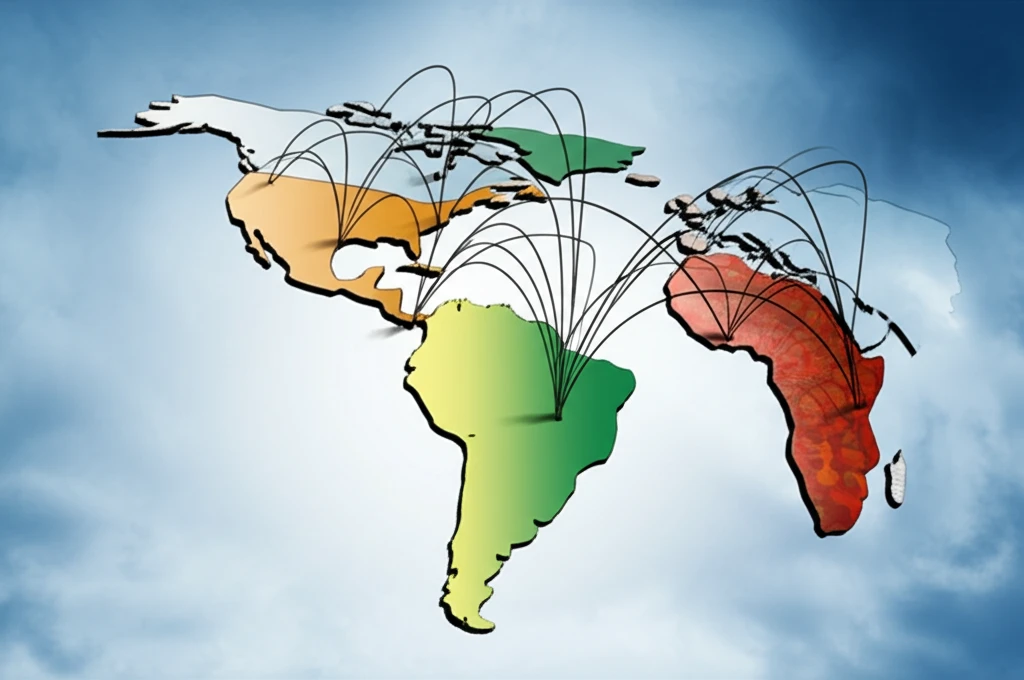
Is Economic Convergence Across the Americas Possible? A Survival Analysis

"Discover how survival analysis reveals the hidden factors influencing GDP growth in the Americas and what it means for the region's economic future."
In today's economic landscape, understanding how countries achieve specific levels of economic growth is more critical than ever. A recent study examines the economic trajectories of 33 countries in the Americas, providing insights into what drives their success or stalls their progress.
The research uses a sophisticated approach called survival analysis to explore the time it takes for these countries to achieve a 5% increase in GDP per capita. This method allows researchers to consider various factors, including vulnerabilities and risks, offering a comprehensive view of the challenges and opportunities each nation faces.
By integrating machine learning algorithms and economic interpretation, this study contributes to both theoretical advancements in economic literature and the development of more effective policies aimed at promoting sustained economic growth. It's a deep dive into the economic dynamics of the Americas, offering valuable lessons for policymakers and stakeholders.
Convergence in the Americas: An Overview
Economic convergence across the Americas remains a contested and evolving topic among economists and policymakers. While some regions have shown signs of narrowing income gaps relative to advanced economies, others have experienced persistent or widening disparities. The degree to which developing economies in Latin America and the Caribbean can catch up with the United States and Canada depends on a complex interplay of institutional, structural, and policy factors. Empirical evidence on convergence rates varies considerably across methodologies and time periods examined, making definitive conclusions elusive.
Methodological Approaches to Studying Convergence
Traditional convergence analysis relies on cross-country growth regressions and per capita income comparisons, though these methods face well-documented limitations regarding omitted variable bias and endogeneity. Panel data techniques and time-series approaches offer alternative frameworks, but each carries assumptions about structural stability that may not hold over long horizons. More recent survival analysis methods attempt to model the duration until convergence events occur, providing a complementary perspective to standard growth accounting. These newer approaches can capture time-varying covariates but require careful specification of baseline hazard functions.
Historical Context of Americas Convergence
The study of economic convergence has roots in classical growth theory, though its modern empirical investigation gained momentum in the late twentieth century. Various episodes of catch-up growth and divergence have been documented across the Americas, from post-war periods of rapid industrialization to more recent commodity-driven growth cycles. The foundational question of whether poorer economies systematically grow faster than richer ones remains unresolved in the empirical literature. Historical evidence suggests convergence is neither automatic nor guaranteed, but rather contingent on specific policy and institutional conditions.
Decoding Economic Growth: What Factors Really Matter?
At the heart of the study is an effort to understand the intricate relationships between various factors and the time it takes for a country to achieve a 5% increase in GDP per capita. The researchers considered a range of key variables to capture multifaceted vulnerabilities:
- Vul_Inherent: Captures inherent vulnerabilities like proximity to global markets and landlocked status.
- Vul_Fragility_Democracy: Focuses on the stability of democratic institutions.
- Vul_Human Rights: Assesses equal treatment and absence of discrimination.
- Natural Risk: Assesses disasters as occurrences or situations that surpass local capacity.
- Commercial Risk: This variable captures the commercial risks associated with countries.
- Financial Risk: Focused on economic stability.
- Endogenous Risk: Examining internal economic factors.
Recent Research on Convergence Dynamics
Contemporary research continues to refine our understanding of convergence patterns across the Americas through advanced econometric techniques. Newer methodologies, including survival analysis and non-linear time series models, have provided nuanced findings about the probability and timing of convergence events. The literature increasingly recognizes that aggregate convergence metrics may mask significant heterogeneity across country pairs and sub-periods. These methodological advances allow researchers to better account for the non-linear and conditional nature of convergence processes.
Challenges to Convergence Theory
Critics of convergence theory point to persistent income disparities across the Americas as evidence against systematic catch-up growth. Institutional quality, governance structures, and policy inconsistencies have been identified as factors that impede convergence in practice. Some scholars argue that the conditional convergence framework is more relevant than absolute convergence, acknowledging that structural differences between economies limit the pace of catch-up. The 'middle-income trap' phenomenon, where countries stall after initial growth, further complicates convergence narratives for many Latin American economies.
Cross-Country Comparisons and Patterns
Comparative analyses reveal that convergence experiences across the Americas have been highly uneven across countries and time periods. Some country pairs have exhibited stronger convergence tendencies than others, often correlating with trade integration and institutional similarities. The heterogeneity of outcomes underscores the importance of country-specific factors in determining convergence trajectories. Regional blocs such as Mercosur and the Pacific Alliance represent different institutional experiments that may influence convergence dynamics.
Charting a Path to Economic Convergence: Key Takeaways
This study offers valuable insights into the factors influencing economic growth in the Americas, providing a foundation for informed policymaking and strategic decision-making. By understanding the complex interplay of risks, vulnerabilities, and capabilities, countries can tailor their policies to address specific challenges and leverage their strengths, ultimately charting a path towards sustainable economic convergence.
Expert Perspectives on Convergence Prospects
Expert commentary on economic convergence in the Americas reflects a range of perspectives, from cautious optimism to skepticism about the likelihood of systematic catch-up. Many scholars emphasize that convergence is not inevitable but depends on sustained policy commitment and institutional development. The survival analysis framework offers a way to quantify the probability of convergence given specific economic conditions and time horizons. There is broad agreement that understanding convergence requires integrating macroeconomic, institutional, and social dimensions.
Looking Ahead: Convergence Prospects
Future research on convergence across the Americas is likely to benefit from advances in econometric methods and richer data availability at the sub-national level. Climate change, technological disruption, and shifting global trade patterns present new variables that could fundamentally alter convergence dynamics in coming decades. The intersection of macroeconomic policy with social and environmental factors represents a promising frontier for convergence research. Digital economy developments and infrastructure investments may also reshape relative growth trajectories across the region.
Systemic Factors Shaping Convergence
Systemic challenges such as institutional fragility, inequality, and debt sustainability continue to shape the convergence landscape across the Americas. These structural constraints often limit the effectiveness of conventional policy interventions aimed at promoting catch-up growth. External shocks, including commodity price volatility and global financial crises, have historically disrupted convergence trajectories for vulnerable economies. Addressing these broader systemic issues may be a prerequisite to achieving meaningful and sustained convergence outcomes.
Human Dimensions of Economic Convergence
The real-world implications of convergence or divergence extend beyond aggregate economic statistics to affect living standards and opportunities for millions of people across the Americas. Migration patterns, labor market dynamics, and access to education and healthcare are all influenced by relative economic trajectories between countries. Understanding these human dimensions provides important context for evaluating the significance of convergence research findings. Ultimately, the policy relevance of convergence analysis lies in its potential to inform interventions that improve material well-being across the region.