
How to Actually Remember What You Study, Not Just Re-Read It

"Rereading feels like studying. Retrieval is what actually works."
You spend an hour before the exam reading through your notes. You get to the end and it feels like it worked — the material seems familiar, the highlighted lines look right, nothing seems missing. Then you sit down for the actual test and the first question makes your mind go blank. That gap between "this feels familiar" and "I can produce this from memory with nothing in front of me" is not bad luck. It is one of the best-documented findings in memory research, and it explains why rereading is probably the single most common study habit and also one of the least effective.

Private, on-device AI for your documents — ask questions, get cited answers.

The confusion happens because recognizing information and retrieving it are different mental operations. When you reread a page, your brain processes the words more smoothly each time, and that growing smoothness gets misread as growing knowledge. Psychologists call this a fluency illusion: the text feels easier to get through, so it feels more learned, even though nothing has actually been practiced except reading itself. Pulling an answer out of memory with no notes in front of you, which is what a real exam requires, is a different skill, and it is one that rereading never rehearses.
The fix is not a trick or a new app. It's a specific, well-tested study behavior called retrieval practice, and it has been tested directly against rereading in controlled experiments, not just recommended by well-meaning teachers. Below is what that research actually found, a concrete way to build a retrieval habit around your own notes and textbooks, and, since checking your own answers against long source material is the step most people quietly give up on, one tool that can make that particular part faster.
The 90% Forgetting Problem
Most people forget 90% of what they study, not because they are slow, but because the brain was never built for passive reading. Learners read books and save posts yet remember almost nothing of what they consume. This widespread forgetting is why study techniques that force active engagement are increasingly popular.
Why Re-Reading Falls Short
The standard approach to studying is simply rereading notes, but retrieval practice research shows that recalling information is what actually strengthens learning. Instead of just rereading notes, learners actively recall key ideas through quick quizzes, which helps them remember for longer. Passive reading fails because the brain was not built for it, making retrieval a more effective alternative.
Foundations of Retrieval Practice
Retrieval practice, or reconstructing knowledge by bringing it to mind from memory, has been shown by numerous researchers to improve student learning, including work cited by Roediger and colleagues in 2011. The decision-lab reference guides describe retrieval as how we access stored memories and bring them into awareness, underscoring its central role in learning. These findings established the scientific basis for modern active-recall study methods.
What the Research Actually Shows
Start with what "studying" usually means in practice. In a 2009 survey of 177 college students by Jeffrey Karpicke, Andrew Butler, and Henry Roediger, 84 percent listed rereading their notes or textbook as a study strategy — by far the most common answer of anything students listed — while only 11 percent mentioned testing themselves on the material at all. Rereading feels active: you're moving through the material, engaging with it. But compared with retrieval, it's fundamentally passive — you're following a route the author already laid out, not reconstructing it from your own memory. Retrieval practice flips that. Instead of looking at the answer, you try to produce it first, notice exactly where you got stuck, and only then look. That struggle before you check is not a design flaw; the difficulty of pulling something out of memory under pressure is part of what makes the memory more durable afterward, a pattern researchers call desirable difficulty.
That 84-percent figure comes from a study titled Metacognitive Strategies in Student Learning: Do Students Practise Retrieval When They Study on Their Own?, published in 2009 in the journal Memory by Jeffrey Karpicke, Andrew Butler, and Henry Roediger. The same 177 students were also asked directly: after reading a textbook chapter once, would you rather go back and reread it, or try to recall it from memory? 57 percent chose rereading. Only 18 percent chose testing themselves.
The clearest demonstration of why that gap matters comes from a related, earlier study: a 2006 paper by Henry Roediger and Jeffrey Karpicke — two of the three researchers behind the survey above — published in Psychological Science and titled Test-Enhanced Learning: Taking Memory Tests Improves Long-Term Retention. Students read prose passages, then either restudied the material repeatedly or took a recall test on it repeatedly, with no feedback given either way. When everyone was tested five minutes later, the rereading group did slightly better — repetition of the actual text has a short-term edge. But when the final test was pushed out to two days or a full week later, that result flipped hard: the students who had quizzed themselves, not reread, remembered substantially more. Restudying felt more effective in the moment and produced worse long-term memory; testing did the opposite.
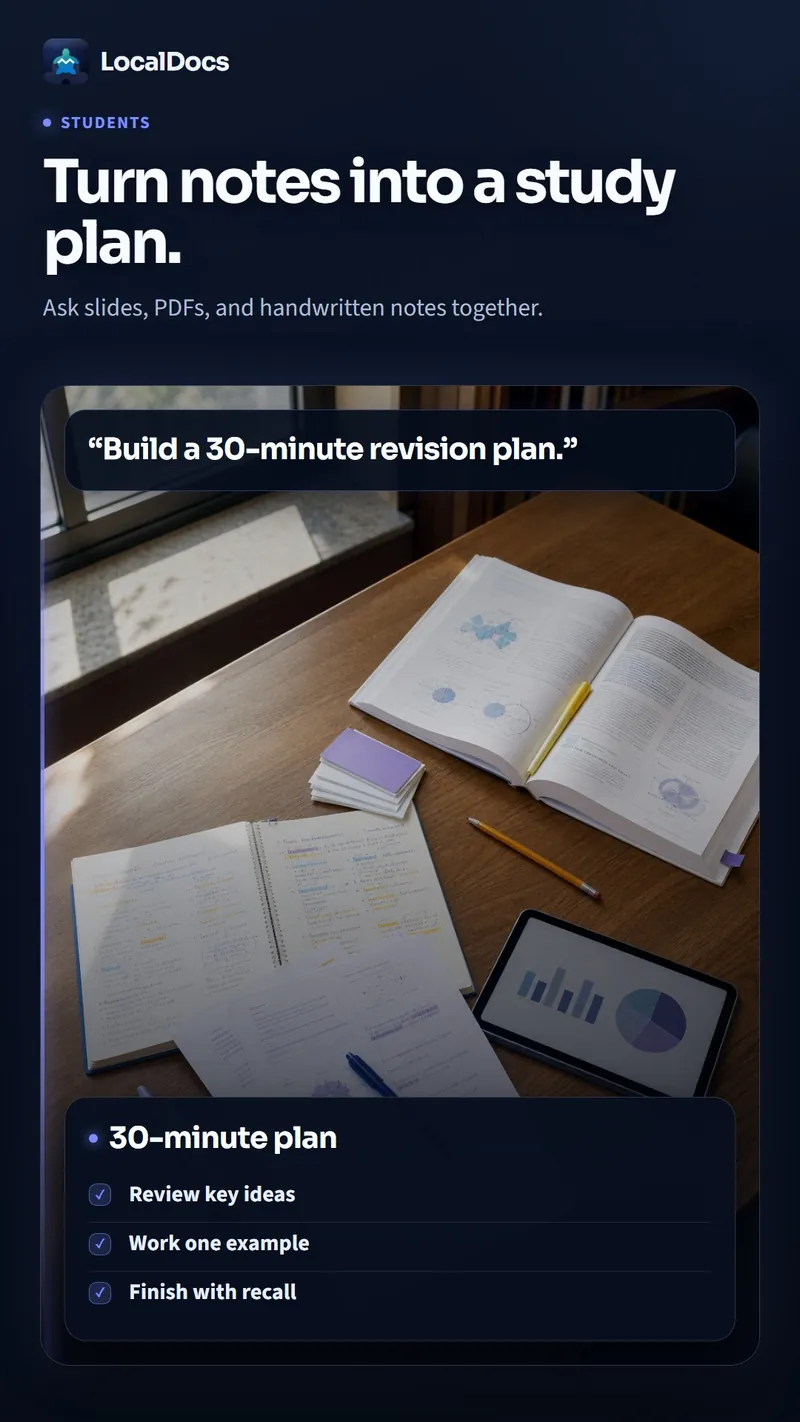
That timing detail matters, because it's exactly what makes rereading feel deceptively good the night before a quiz and then fail you on a cumulative final a month later. It's also not an isolated result. In 2013, a team led by John Dunlosky reviewed the evidence behind ten common study techniques for the journal Psychological Science in the Public Interest, in a report titled Improving Students' Learning With Effective Learning Techniques. Of the ten, they rated practice testing and spacing study sessions out over time as the two with the strongest, most consistent evidence behind them. Rereading — used by nearly every student surveyed — was rated low utility, backed by comparatively little evidence that it actually works.
- Close the notes first. Before you open anything, write or say out loud everything you remember about the topic — don't peek to jog your memory, that defeats the point.
- Turn your own headings and key terms into questions. "Causes of the French Revolution" becomes "What caused the French Revolution?" — then answer it from memory, not from the page.
- Space the repeats out over days, not hours. The Roediger and Karpicke effect showed up on the delayed tests, not the immediate one; quizzing yourself twice in the same sitting doesn't reproduce it.
- Check every answer against the actual source, not against your memory of your notes, and pay closest attention to what you got wrong or left out entirely.
- Re-quiz yourself on just the material you missed after another delay, instead of moving on once you've technically covered it once.
Neuroscience of Retrieval
Retrieval is the process of how we access stored memories and bring them into awareness, and researchers continue to examine what affects it and why it is central to learning. Reference guides in neuroscience explain that the way we retrieve memories shapes learning and even identity. This ongoing work reinforces the message that actively recalling material, rather than rereading it, is essential for lasting understanding.
Retrieval Practice as a Buzzword
Retrieval practice has become a new buzzword in education, which raises questions about whether the concept is being applied meaningfully or merely labeled. The approach works by having students recall something they learned a reasonable time after it was first taught, but oversimplified or rushed implementations may miss the timing and spacing that make it effective. Critics caution that popularity alone does not guarantee proper application in classrooms.
Feynman, Blurting, and Active Recall Compared
Study frameworks overlap heavily in their core principle of active retrieval. The Feynman technique asks learners to explain a concept in their own words, while the blurting method has students write out everything they remember, then study only the gaps. Active recall approaches share this same emphasis on pulling information from memory, making the techniques variations on one underlying idea.
That fourth step — checking your self-generated answer against the actual source — is where the technique usually breaks down in practice, especially against a full semester of notes, scanned handouts and a few hundred pages of textbook. Digging back through a folder of PDFs to confirm a detail every single time you quiz yourself is tedious enough that most people quietly stop doing it.
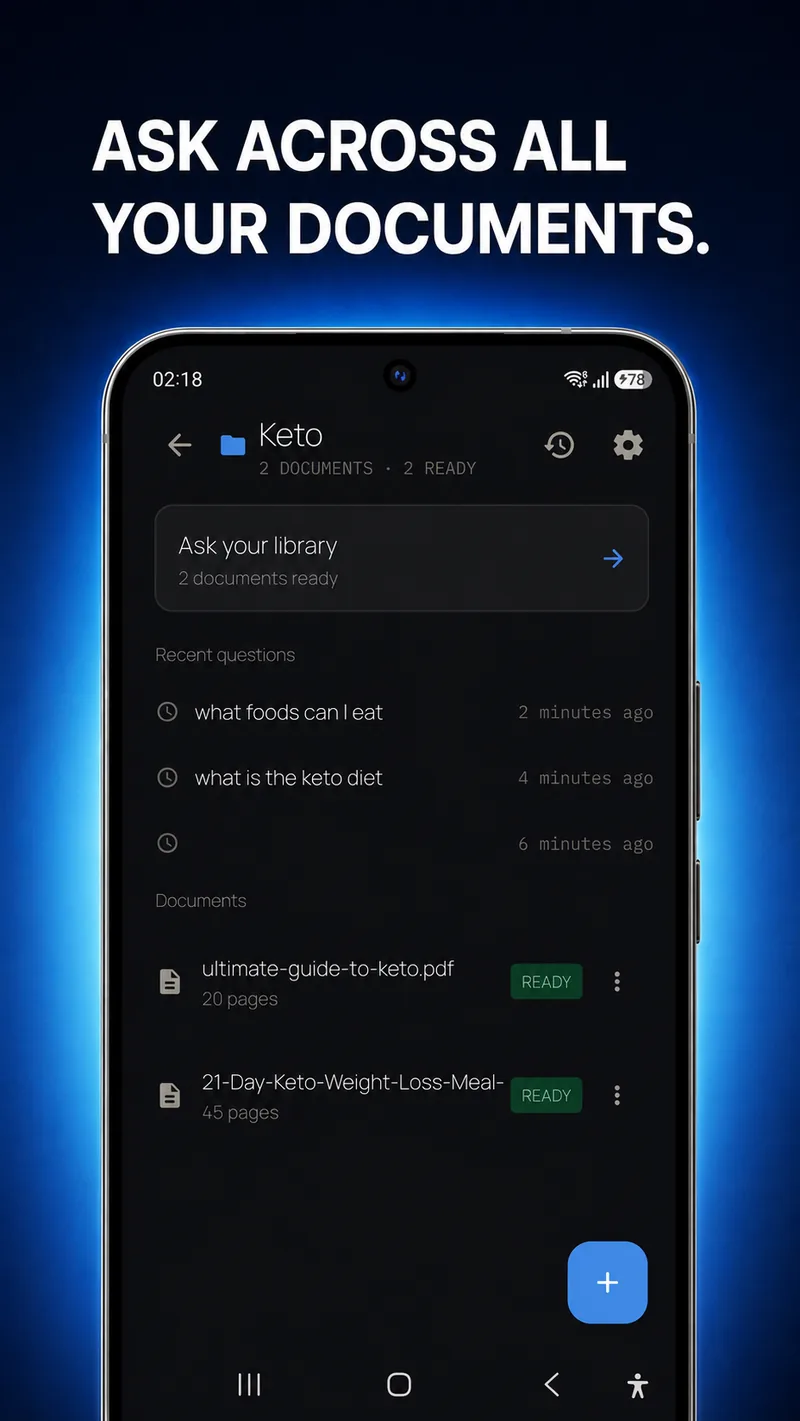
That's the specific gap LocalDocs is built for. Point it at a folder of your own notes, scanned readings or textbook PDFs — it reads PDF, Word (.docx), plain text, Markdown and HTML files, and reads a photo or hand-drawn sketch when you attach one to your question — and ask it the same question you just tried to answer from memory. It answers with a citation to the exact document, which you tap to open and check yourself: the same verification step you'd otherwise do by hand, just faster. The processing happens on the phone itself — your notes and the question you ask about them aren't uploaded to a server to generate that answer, and no account or internet connection is needed once your files are loaded. That's a narrower claim than "private," on purpose: a small on-device model can still get a detail wrong, which is exactly why the citation is there to check against rather than take on faith, and on-device processing doesn't stop someone holding your unlocked phone from reading your files, doesn't stop device malware, and does nothing if the notes folder you pointed it at is already synced to Google Drive or a similar service, since those files left the phone before LocalDocs ever touched them. It also means a large library — the app's own example is 23 documents across 10 folders — or a question that has to be checked against many files at once can take longer to answer than sending the same question to a big cloud model, because the work is running on the processor in your pocket, not a data center rack. LocalDocs is Mystum's own app — we built it, and we're telling you about it here directly. If turning your own material into a self-quiz sounds worth automating the checking step for, you can try LocalDocs here.
The Real Takeaway
None of this requires an app, a subscription, or a system with a name. It requires closing the book before you claim to know something, and then finding out if that's actually true. That's the uncomfortable part, and it's also the entire mechanism — the discomfort of failing to recall something, followed by checking it, is what makes the memory stick harder the second time around.
The Teach-It, Feel-It, Space-It Hack
Popular study advice condenses the science into a simple three-step brain hack: teach it, feel it, space it. Practitioners also refine retrieval through the blurting method's final step, where learners reread missed sections, close their notes, and blurt again until they can reproduce the key concepts without looking. Together these steps reflect a consensus that repeated, spaced recall outperforms passive reading.
Studying Less to Remember More
Educators and study coaches now promote methods that aim to remember more while studying less, such as optimized note-taking and targeted recall routines. One widely shared example claims a master's program completed in a sixth of the usual time by applying these efficiency principles. The direction of this work suggests the future of studying lies in smarter retrieval strategies rather than more hours of rereading.
Rethinking Passive Study Habits
Despite the evidence, most learners still default to passive reading, and classroom practice has been slow to shift toward retrieval-based methods. Teachers are now being given practical retrieval-practice ideas and strategies to bring recall activities into normal instruction. The systemic challenge is closing the gap between well-supported research and the everyday habits of students and educators.
Remembering More in Real Life
The real-world payoff of active recall is the ability to actually remember everything you read rather than letting it fade. Study creators demonstrate these techniques in practical formats, from step-by-step blurting guides to short-form videos on active recall methods. For the individual learner, the impact is straightforward: reproducing key concepts from memory without looking means the material was truly learned.
Start small: pick the one class or subject where you're currently rereading a chapter the night before a quiz, and swap that single session for a self-test instead. Write five questions from memory before you open the book, answer them, then check. Keep it up for one exam cycle and you'll have a far better sense of where you actually stand than any amount of highlighting ever gave you, and you'll know it a week before the test instead of finding out during it.
The research behind this isn't new or contested. It's decades of work, replicated across age groups and subjects, and the studies cited above are freely searchable if you'd rather read the original data than take a summary's word for it. Retrieval practice is one of the rare study techniques where the evidence and the intuition actually agree once you've tried it for yourself.
Private, on-device AI for your documents — ask questions, get cited answers.