
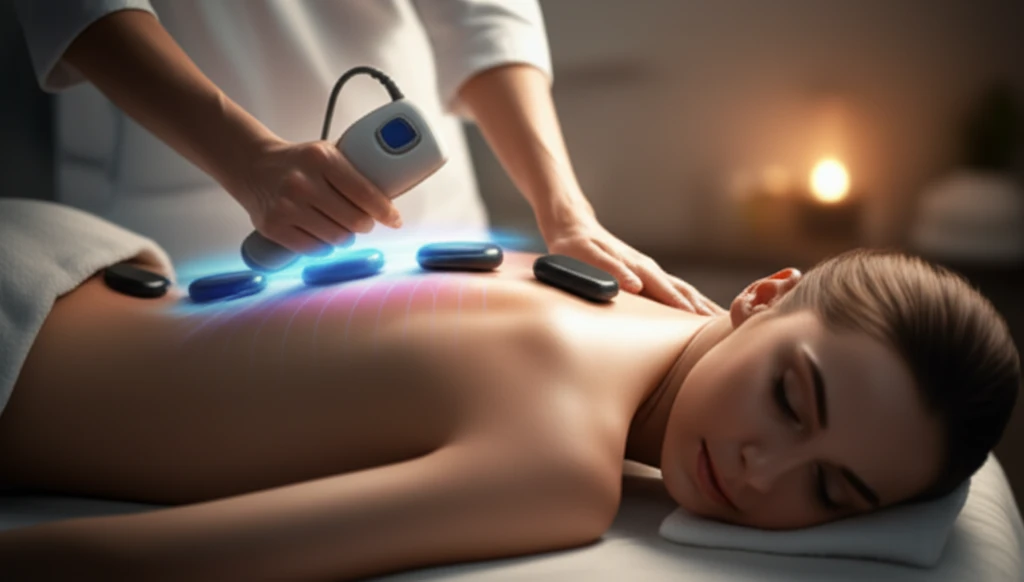
Hot or Not? Unlocking the Secrets of Heat and Ultrasound Therapy for Muscle Pain

"Discover the optimal sequence for hot pack and ultrasound treatments to relieve myofascial trigger points and enhance muscle recovery."
Muscle pain is a widespread issue, especially among athletes and active individuals. Often, this pain stems from myofascial pain syndrome (MPS), characterized by sensitive spots known as trigger points within the muscles. These trigger points can cause localized discomfort and referred pain, impacting performance and overall well-being.
To combat muscle pain and trigger points, many therapists and individuals turn to heat and ultrasound therapies. Heat, typically applied via hot packs, helps to relax muscles and increase blood flow. Ultrasound uses sound waves to penetrate deeper tissues, promoting healing and reducing inflammation. But is there a 'right' way to combine these therapies?
A recent study investigated the effects of different sequences of hot pack and ultrasound treatments on latent myofascial trigger points (LMTrP) in the upper trapezius muscle. The goal was to determine if applying heat before ultrasound, or vice versa, yielded better results in terms of pain relief and physiological responses. Let's dive into the findings and explore how you can optimize your muscle recovery routine.
Heat, Circulation, and Ultrasound Research
The study on non-specific back pain in middle-aged females reports that moist heat packs increase superficial tissue temperature, arterial supply, and venous drainage. It also describes a soothing effect on free nerve endings. Separately, the PDH Academy course identifies research examining the treatment sequence of a hot pack and ultrasound for upper trapezius trigger points.
Accepted Non-Drug Approaches
A 2025 review describes non-pharmacological interventions as critical adjunctive or stand-alone options for chronic pain and identifies digital therapeutics as an emerging approach. Massage therapy is described as a popular complementary and integrative health modality involving manual assessment and manipulation of superficial soft tissues, including skin, muscle, tendon, ligament, and fascia. The cited fascial-manipulation review reports possible improvements in pain, range of motion, and overall function, but notes moderate methodological quality, small samples, short follow-up, and a need for standardized protocols and higher-quality long-term research.
Decoding Hot Pack and Ultrasound: What the Science Says
The study, published in the Asian Journal of Sports Medicine, involved 30 participants with latent trigger points in their upper trapezius muscles. Researchers compared two treatment sequences: hot pack followed by ultrasound (HP + US) and ultrasound followed by hot pack (US + HP). Each participant received both treatments in random order, with a break of 24-48 hours between sessions.
- Tissue Blood Flow (TBF): Measured using a laser Doppler blood flow meter to assess circulation in the trigger point area.
- Pressure Pain Threshold (PPT): Determined using a digital pressure algometer to gauge sensitivity to pressure.
- Supra-Thermal Threshold (STT): Assessed using a thermal sensory analyzer to measure pain response to different temperatures.
- Visual Analog Scale (VAS): A subjective pain rating scale where participants rated their pain levels.
Recent Modalities Research
A 2014 International Journal of Physiotherapy and Research study compared muscle relaxation therapy involving shortwave diathermy, hot packs, stretching exercise, and ultrasound. One cited treatment protocol for upper trapezius trigger points used ultrasound at 1.5 W/cm² and 1 MHz for 5 minutes, passive stretching, and a hot pack at 70–75 C for 15 minutes. Recent research also identifies heat therapy, ultrasound therapy, and self-stretching as interventions reported for upper trapezius muscle stiffness, while another trial emphasizes the need to examine placebo effects, treatment dose, and long-term effects.
A Key Measurement Limitation
The study titled “Effect of Therapeutic Sequence of Hot Pack and Ultrasound on Physiological Response Over Trigger Point of Upper Trapezius” reports a specific limitation. The researchers did not measure intramuscular temperature directly. They also did not directly measure tissue temperature, which limits conclusions about the temperatures reached beneath the treatment area.
Comparisons Across Treatment Options
A study comparing trigger-point injection agents reported that ultrasonographic muscle depth increased at the end of injection in the botulinum toxin type A and 20% dextrose groups, with p<0.05. Another study randomly divided patients with myofascial pain syndrome into two groups to examine Kinesio taping and upper-limb coordination exercise. A separate report on myofascial techniques and Kinesio tape gave Shober-test values of 1.67±0.44 cm before treatment and 1.96±0.54 cm after treatment for the control group, compared with 1.8±0.29 cm before and 3.16±0.43 cm after treatment for the experimental group.
The Takeaway: Optimizing Your Muscle Pain Relief
While both hot pack and ultrasound, regardless of sequence, can provide benefits for muscle pain and trigger points, the study suggests that applying heat before ultrasound may offer a slight edge. The researchers theorize that heat increases superficial blood flow, making the deeper tissues more receptive to the ultrasound waves. Ultimately, the best approach may depend on individual preferences and the specific nature of your muscle pain. Consulting with a physical therapist or healthcare professional can help you determine the most effective treatment strategy for your needs.
Evidence and Treatment Choices
A systematic review and meta-analysis registered in PROSPERO under ID CRD42020170632 evaluated randomized controlled trials of heat and cold therapy for delayed-onset muscle soreness. A 2024 systematic review examined the efficacy and safety of long-term skeletal muscle-relaxant use for conditions including low back pain, fibromyalgia, headaches, painful cramps, and spasticity. A survey cited in a review of topical pain treatments found that 20% of the European population met its criteria for persistent pain, two-thirds had musculoskeletal conditions, and only 34% of people with persistent pain reported that medications provided adequate relief.
Pain as a Global Challenge
Chronic pain is described as a global health concern in a topical review. Musculoskeletal pain includes conditions involving bones, joints, and related muscular tissues, such as low back pain, arthritic pain, and widespread muscle pain. A 2024 review states that pain treatment remains challenging and discusses pharmacological, behavioral, and interventional options, while a 2025 review examines chronic-pain interventions through the equity principles of justice, access, and knowledge.
From Case Reports to Practice
A collection of massage-therapy case studies presents case reports as a way to connect theory with real-world practice and describes outcomes such as reduced pain, improved flexibility, and enhanced relaxation. The Massage Therapy Foundation archive includes a practitioner case report on post-exercise massage and recovery following submaximal aerobic exercise, with the report describing increased parasympathetic activity as part of the proposed recovery process. In a study of seven women with fibromyalgia, one participant experienced a considerable reduction in pain intensity and attributed the improvement to physical activity.