
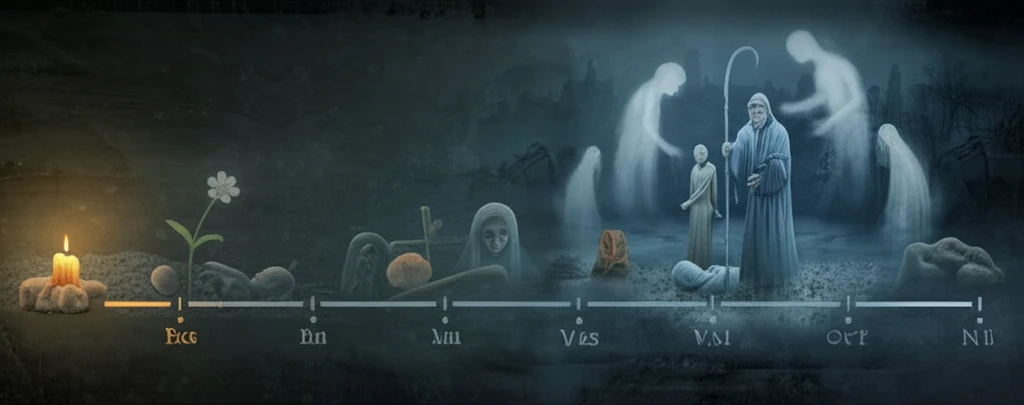
Honoring Little Souls: How Funeral Rites for Stillborn and Young Children Evolved Through History

"From ancient burials to modern memorial practices, explore the powerful ways societies have grieved and honored their youngest members"
The death of a young child has always evoked profound sorrow and unique responses. Throughout history, societies have developed specific ways to mourn and commemorate these little lives, reflecting both the deep emotional bond between parent and child and the cultural values surrounding life and death. These practices offer a glimpse into how societies have grappled with loss, expressed grief, and sought to provide comfort to grieving families.
Funeral rites, with their defined ceremonies and social practices, serve as a crucial framework for processing grief and marking transitions. These rites address the profound sense of loss and helps communities heal. Historically, funeral rites operate on multiple levels:
<ul><li>Symbolically, they acknowledge the cycle of life and attempt to grapple with the disruption caused by death.</li><li>Socially, they provide a structure for re-establishing equilibrium within a community shaken by loss.</li><li>Spiritually, they connect the bereaved to the community's foundational myths and beliefs.</li></ul>
The Scale of Early Childhood Loss
In the early 1900s, one in ten Irish children died before their first birthday, giving parents strong reason to fear that the Angel of Death might visit the cradle of the newly born. Grief, broadly defined as the response to the loss of something deemed important, in particular the death of a person to whom a bond or affection was formed, was therefore a recurring experience in ordinary households.
Mourning Customs for the Very Young
In nineteenth-century England, death culture, mourning, and the experience of infant and child loss were a prominent part of society, and infant mortality affected all social classes. Dedicated children's cemetery sections, such as the Babyland burial site at Forest Lawn Glendale cemetery, emerged as specialized resting places for infants, marked by tombstones and cherub memorials meant to honor these little angels.
Limbo and the Fear of the Unbaptised
Fear of Limbo drove waves of infant baptism, as parents had good reason to feel apprehensive that a child who died unbaptised would face spiritual peril. This religious anxiety shaped how families prepared for newborn death and influenced the rites, prayers, and burial practices surrounding infants who did not survive.
A Journey Through Time: From Prehistory to the Enlightenment
While modern societies have increasingly medicalized and secularized death, the need for meaningful rituals persists. Understanding the historical evolution of funeral practices can inform and enrich our contemporary approaches to grieving the loss of a young child. This exploration delves into the history of funeral rites for stillborn and young children, tracing their evolution from prehistoric times to the Enlightenment, drawing from archaeological findings, historical accounts, and sociological and anthropological studies.
- Prehistoric Echoes: Evidence suggests that even in prehistoric times, communities recognized the loss of a child, as seen in the care taken in burials.
- Antiquity's Monuments: Ancient civilizations left behind monuments, epitaphs, and grave goods that reveal the importance placed on children and the grief experienced at their passing.
- Medieval Matters: The dominance of the Catholic Church in medieval Europe profoundly shaped funeral practices, with the concept of baptism playing a central role in determining a child's fate in the afterlife.
The Neuroscience of Grief Across Cultures
Studies of grieving brains, whether scans of the brain regions that process grief or measures of the stress hormone cortisol released in grief, show no differences in relation to race, age, or religion. This suggests that the underlying biological response to loss is universal even as the mourning rituals built around it differ widely from culture to culture.
Framing Death for Children
Some scholars argue that the cultural conception of these challenges explains the belief that death and grief must be uniquely framed for children in our society. The ways this framing is translated through helpful individuals and cultural artifacts can both support and constrain how a family experiences and expresses mourning.
Ritual Differences, Shared Grief
Different cultures deal with grief and mourning in markedly different ways, yet the neurological and hormonal responses measured in grieving people are the same across populations. Specialized burial spaces for infants, from children's cemetery sections to cherub memorial sites, show how diverse societies have each chosen to mark these losses while responding to the same universal experience of mourning.
Glimmers of Grief Across the Ages
From the archaeological evidence of prehistoric burials to the elaborate rituals of ancient civilizations and the religious complexities of the Middle Ages, the history of funeral rites for stillborn and young children reveals a persistent thread: the enduring human need to acknowledge loss, express grief, and honor even the smallest of lives. As we move forward, understanding this history can inform our contemporary practices, ensuring that we provide meaningful support and recognition to those who grieve the loss of a child.
A Shared Experience Across Classes
Infant mortality and child death affected all social classes in nineteenth-century England, making death culture, mourning, and the experience of infant and child loss a prominent part of everyday life. This universality meant that funeral rites for stillborn and young children were not marginal practices but central expressions of a community's values, faith, and understanding of loss.
Evolving Memorial Spaces for Infants
Dedicated burial grounds such as the Babyland children's cemetery section at Forest Lawn Glendale represent an ongoing evolution in how societies set aside sacred space specifically for the very young. Designs such as cherub memorial sites and cemetery layouts shaped like a mother's heart show how funeral rites for infants continue to be reimagined to comfort grieving families.
Religious Doctrine and Social Pressure
The fear of Limbo drove waves of infant baptism in early twentieth-century Ireland, demonstrating how theological doctrine could impose both spiritual and practical demands on grieving families. Cultural beliefs about how death and grief must be framed, particularly for children, continue to be translated through helpful individuals and cultural artifacts that shape who is recognized as a mourner and how their loss is publicly acknowledged.
Grief in the Family Circle
Grief is the response to the loss of something deemed important, in particular the death of a person to whom a bond or affection was formed, and the loss of a child is among the most profound of these bonds. Memorial gestures such as heart-shaped plots and dedicated infant sections give parents a lasting place where their little angels can be publicly remembered and mourned.