
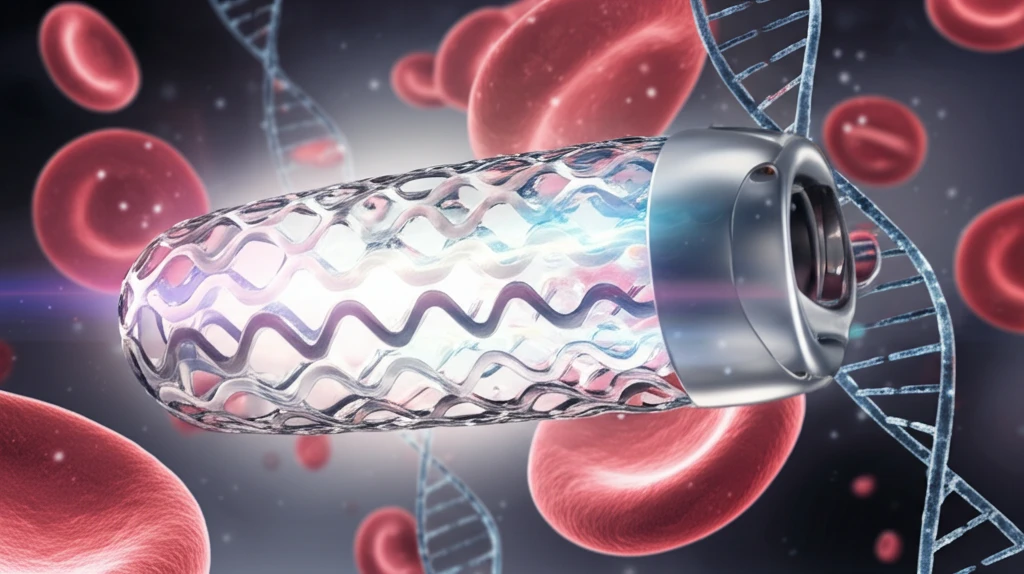
Heart Health Revolution: Advanced Coatings Extend Life of Cardiovascular Implants

"Discover how innovative surface layers on NiTi alloy implants are reducing complications and improving patient outcomes in cardiovascular treatments."
Medical science is constantly evolving, pushing the boundaries of what’s possible in patient care. Cardiovascular implants, essential in treating heart conditions, are benefiting from cutting-edge materials science. The focus is now on enhancing the biocompatibility and longevity of these life-saving devices.
One such advancement involves the use of Nitinol (NiTi), a shape memory alloy celebrated for its flexibility and resilience. NiTi implants can simplify surgical procedures and provide sustained support in cardiovascular applications. However, like all medical materials, NiTi isn't without its challenges.
The primary concern lies in the potential release of nickel ions from the alloy into the body, which can trigger adverse reactions. Scientists are tackling this issue head-on, developing specialized surface treatments to create a barrier between the implant and the body’s tissues. One particularly promising solution is the application of hybrid a-CNH+TiO₂+TiN surface layers.
A Fast-Growing Market for Implants
The cardiovascular implants market is expanding rapidly, with one analysis projecting growth from USD 41.4 billion in 2024 to USD 96.2 billion by 2034. Another forecast pegs the market at USD 29.0 billion in 2025 and expects it to reach USD 46.5 billion by 2034, a CAGR of 5.22%. The differing figures reflect varying methodologies, but both confirm sustained demand for devices such as stents, pacemakers, and heart valves.
Balancing Mechanical Strength and Biocompatibility
For cardiovascular implants, including stents, pacemakers, and heart valves, materials must combine superior mechanical properties with excellent biocompatibility and resistance to the body's environment. Electrodeposition is considered a crucial technique for producing these implant materials and coatings. A persistent limitation is damaging protein adsorption on synthetic grafts, which can shorten device life and undermine performance.
From Mechanical Devices to Bio-Digital Platforms
Innovations in cardiovascular implants are transitioning from purely mechanical devices toward bio-digital platforms that integrate material science, precision delivery, and remote monitoring. This shift builds on a long line of biomaterials research documented in dedicated textbooks on the cardiovascular system. The evolution reflects growing recognition that device longevity depends on the interface between engineered surfaces and living tissue.
The Science Behind the Surface: a-CNH+TiO₂+TiN Coatings
Researchers have engineered a novel hybrid surface layer, combining amorphous carbon (a-CNH), titanium dioxide (TiO₂), and titanium nitride (TiN) on NiTi alloys. This multi-layered coating is designed to minimize nickel ion release, enhance corrosion resistance, and improve the overall biocompatibility of cardiovascular implants. The process involves a combination of glow discharge oxynitriding and radio frequency chemical vapor deposition, creating a robust and integrated surface.
- Reduced Nickel Release: The coating acts as a barrier, significantly limiting the release of harmful nickel ions into the surrounding tissues.
- Enhanced Corrosion Resistance: The TiO₂ and TiN layers provide a protective shield against corrosion, extending the lifespan of the implant.
- Improved Biocompatibility: The amorphous carbon layer promotes better interaction with blood and reduces the risk of blood clot formation.
- Decreased Platelet Activation: The modified surface minimizes the activation of platelets, lowering the potential for thrombosis.
Coatings That Fight Protein Adsorption
New materials and coating techniques are extending the life of vascular implants by fighting the damaging protein adsorption that occurs in synthetic grafts. Researchers have shown that the morphology of surface nanoporous layers on nitinol alloys depends on anodization temperature, which influences electrolyte viscosity and the dissolution rate of the anodically-grown oxide layer. Such surface engineering is central to improving how implants interact with blood and tissue over the long term.
The Hard-to-Deform Challenge of Nitinol
Nickel-titanium shape-memory alloys, widely used in implants, are difficult to process. NiTi alloys are generally considered hard-to-deform materials when processed by equal-channel angular pressing at room temperature. Conventional machining of NiTi SMAs also faces significant challenges due to high thermal and mechanical distortions, meaning that manufacturing remains a practical hurdle despite promising material properties.
Divergent Forecasts, Shared Trajectory
Market analysts report notably different growth figures, from a 5.22% CAGR through 2034 to projections reaching USD 96.2 billion by that year. Regardless of the exact numbers, both outlooks show robust expansion for cardiovascular implants. Similarly, research spans multiple surface-treatment routes, from electrodeposition to anodization, each offering trade-offs between manufacturability and biocompatibility.
The Future of Cardiovascular Implants
The development of hybrid surface layers like a-CNH+TiO₂+TiN represents a significant step forward in cardiovascular implant technology. By addressing the challenges associated with NiTi alloys, researchers are paving the way for safer, more durable, and more effective medical devices. While further testing and clinical trials are essential, these innovative coatings hold tremendous promise for improving patient outcomes and expanding the range of applications for NiTi shape memory alloys in cardiology.
Material Science Meets Digital Care
Expert commentary frames the field as moving beyond mechanical hardware toward bio-digital platforms that unite material science with precision delivery and remote monitoring. Surface coatings play a central role, since controlling protein adsorption in synthetic grafts is key to extending device life. The result is a more integrated view of implants as living-system partners rather than passive components.
Precision Delivery and Remote Monitoring
The next frontiers for cardiovascular implants lie in bio-digital platforms that combine advanced materials with precision delivery and remote monitoring. Continued refinement of surface nanoporous layers through techniques such as temperature-controlled anodization promises finer control over implant-tissue interactions. These advances are expected to extend device longevity while enabling more personalized follow-up care.
Cost and Quality-of-Life Pressures
Extending the life of vascular implants addresses both economic and clinical pressures: longer-lasting grafts save costs while greatly improving patients' quality of life. The materials chosen must still satisfy demanding mechanical and biocompatibility requirements across a wide range of devices. Overcoming manufacturing difficulties for shape-memory alloys remains a systemic bottleneck that the broader supply chain must resolve.
Longer-Lasting Implants, Better Daily Lives
The ultimate measure of these innovations is patient quality of life. By fighting damaging protein adsorption in synthetic grafts, new materials and coatings extend the usable life of implants and greatly improve patients' day-to-day experience. Fewer device failures and replacements translate directly into fewer procedures, less recovery time, and more stable long-term health outcomes.