
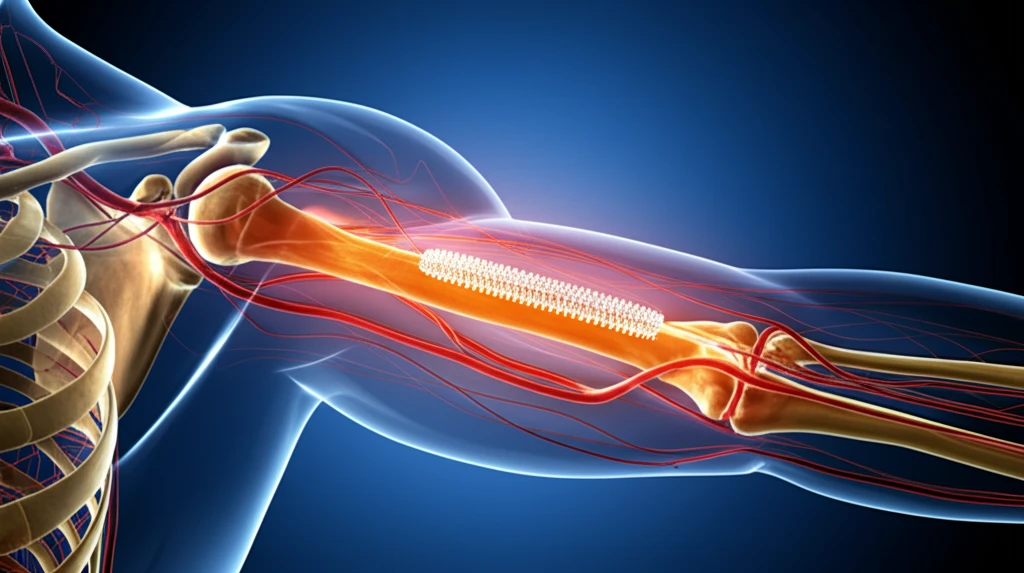
Healing Hands: How Stents are Revolutionizing Upper Limb Trauma Treatment

"Discover how endovascular stenting offers a minimally invasive solution for complex arm fractures and vascular injuries, restoring hope and mobility."
Upper arm (humerus) fractures accompanied by damage to the brachial artery are thankfully rare, but when they occur, they present a significant challenge. The brachial artery is the main blood vessel supplying the arm, and any injury can lead to severe complications, including limb-threatening ischemia (lack of blood flow). Traditionally, open surgical repair has been the standard approach to restore blood flow, but a newer technique called endovascular stenting is emerging as a less invasive alternative.
Endovascular stenting involves inserting a small, mesh-like tube (stent) into the damaged artery through a small incision, typically in the groin. The stent is then guided to the site of the injury and expanded, opening up the artery and restoring blood flow. This minimally invasive approach offers several potential benefits over open surgery, including smaller incisions, less pain, and faster recovery times.
This article explores the innovative use of stents to address complex cases of upper arm fractures coupled with arterial injuries. By examining a specific case study and delving into the broader implications of this technique, we aim to shed light on how this approach can revolutionize trauma treatment and improve patient outcomes.
Brachial Artery Trauma by the Numbers
Upper extremity injuries constitute approximately 40% of all peripheral vascular injuries, and more than 67% result from penetrating trauma, according to one clinical review. Brachial artery injuries are the most commonly reported, accounting for 40-55% of all upper extremity arterial injuries. An analysis of 124 surgically managed injuries identified 47 brachial artery injuries among 116 arterial injuries in 113 patients. The median nerve courses with the brachial artery throughout its length, a relationship that shapes both the injury and its repair.
Anatomy, Diagnosis, and the Limits of Repair
The brachial artery is the most frequently injured artery in the upper extremity due to its vulnerability. It is wholly superficial, covered only by skin and deep fasciae, which explains the high risk of injury as well as the ease of clinical diagnosis. The median nerve courses with the brachial artery throughout its length, while the radial and ulnar nerves parallel portions of it. All brachial artery injuries can be managed successfully unless associated with severe concomitant damage to nerves.
A Long-Recognized Vulnerable Vessel
The brachial artery has long been recognized as vulnerable because it runs close to the skin, and it is frequently damaged by stab wounds, window glass injuries, workplace accidents, traffic accidents, and gunshots, as WebMD reports. Iatrogenic injuries also carry risk: a brachial arteriovenous fistula resulting from antecubital vascular access is rare and develops slowly. One report describes an 18-year-old man who developed such a fistula after venipunctures in his left arm at 10 months of age. Both cases underscore that the artery's superficial course has made it a lasting focus of injury across decades.
The Case for Stents: A Minimally Invasive Revolution
The traditional treatment for a damaged brachial artery during an upper arm fracture typically involves open surgery to repair the artery. However, in recent years, endovascular stenting has emerged as a promising alternative. This minimally invasive approach has several advantages:
- Minimally Invasive: Stenting requires only a small incision, reducing trauma to surrounding tissues.
- Faster Recovery: Patients often experience less pain and a quicker return to function compared to open surgery.
- Reduced Risk: Stenting can minimize the risk of complications associated with extensive surgery.
New Cases, Rare Mechanisms, and Pediatric Outcomes
Traumatic brachial artery injuries constitute a significant portion of upper extremity vascular injuries and can lead to severe complications if not promptly managed. One pediatric review reports that brachial artery injury accounts for approximately 28% of all vascular injuries. Blunt trauma causing brachial artery injury in a young patient is very rare and may be associated with closed elbow dislocation or instability. Notably, the elbow dislocation may not be evident clinically or radiologically on initial presentation.
When Diagnosis Is Not Straightforward
Recognizing brachial artery injury is not always straightforward, and the diagnostic technique carries its own challenges. The LITFL reference notes that the ipsilateral brachial artery is detected with a Doppler device until the brachial artery is clearly heard. Alternatively, the cuff can be placed on the forearm and the ulnar or radial arteries assessed, provided the cuff is positioned distal to the injury. This guidance illustrates how examination findings can vary and why correct cuff placement is essential to avoid misleading readings.
Two Clinical Faces of the Brachial Artery
Elbow dislocation is the most common major joint dislocation in adults, second only to the shoulder, and it may be accompanied by brachial artery injury. In a separate clinical context, the brachial artery is also used as a site for invasive blood pressure monitoring. One review notes the lack of rigorous studies comparing the brachial and femoral approaches for this purpose, while acknowledging that some specific risks could be mentioned. These contrasting applications, trauma and monitoring, highlight the artery's dual clinical significance.
Looking Ahead: The Future of Stent Technology
Endovascular stenting shows great promise in treating brachial artery injuries associated with upper arm fractures. As technology advances and techniques refine, this minimally invasive approach has the potential to become a preferred method, offering patients improved outcomes and a faster return to their active lives. Further research is needed to determine the long-term effectiveness of stenting compared to open surgery and to identify the ideal candidates for this treatment.
Bringing the Evidence Together
Taken together, the available literature suggests that brachial artery injury remains a leading and often manageable form of upper extremity vascular trauma. Outcomes appear to depend largely on prompt recognition and on whether severe nerve damage is also present. At the same time, much of the evidence comes from case reports and single-center series rather than large comparative trials, so firm conclusions should be drawn cautiously. Clinicians broadly agree, however, that timely diagnosis and appropriate revascularization are central to preserving limb function.
Refining Monitoring and Managing Late Complications
Monitoring and treatment of brachial artery conditions continue to evolve. One group reports having used brachial intra-arterial pressure monitoring for nearly 30 years, because radial artery readings were often inaccurate and radial-to-aortic pressure gradients frequently developed during and after separation from cardiopulmonary bypass. On the treatment side, infection remains a serious complication of vascular injury, requiring immediate debridement and antibiotic therapy. Late complications such as arteriovenous fistulas and false aneurysms are usually managed with operative repair.
Subtle Injuries in Everyday Trauma Care
Brachial artery injury from blunt trauma in a civilian setting is uncommon and has been reported in association with occult elbow instability or dislocation and minor fractures around the elbow joint. When there is clinical evidence of distal ischemia, the accepted treatment is surgical revascularization. This case illustrates how such injuries can be subtle and why a high index of suspicion is needed during initial trauma assessment.
What a Damaged Artery Means for a Patient
Traumatic brachial artery injuries constitute a relatively large proportion of peripheral arterial injuries. According to one analysis of 124 surgically managed injuries, upper extremity arterial injuries have the potential to significantly impact the outcome of the trauma patient. Behind these statistics, the speed and quality of treatment can determine whether a patient keeps full use of their arm, and with it their livelihood and independence.