
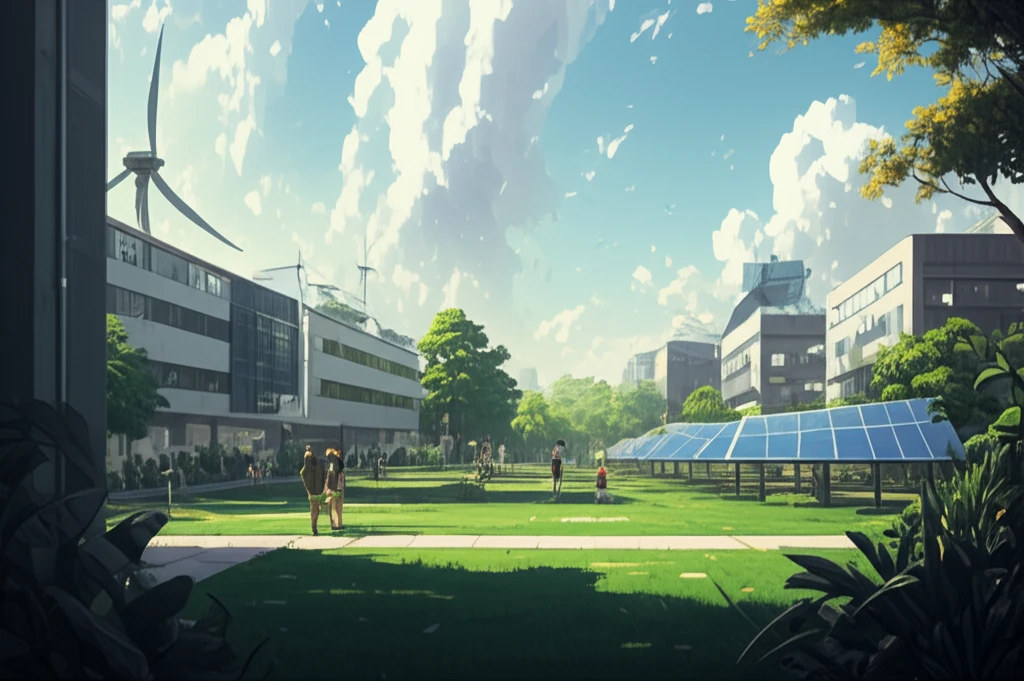
Greener Campuses: How Colleges are Leading the Way in Ecological Civilization

"Explore how universities are integrating sustainability into their curriculum and campus life to cultivate an environmentally conscious generation."
As environmental concerns grow, higher education institutions are taking a leading role in promoting ecological civilization. With a focus on sustainability and environmental responsibility, colleges are implementing innovative approaches to educate students and transform their campuses into models of ecological stewardship. These efforts not only address environmental challenges but also prepare students to be leaders in creating a more sustainable world.
Ecological civilization is a concept that seeks to harmonize human activities with the natural environment. It emphasizes the importance of sustainable development, resource conservation, and ecological balance. Colleges and universities are uniquely positioned to advance this vision by integrating ecological principles into their academic programs, campus operations, and community engagement initiatives.
This article explores how colleges are embracing ecological civilization through innovative curriculum design, campus sustainability projects, and community partnerships. By examining these initiatives, we can gain insights into how higher education institutions are shaping the next generation of environmental leaders and contributing to a more sustainable future.
Defining Ecological Civilization
Ecological civilization is associated with quests for a circular economy where one facility's waste—including energy, water, and materials—becomes another facility's input. The notion has become central to Chinese efforts to confront environmental problems, though it is characterized differently by its proponents. An ecological civilization would be based on core principles that sustain living systems coexisting stably in natural ecologies, offering a model for organizing human society toward sustainable abundance.
Green Development and Educational Gaps
Ecological civilization is described as a new form of civilization built upon industrial civilization, achieving modernization through green development and realizing harmonious coexistence between humanity and nature. However, scholars highlight significant limitations in current environmental education approaches, which often remain solely theoretical, superficial, and disconnected from lived experience. Bridging the gap between ecological theory and practice remains a central challenge for institutions pursuing this vision.
Origins of the Concept
The term 'ecological civilization' originated from Qianji Ye's 1984 work while in the Soviet Union and was subsequently adopted in China, embedding Marxist principles with ecological perspectives from traditional Chinese philosophy. Research in this area has also intersected with Christian social ethics, including Pope Francis's writings on ecology and China's ecological civilization efforts. The concept thus draws from both Eastern philosophical traditions and broader global intellectual currents.
Building Ecological Civilization: Key Strategies for Colleges
Colleges are employing a variety of strategies to promote ecological civilization among their students and within their communities. These strategies encompass curriculum development, campus sustainability initiatives, and community engagement efforts, all aimed at fostering a deep understanding of ecological principles and inspiring action towards a more sustainable future. Ecological management is at the core of these strategies.
- Environmental Studies Programs: Offering comprehensive programs that cover ecology, conservation, and environmental policy.
- Sustainability Courses: Integrating sustainability concepts into business, engineering, and other fields.
- Experiential Learning: Providing hands-on opportunities for students to engage in environmental research and conservation projects.
- Community-Based Projects: Partnering with local organizations to address environmental challenges in the community.
Competing Visions of Ecological Civilization
The notion of ecological civilization has become central to Chinese efforts to confront and deal with environmental problems, yet it is characterized by its proponents in fundamentally different ways. Some scholars see it as simply an adjunct to existing economic structures, while others view it as a transformative reorientation of civilization's core priorities. This plurality of interpretations reflects ongoing scholarly debate about what ecological civilization actually entails in practice.
Structural Contradictions and Critiques
Critics question whether green technologies such as EVs and solar farms can truly address coal dependence or industrial agriculture, arguing that technological fixes alone do not constitute systemic change. A deeper philosophical critique examines the failure to move beyond the discourses of economics, politics, and techno-science toward genuine ecological reorganization. The central tension remains whether a high-consumption economy can ever be truly sustainable, or whether ecological civilization demands fundamentally different economic structures.
East-West Perspectives
Compared to modern industrial civilization, ecological civilization is understood as respecting nature, valuing the countryside and farmers, and cherishing organic communities. Dr. Mary Tucker has emphasized that ecological civilization can be understood through systems thinking, offering a framework that bridges Eastern and Western philosophical traditions. This comparative lens reveals how different cultural contexts shape distinct yet potentially complementary approaches to ecological governance.
The Path Forward: Cultivating a Generation of Environmental Stewards
As colleges continue to embrace ecological civilization, they are playing a vital role in shaping the next generation of environmental stewards. By integrating sustainability into their curriculum, operations, and community engagement efforts, colleges are empowering students to become leaders in the transition to a more sustainable world. This holistic approach to education not only benefits the environment but also prepares students for careers in the growing green economy, fostering a future where ecological balance and human progress go hand in hand.
Evaluation and Key Ingredients
Building ecological civilization for a country with over 1.4 billion people has no precedent in human history and demands extraordinary wisdom to protect the ecological environment across vast territory. Spencer Scott, PhD, identifies six essential ingredients for an ecological civilization, beginning with renewable energy and energy efficiency. International experts have also stressed that no single nation can build an ecological civilization alone, as air, water, and climate transcend national borders.
Theoretical Advancement and Resilience Science
Xi Jinping Thought on Ecological Civilization is enriching existing ideas on global sustainable development according to recent think tank reports. Research on social-ecological resilience and collapse is being unified across disciplines, offering frameworks for understanding how societies and ecosystems co-evolve. These theoretical developments suggest that ecological civilization is not merely aspirational but is being actively theorized as a governance paradigm.
Historical Perspective and Political Will
While the challenges of realizing ecological civilization are enormous, the possibility becomes more plausible when seen in broad historical perspective. China's political commitment has been reinforced at successive Party congresses, with President Xi reiterating the goal and affirming concrete steps in its direction. The tension between industrial-era momentum and ecological imperatives continues to shape the trajectory of this civilizational project.
Wealth, Tradition, and Human Migration
In the United States, the top 1% of the population controls more wealth than the bottom 90% combined—a stark illustration of the inequality that ecological civilization must address. Drawing on Chinese tradition and process philosophy, scholars argue this vision offers foundations for a more equitable world. Meanwhile, the impacts of ecological disruption are already visible in regions like the Sahel, where diverse societies have experienced environmental consequences from the earliest periods of human migration.